Earth spins at about 1670 km/h (1037 mph) at the equator, yet we don’t feel it because we, the air, and everything around us move along with the surface at that same steady speed. With no relative motion and no sudden change in speed or direction, there is nothing for our bodies to sense.
One of life’s undeniable truths is that the Earth is constantly rotating on its axis. What you might not know is that it is doing so very, very fast.
For those that aren’t already aware, different parts of our planet experience different rotational speeds depending on their geographical location on Earth’s surface.
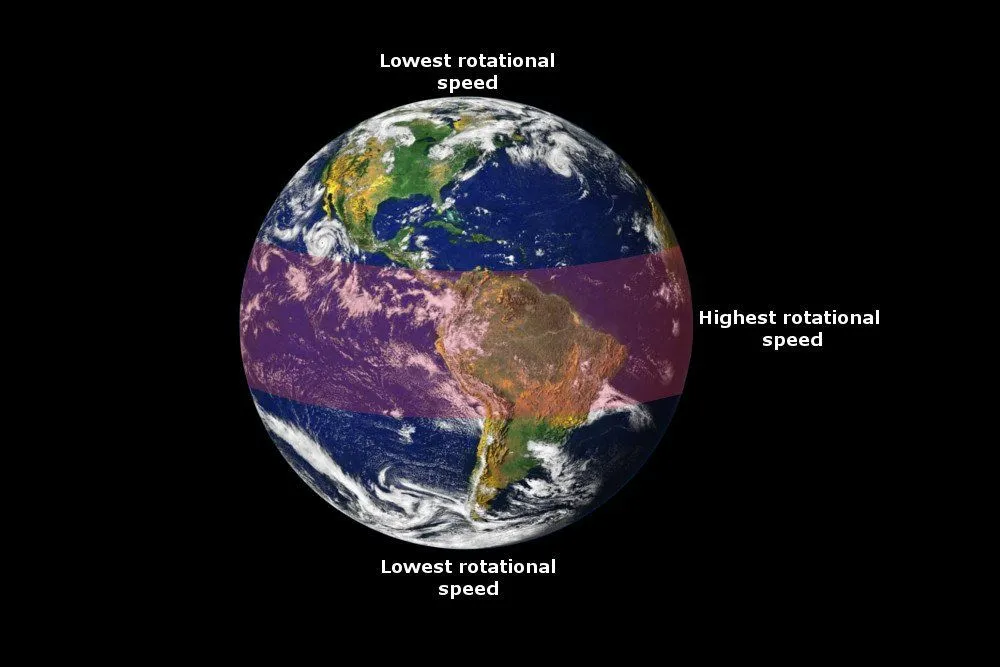
The equatorial regions have the highest rotational speed (which is why most rockets and satellites are launched from near the equator), clocking in at roughly 1670 km/h (1037 mph)! The speed drops as you move toward the poles, since those latitudes trace out smaller circles in a single day.
To put that in perspective, the Shanghai maglev train, one of the fastest passenger trains ever to run in commercial service, had a top speed of 431 km/h (268 mph) before it was throttled back to 300 km/h (186 mph) in 2021. Even at its fastest, it covered barely a quarter of the speed at which the equator is whipping around Earth’s axis, which should give you some idea of how fast the planet really rotates!
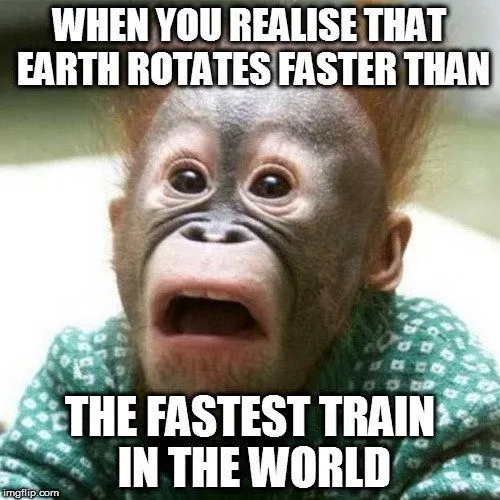
Now that you know that Earth rotates blisteringly fast on its axis, don’t you wonder why we, the inhabitants of the planet, don’t feel it?
Why Don’t We Feel That The Earth Is Rotating?
Short answer: Earth spins at about 1670 km/h (1037 mph) at the equator, but we don’t feel it because we move along with the surface at the same steady speed, with no relative motion to sense. That’s the same reason why, when we jump in the air, we land in the same (original) spot.
This can be understood better with the help of the ‘traveling in a bus’ analogy.
Sitting In A Moving Bus
When you’re sitting in a bus cruising at a constant 65 km/h (40 mph), do you feel that you’re moving at that speed?
Of course you don’t, because you are sitting inside it and therefore moving along with it at the same speed. Your motion is coupled with the motion of the bus. In technical terms, you could say that there is no relative motion between you and the bus. We perceive motion only when there ‘is’ some relative motion between two objects. Since everything inside the bus – the seats, window, bar, other passengers – moves at the same speed as the bus, it’s somewhat difficult to imagine that all of us are clocking 65 km/h (40 mph)!

However, when the bus banks a sharp turn, decelerates rapidly or halts suddenly, the movement of the bus becomes obvious, because in each of those aforementioned scenarios, there appears to be relative motion between the bus and you. For instance, when the bus stops suddenly, you get pushed forward (due to inertia), or when the bus turns, you sway to your side (again, caused by inertia).
Now, let’s apply the same reasoning to the case of Earth’s rotation.
We Do Not Perceive Earth’s Rotation Because…
Everything that’s attached to the surface of the Earth moves at the same speed as the Earth, thereby making us (who are also attached to the surface) feel that our planet is not moving at all.
What do you think will happen if you jump inside a moving bus? Since the bus is moving forward, will the bus floor slip beneath your feet and make you land behind the spot from where you jump?

Of course not! You will land in the same spot, unless the bus accelerates or slows down during your jump. Similarly, when we jump outside, our motion remains coupled with Earth’s rotation, which is why we land in the same spot.
Given that our planet does not accelerate, decelerate or change direction during its rotation, it’s impossible for us to physically perceive its rotation. As it turns out, that’s also in our best interest!
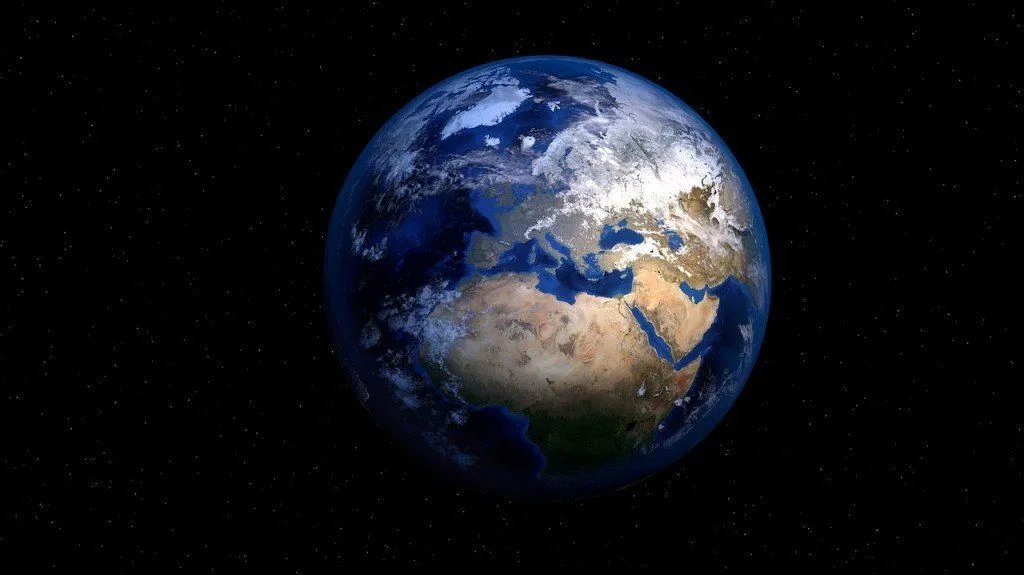
For example, if the Earth were to accelerate or slow down suddenly, everything on the ground would be uprooted from its present location and thrown off, resulting in nothing short of annihilation. We have actually written an entire article about the nasty effects that Earth’s sudden halt would have on life and other things.
Interestingly, if you manage to jump ‘high’ enough (to the order of a few hundred kilometers above Earth’s surface, meaning that you decouple yourself from Earth’s rotation), you will certainly land in a different spot from where you jumped. However, unless you’re a superhero, this probably won’t apply to your abilities…
How Fast Does The Earth Actually Spin (And Move)?

So we’ve established that we can’t feel the spin, but exactly how fast is the ground beneath your feet actually traveling? The honest answer is that there isn’t one tidy number, because it depends on where you’re standing and on which of Earth’s motions you decide to count.
Start with the rotation alone. Earth makes one full turn on its axis roughly every 24 hours, spinning from west to east (which is why the Sun appears to climb up the eastern sky each morning). A point on the equator has to sweep all the way around the planet’s widest circle in that time, so it tears along at about 1670 km/h (1037 mph). Move toward either pole and the daily circle you trace gets smaller, so your speed falls; at the latitudes of London or New York you’re being carried along at very roughly 1000–1300 km/h (about 600–800 mph), and standing right at a pole your rotational speed shrinks to almost nothing.
But rotation is only the gentlest of Earth’s motions. The whole planet is also orbiting the Sun at a blistering average of around 107,000 km/h (about 67,000 mph), edging slightly faster or slower through the year as our slightly oval orbit tightens and loosens. And the Sun itself is no anchor: it sweeps the entire solar system around the center of the Milky Way at roughly 828,000 km/h (about 230 km/s), a circuit so colossal that a single lap of the galaxy takes around 230 million years. Stack all of those motions together and you’re hurtling through space at hundreds of thousands of kilometers per hour while feeling perfectly, reassuringly still.
If Earth Spins So Fast, Why Don’t We Fly Off?

If the equator is whipping around at 1670 km/h (1037 mph), it’s fair to ask why we aren’t simply flung off the surface like water flicked from a spinning umbrella. The reassuring answer comes down to a hopelessly lopsided tug-of-war between two effects.
Spinning in a circle does try to throw you outward, away from the axis. That outward tendency is the centrifugal effect, and it’s the very thing you feel pressing you sideways on a fast merry-go-round. For someone standing on the equator, though, this outward pull is astonishingly feeble: the acceleration it produces is only about 0.034 m/s². Now compare that to the acceleration of gravity, which hauls everything toward Earth’s center at roughly 9.8 m/s². Gravity is therefore close to 290 times stronger than the spin’s attempt to throw you off, so it wins the contest overwhelmingly. The only trace the rotation leaves is that it trims your apparent weight at the equator by about a third of one percent, which is why you stay firmly planted instead of drifting away.
For Earth to actually start shedding people and oceans from the equator, it would have to spin many times faster than it does, fast enough for that outward centrifugal effect to rival gravity itself. The current imbalance does still leave a subtle fingerprint, though: because the equator both bulges outward and rotates fastest, you weigh very slightly less standing there than you would at the North Pole. At the leisurely once-a-day pace Earth actually keeps, gravity has the whole contest comfortably in hand.
References (click to expand)
- How Fast Does Earth Spin? Britannica
- Why can't we feel the Earth move? UCSB Science Line, University of California, Santa Barbara
- Can we feel the Earth spin? (Beginner) - Curious About Astronomy? Ask an Astronomer - curious.astro.cornell.edu
- Reference Systems (Earth's orbital speed around the Sun). Basics of Space Flight. NASA Science.
- Does the Sun move around the Milky Way? StarChild, NASA Goddard Space Flight Center.
- Why Don't Humans Get Thrown Off the Surface of the Earth Due to its Rotation? National Radio Astronomy Observatory.
- Earth's Rotation and Centripetal Acceleration. Physics Van, University of Illinois Urbana-Champaign.