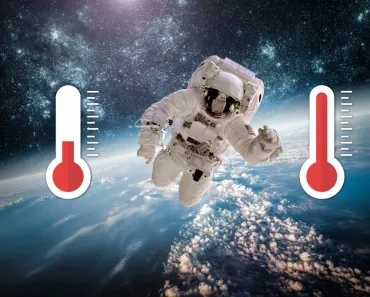
Heat is a form of energy, and it travels through radiation. Radiation is a form of energy that does not need a medium to travel, which is why heat can travel through a vacuum.
‘The outer space is a near-perfect vacuum; so, how does heat travel through space?’
A lot of people get befuddled by this question. In simple words, does heat need a medium to travel? If it does indeed, then how do sun’s ‘heat rays’ travel through the vacuum of space before reaching Earth?
The answer is quite simple: heat is a form of energy released from the sun and travels through radiation, which is why the sun feels hot.
What Is Heat?
This probably seems like a very dumb question to ask, but the concept of ‘heat’ is much more than ‘something that a thermometer measures’ if you really dig deeper. In everyday terminology, we say that something emits ‘heat’ when it feels hot to the touch, or we can say that air is being ‘heated up’ by the effects of global warming and so on. However, what is ‘heat’ at its most basic definition?

Heat is a form of energy. It is the energy that an object possesses by virtue of the movement of its constituent particles. These particles are continuously moving, hitting and bouncing off each other (solids allow minimal movement, while gases allow maximum movement of constituent particles). The faster these particles move and hit each other, the hotter the object in question becomes.
When you ‘heat’ something up using a burner (or any heat source), what you do is essentially raise the average kinetic energy of the substance’s particles, which in turn raises its overall temperature.
Transfer Of Heat
Heat can be transferred in three different ways: conduction, convection and radiation.
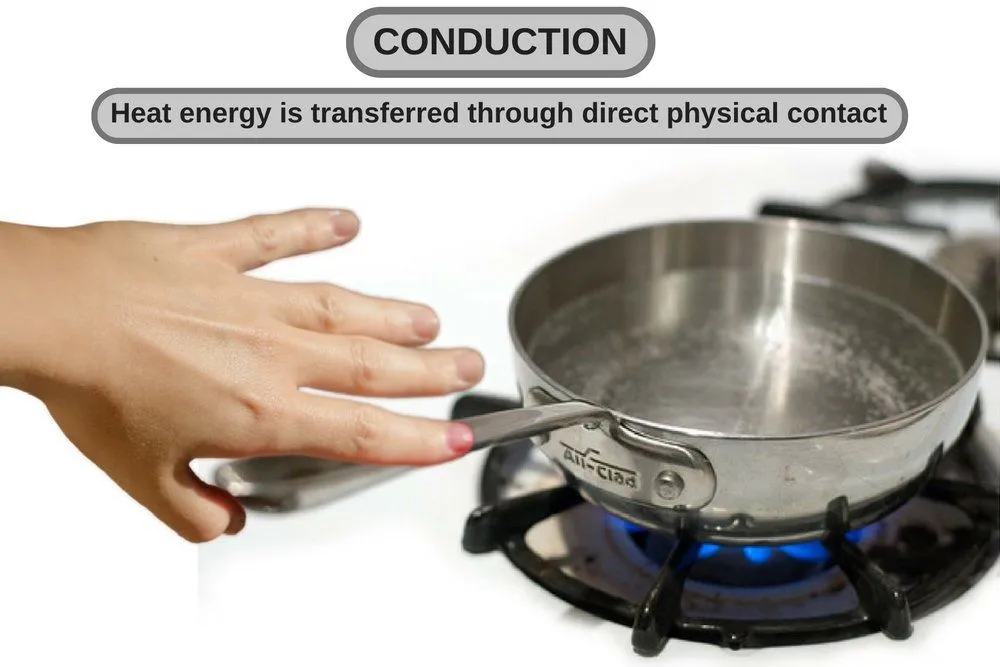
In basic terms, conduction occurs when two bodies are in contact with each other. This is the most significant and common method of heat transfer and it occurs when rapidly moving or vibrating particles interact with particles of a neighboring object and transfer some of their energy to the latter.
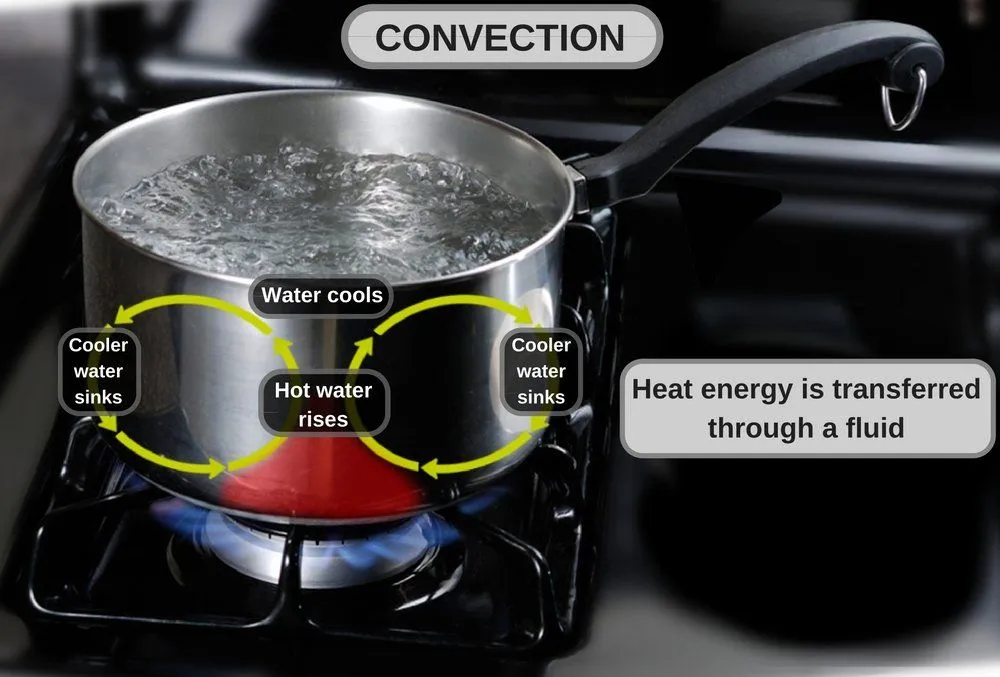
On the other hand, convection occurs when a heated fluid (e.g., air, water etc.) moves away from the source of heat and comes in contact with other substances, transferring some of their energy in the process.
There are numerous examples of heat transfer through both conduction and convection, so it’s easy to mistakenly assume that these are the only two methods by which heat is transferred.
Heat Transfer Through Radiation
The third method of transferring heat – the one responsible for heating the planet and everyone on it – is radiation. In space, there are hardly any particles (making it a near-perfect vacuum), but there is radiation, which gets converted into heat when it collides with an object. Radiation is responsible for heating not only Earth-bound objects, but also objects that are not (physically) adhered to our planet, such as the ISS, the moon and other celestial bodies.
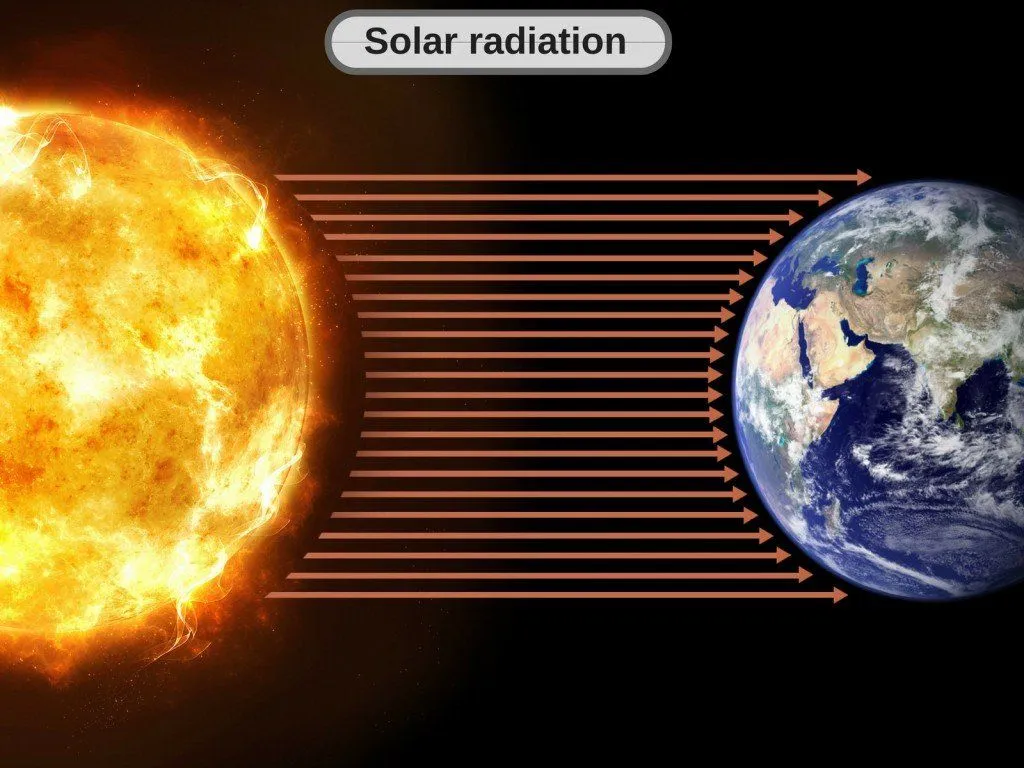
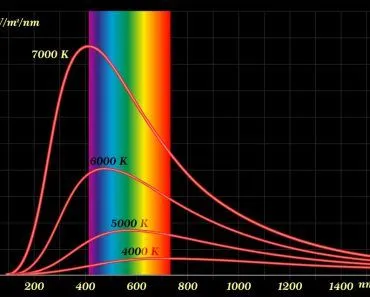
You see, the reason that the sun ‘burns’ all the time is that it plays host to nuclear fusion reactions of epic proportions. These reactions, quite predictably, release massive amounts of energy all the time, which is then released all around the sun into space via electromagnetic waves. The sun emits radiation at many wavelengths across the EM spectrum, including infrared, UV and X-rays (Source). It also emits EM waves in the visible range of the spectrum, which is the reason we can see the Sun in the first place!
Now, if you remember reading about electromagnetic waves/radiation in your high school physics class, then you might recall one singular truth about them…

Precisely! EM waves don’t need a medium to propagate, meaning that they CAN travel through a vacuum. This is why see the sun and feel the ‘sunlight’ on our planet. The sun’s radiation consists of small, massless packets of energy called photons. They travel seamlessly through space; whenever they strike any object, the object absorbs photons and its energy is increased, which then heats it up.
So, these photons travel through a vacuum without any problem, but as soon as they collide with an object, like the Earth or other celestial bodies, they get absorbed and impart heat energy to the host object in the process.
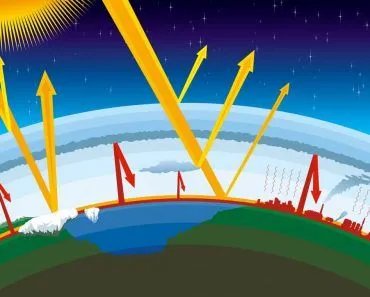
The atmosphere then plays a second role. Of the sunlight reaching Earth, about 29% is reflected straight back to space, roughly 23% is absorbed by gases and clouds, and the remaining ~48% is absorbed at the surface (per NASA’s CERES satellite measurements). The surface re-radiates that energy as infrared, and greenhouse gases like water vapour and CO₂ absorb a large fraction of those outgoing infrared photons before they escape, which is what keeps Earth far warmer than it would otherwise be.
How Does The Sun ‘Burn’ Without Oxygen?
Here is a question that trips up a lot of people: if there is no air in space, and a fire needs oxygen, then how does the Sun keep burning? The short answer is that the Sun does not burn at all, at least not in the way a campfire or a candle does. As NASA puts it bluntly, the Sun “does not ‘burn’, like we think of logs in a fire or paper burning.”
A campfire runs on chemical combustion, a reaction between fuel and oxygen. The Sun runs on something completely different: nuclear fusion. Deep in the Sun’s core, where the temperature reaches roughly 15 million °C (about 27 million °F) and the pressure is crushing, hydrogen nuclei are squeezed together so hard that they fuse into helium. That fusion releases a staggering amount of energy, and because it is a nuclear process rather than a chemical one, it needs no oxygen whatsoever. As physicist Christopher Baird of West Texas A&M University writes, “The burning of the sun is not chemical combustion. It is nuclear fusion,” which is why the Sun never “runs out of oxygen” in the first place.

So the Sun is less like a bonfire and more like a colossal, self-sustaining hydrogen bomb held together by its own gravity. The vacuum of space is no obstacle to it, because fusion does not depend on the surroundings at all. (If you have ever wondered what it would take to put the Sun out, the answer is delightfully counterintuitive: you can read more in our piece on how much water it would take to extinguish the Sun.)
How Long Does The Sun’s Heat Take To Reach Us?
Since the Sun warms us through radiation, and radiation is electromagnetic energy, a natural follow-up is: how fast does it get here? The answer is that the Sun’s heat travels at the speed of light, because the infrared and visible photons carrying that energy are light. In a vacuum, light moves at about 300,000 km/s (roughly 186,000 miles per second).
Earth orbits at an average distance of about 150 million km (93 million miles) from the Sun, a span astronomers call one astronomical unit. Divide that distance by the speed of light and you get a travel time of roughly 500 seconds, or about 8 minutes and 20 seconds. In other words, the sunlight warming your face right now left the Sun’s surface more than eight minutes ago. If the Sun were somehow switched off, we would carry on feeling its warmth for those eight-odd minutes before the last photons arrived and the sky went dark.
If The Sun Is So Hot, Why Is Space So Cold?
This is one of the most common puzzles people raise, and it follows directly from everything above. If the Sun is blasting out radiation in every direction, why is the space between the planets famously freezing rather than scorching?
The key is that radiation only becomes heat when it strikes something that can absorb it. Empty space is a near-perfect vacuum, with almost no atoms or molecules for the Sun’s photons to warm. The radiation streams straight through that emptiness without depositing its energy anywhere, so the vacuum itself never heats up. As space physicist Nathan Case of Lancaster University explains, the Sun’s energy is “radiated from the sun, through the vacuum of space at the speed of light,” and only when it “arrives at Earth” does some of it transfer into the gases of our atmosphere.

With nothing to hold or spread the warmth, the background temperature of deep space settles down near the chill of the cosmic microwave background, the faint afterglow of the Big Bang, at about 2.7 kelvin (roughly -270 °C or -455 °F), just a whisker above absolute zero. So space is not cold because the Sun is weak; it is cold because there is almost nothing out there for the Sun’s radiation to warm. We dig into the wider version of this question in why space is cold even though it is full of stars.
Could You Feel The Sun’s Heat In Space?
If the vacuum itself stays cold, what about a solid object floating in it, like an astronaut or a spacecraft? Here things get extreme. An object in space can absorb the Sun’s radiation, and because there is no atmosphere to spread that heat around or carry it away, the sunlit side bakes while the shaded side freezes at the same time.

NASA spells out just how wide that gap is. On a spacewalk, it notes, “Temperatures on spacewalks may vary from as cold as minus 250 degrees Fahrenheit to as hot as 250 degrees in the sunlight.” That is roughly -157 °C in shadow and +121 °C in direct sunlight, a swing of nearly 280 °C across a single suit. It is precisely why spacesuits are so heavily insulated and wrapped in reflective outer layers: in space, the Sun’s radiation absolutely can be felt, and felt brutally, the instant it has a solid surface to land on. The very same effect that warms your face on a sunny afternoon is the one a spacewalking astronaut has to be carefully shielded from. For a deeper look at why those infrared rays carry the sensation of warmth at all, see why infrared waves are associated with heat.
Next time someone asks you how heat can possibly travel through the vacuum of space, just remember that it’s not the ‘heat’ traveling through the vacuum, but rather the electromagnetic radiation, and which doesn’t need a medium to propagate!
References (click to expand)
- Cool Cosmos - Caltech. The California Institute of Technology
- Heat transfer - Wikipedia. Wikipedia
- Anatomy of an Electromagnetic Wave - NASA Science. Tration
- Staying Cool on the ISS - NASA Science. The National Aeronautics and Space Administration
- How can the Sun ‘burn’? - StarChild. NASA Goddard Space Flight Center
- Why does the sun not run out of oxygen as it burns? Christopher S. Baird, West Texas A&M University
- Sun: Facts - NASA Science
- Curious Kids: how does heat travel through space if space is a vacuum? Nathan Case, Lancaster University - The Conversation
- Spacewalk Spacesuit Basics - NASA
- Scientists Say: Cosmic microwave background - Science News Explores (Society for Science)