Space is cold because it is inconceivably vast, so the heat radiated by stars dissipates almost completely in the empty space between them. The average temperature of deep space is about 2.7 K (roughly -270 °C or -455 °F), set by the leftover glow of the Big Bang. That is only a few degrees above absolute zero (0 K), the coldest temperature physically possible.
Have you taken the time to look up at the stars lately? Go out on any clear night and stare into the vastness of space, and at most points on the globe, you can see anywhere from 2,000-5,000 stars. That can make for an impressive sight for stargazers, and yet that is only a microscopic fraction of how many stars are out there.
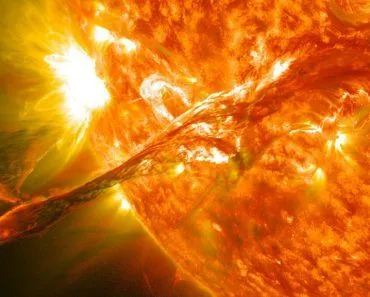
Now, consider the star of our solar system (the Sun), and how hot it is (about 5,800 K on the surface, which is roughly 5,500 °C or nearly 10,000 °F). That star is roughly 150 million kilometers (about 93 million miles) away from Earth, which sounds like an incredible distance. As we know, without the warmth of the Sun, life wouldn’t exist on our planet, so it clearly pumps out a lot of heat.
With so many stars out there in the universe, pushing out unbelievable amounts of heat, you might think that space would be hot, and yet, space is extremely cold! How is that possible?
Our Tiny Corner Of The Galaxy
The simplest answer to this question is that space is inconceivably enormous, so the heat of stars dissipates to nearly absolute zero between them. However, let’s have a bit of fun and put this undeniable reality into perspective.

Sitting 150 million kilometers away, every second, our Sun radiates roughly 3.8 × 1026 watts, energy equivalent to nearly 100 billion 1-megaton hydrogen bombs going off every single second. Even at the speed of light (about 300,000 km/s, or roughly 186,000 mi/s, the fastest speed anything in the universe can move), light from our Sun still takes about 8 minutes and 20 seconds to reach Earth.
If you wanted to wait for light from the next closest star to reach our planet (Proxima Centauri), you would have to wait about 4.25 years! There are only around 30 known stars (most of them faint red dwarfs) within 12.5 light years of Earth, and to put the idea of a light year in perspective, consider that 1 light year equals roughly 9.46 trillion kilometers (about 5.88 trillion miles), so our Sun is only about 0.000016 light years away from Earth.
If you haven’t gotten the impression thus far, even our minuscule corner of the Milky Way is huge, with only about 30 known stars within roughly 120 trillion kilometers (about 75 trillion miles) in any direction.

Stepping it up one more notch, the Milky Way Galaxy is 100,000 light years in diameter and contains more than 100 billion stars. You might not believe this, but the Milky Way galaxy is considered puny in comparison to other galaxies spread across the universe, some of which are more than 1.5 million light years in diameter! The distance between the Milky Way and our closest galactic neighbor (Andromeda galaxy) is 2.5 million light years.
For the final, mind-boggling level of universal scale, consider this: scientists estimate that the observable universe contains somewhere between a few hundred billion and up to 2 trillion galaxies, spread across a region that stretches roughly 46 billion light years in every direction from Earth.
Lots Of Stuff, But A Whole Lot More Space
With all those galaxies and stars filling up the void of space, it seems like space should be a sauna, particularly because our blazing Sun is just an average-sized yellow dwarf. The hottest known stars, such as the Wolf-Rayet star WR 102, can have surface temperatures above 200,000 K (more than 360,000 °F), tens of times hotter than the Sun.
However, the fact is, the most common temperature in the observable universe is 2.7 K (approximately -270 °C or -455 °F). The coldest theoretical temperature is 0 K (also known as absolute zero), which means that most of the universe is nearly as cold as physically possible.

It’s important to understand that space itself is not “cold” in the same way as we understand it, space is simply empty. If the entire universe was a cube with dimensions of 30 billion light years on each side, all of the matter in the universe could fit in a smaller cube in the corner with dimensions of only 1,000 light years on each side.
Radiation Vs. Distance
In a perfect vacuum, there is no temperature, because there are no molecules to possess heat. However, heat can be transferred through radiation (light energy, which includes the visible spectrum).
As radiation is shot out into space from the Sun, the radiant intensity at the Sun’s surface is roughly 63 million watts per square meter. By the time that energy reaches Earth, the radiant intensity has fallen to about 1,361 watts per square meter (a value known as the solar constant). I’ll do that math for you and tell you that the intensity of sunlight is roughly 46,000 times weaker by the time it reaches our planet.

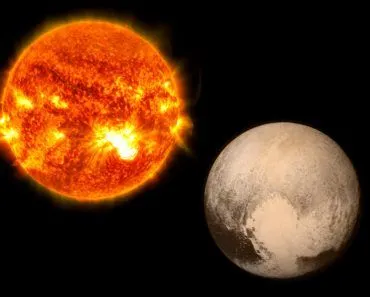
Remember, that huge reduction in radiation energy occurs over a distance of .000016 light years! Pluto, for example, lies roughly 5.9 billion kilometers (about 3.7 billion miles) from the Sun, and the average surface temperature of that dwarf planet, which receives hardly any radiation from our Sun, is only about 40 K (roughly 40 degrees above absolute zero, or about -388 °F)! Almost all the radiation of the Sun is gone by the time it leaves our solar system!
In the space between stars in our galaxy, the radiation energy is even further dissipated, leaving the average temperature of interstellar gases and dust at approximately 10 degrees above absolute zero. The lowest temperature figure (2.7 K) in space is found in the vast empty void between galaxies and “blank spots” of the universe. 2.7 Kelvin is the temperature of “cosmic microwave background radiation”, which is the leftover radiation from the Big Bang that is still “hanging around” the universe and keeping the temperature just above absolute zero.
If Space Is So Cold, Why Do Spacecraft Need Cooling?
Here is where the story takes a turn that catches almost everyone out. If the void sits at a bone-chilling 2.7 K, you would expect NASA’s engineers to spend their careers worrying about spacecraft freezing solid. In reality, they spend most of it wrestling with the opposite problem: how to throw heat away fast enough.

The catch is that “cold” needs some way of actually reaching you. Down here, a hot cup of coffee cools off because it is touching things. Heat conducts into the mug and your hand, while the air resting against the cup warms up, drifts away, and gets replaced by cooler air. That second process, convection, does most of the work, and it only exists because there is air around to do the carrying. Take the air away and it simply stops happening. NASA’s engineering guide for small spacecraft puts it about as plainly as you could ask: “In a vacuum, heat is transferred only by radiation and conduction with no convection.” Conduction still shuffles heat around inside the metal of a spacecraft, but once that heat reaches the hull, there is nothing outside to hand it off to.
That leaves radiation as the only exit door. A spacecraft has to glow its heat away as infrared light, which is a far more sluggish business than dumping it into moving air.
If this is ringing a bell, it should! It is exactly the trick your thermos flask pulls: a vacuum gap between two walls, killing conduction and convection and leaving radiation as the only leak. Space, in other words, is a nearly perfect thermos wrapped around every spacecraft we have ever launched. And inside that thermos, the machine never stops making heat. NASA’s thermal engineers balance four sources of it: sunlight absorbed directly, sunlight bounced off the planet below (albedo), the infrared glow of the planet itself (planetshine), and the heat the craft generates all by itself, which comes down to the power its own components dissipate. Every computer, radio and pump aboard is, thermodynamically speaking, a little heater that you cannot switch off.
How Does The Space Station Get Rid Of Its Heat?
The International Space Station is the finest worked example we have. Its eight solar arrays generate somewhere between 75 and 90 kilowatts of electrical power, and essentially all of it eventually turns into waste heat inside a sealed metal can orbiting inside a vacuum. As NASA’s Active Thermal Control System overview states, “Most of the Station’s many systems produce waste heat, which needs to be transferred from the ISS to space.”

The solution is a two-stage plumbing system. Inside the pressurized modules, water does the collecting. The US Destiny laboratory runs a Low Temperature Loop at about 4 °C (40 °F) and a Moderate Temperature Loop at roughly 17 °C (63 °F), picking up heat from avionics, life support gear and experiments. NASA chose water for the simple reason that it is an efficient thermal transport fluid and it is safe to have flowing through a module full of astronauts.
Water, however, is useless outside. So at hardware called Interface Heat Exchangers, the heat gets handed over to a second set of loops filled with anhydrous ammonia, which stays liquid down to a startling -77 °C (-107 °F). Ammonia is nasty, toxic stuff, so every part of that external system is deliberately mounted outside the pressurized volume to keep it away from the crew. Note that this ammonia is single-phase, meaning it never boils. It just circulates as a liquid, soaking up heat at one end and releasing it at the other.
Where it releases that heat is the good bit. The ammonia flows out to two enormous rotating radiator wings, each built from three radiator units. Every one of those units unfolds into eight panels, measures 23.3 by 3.4 meters (76.4 by 11.2 feet) and weighs over 1,120 kilograms (2,475 pounds). There, the heat finally does the only thing it can do in a vacuum: it radiates away as infrared. Between its two loops, this system can dump 35 kilowatts each, for a total of 70 kilowatts of heat rejection. The wings even swivel on rotary joints as the station circles the Earth, angling themselves to maximize how much heat they can shed.
And here is the detail that really gives the game away. The ammonia plumbing is threaded with electrical heaters to keep the fluid conditioned when the thermal load on a loop drops too low, and those rotary joints angle the wings partly to stop the ammonia freezing in the radiator manifolds. The station is not simply fighting cold or fighting heat. It is walking a tightrope between the two, and most days it is the heat that is winning.
Doesn’t Orbital Speed Heat A Spacecraft Up?
There is a tempting explanation lurking here that is worth killing off, because a lot of people reach for it. The station is screaming around the planet at roughly 8 kilometers per second (5 miles per second), so surely all that friction against the atmosphere is what is cooking it?

It isn’t. At the station’s altitude of about 400 kilometers, there is a whisper of atmosphere left, and it is not nothing. The European Space Agency notes that drag makes the outpost lose roughly 100 meters of altitude every single day, which is why it needs regular reboosts from visiting spacecraft just to stay up there. But that drag is quietly stealing the station’s orbital energy. It is not what its radiators are working overtime against. Look back at the four heat sources NASA’s engineers actually balance for a spacecraft in orbit (sunlight, albedo, planetshine and the craft’s own power dissipation) and you will notice that friction is not on the list at all.
Where atmospheric speed genuinely does produce ferocious heat is during reentry, and that is a completely different regime. A returning vehicle plunges out of the near-vacuum into the thick lower atmosphere, and even then, “friction” is a poor description of what happens. According to NASA Glenn Research Center, strong shock waves form against the vehicle, and the temperature of the flow gets so enormous that the chemical bonds of the diatomic molecules in the air are torn apart. The spacecraft is not rubbing against the air so much as violently compressing it. In orbit, there is nowhere near enough air for any of that to matter. The heat problem is coming from inside the spacecraft.
A Sunny Vacation In Space?
As this article showed you, space isn’t cold or hot, it’s simply too huge for radiation in most distant locations to warm up an object, meaning that any heat in an object would radiate outwards, thus making it feel “cold”. If you orbited low over a blazing star, you would certainly be able to get a sun tan and have a toasty vacation.
However, as you move further into the seemingly infinite void of space, less and less radiation would transfer, and the true icy nature of space would be felt!
References (click to expand)
- Ask Us - Space Physics - Heat, Temperature, and the Electromagnetic Spectrum. NASA Cosmicopia, Goddard Space Flight Center
- Why is space so cold? | Ask Dr. Universe. Washington State University
- How Cold is Space? - Universe Today
- Cosmic microwave background - Wikipedia
- Hubble Reveals Observable Universe Contains 10 Times More Galaxies Than Previously Thought - NASA Science
- Active Thermal Control System (ATCS) Overview. NASA
- 7.0 Thermal Control - State of the Art of Small Spacecraft Technology. NASA Small Spacecraft Systems Virtual Institute
- Space Station Facts and Figures - NASA
- Space Station reboost - from the inside. European Space Agency
- Re-Entry Aircraft - Beginner's Guide to Hypersonics. NASA Glenn Research Center