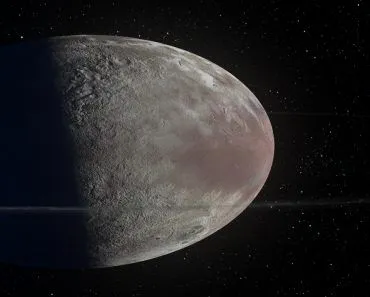
The reason why Pluto is not considered a planet anymore is because it does not satisfy the third requirement of being a planet, which is that it must have “cleared the neighborhood” of its orbit. This means that a planet must be the basic dominant gravitational body in its orbit, and Pluto is not. There are many objects similar to Pluto in and around its orbit, and Pluto is only about 0.07 times the mass of other objects in its orbit. In comparison, Earth has 1.7 million times the mass of other objects in its orbit.
Why Pluto Is Not A Planet?
In August 2006, the International Astronomical Union (IAU) adopted a formal three-part definition of a planet: it must orbit the Sun, be massive enough for its own gravity to pull it into a near-spherical shape, and have "cleared its orbital neighborhood" of other comparable-sized bodies. Pluto passes the first two tests but fails the third. A planet has to be the basic dominant gravitational body in its orbit, Pluto fails to meet this criteria, as there are many objects similar to Pluto in and around its orbit. Pluto is only about 0.07 times the mass of other objects in its orbit. That same year, the IAU created a new category, "dwarf planet", to accommodate Pluto, Ceres, Eris, Haumea and Makemake.
Pluto: The Journey
My (Mercury) Very (Venus) Educated (Earth) Mother (Mars) Just (Jupiter) Showed (Saturn) Us (Uranus) Nine (Neptune) Planets (Pluto). This rhyme helped countless middle school kids, including me, learn the names of the nine planets in our solar system, as well as their order in our solar system!
While Pluto may not be a planet anymore, its discovery has helped astronomers know more about our solar system and the region outside it. Therefore, it’s unlikely that our beloved Pluto will be forgotten anytime soon. In fact, NASA's New Horizons spacecraft, launched on January 19, 2006, completed the first ever flyby of Pluto on July 14, 2015, returning stunning close-up images of Pluto's icy plains, towering mountains and the heart-shaped Sputnik Planitia. It has since flown past the Kuiper Belt object Arrokoth (2019) and continues outward through the outer solar system.
Who Discovered Pluto, And When?
Pluto's story starts not with its discovery, but with a prediction. In the early 1900s, the wealthy Boston astronomer Percival Lowell became convinced that an unseen world, which he called "Planet X", was tugging on the orbits of Uranus and Neptune. He launched a hunt for it from the observatory he had founded in Flagstaff, Arizona, but died in 1916 without finding it.

The search was finally won by a 24-year-old farm boy and self-taught astronomer named Clyde Tombaugh. His job at Lowell Observatory was painstaking: photograph the same patch of sky on different nights, then load the plates into a device called a blink comparator, which flicks rapidly between the two images so that anything that has moved appears to jump back and forth. On 18 February 1930, comparing plates taken on 23 and 29 January, Tombaugh spotted a faint dot shifting against the fixed background stars. That dot was Pluto. Lowell Observatory announced the find on 13 March 1930, the date that would have been Percival Lowell's 75th birthday.
How Did Pluto Get Its Name?
Here is one of the most charming facts in astronomy: the new world was named by an 11-year-old schoolgirl. On the morning the discovery made the papers, Venetia Burney of Oxford, England was having breakfast with her mother and grandfather when the news was read aloud. Familiar with Greek and Roman myths, she suggested it be named after Pluto, the Roman god of the underworld, a fitting choice for a cold, dark, far-flung world the Sun barely reaches.

Her grandfather, Falconer Madan, a former librarian of Oxford's Bodleian Library, passed the suggestion to the astronomer Herbert Hall Turner, who relayed it to the team at Lowell Observatory. The astronomers loved it, and not only for the mythology: the first two letters of PLuto also honor Percival Lowell, the man whose hunt for Planet X had started it all. Venetia, who lived until 2009, saw her childhood suggestion remain the name of a world for nearly 80 years.
Pluto Facts: How Does It Compare To Earth?
For all the affection it inspires, Pluto is a genuinely tiny, frigid world. Its equatorial diameter is only about 2,377 km (1,477 mi), roughly one-fifth the width of Earth and about two-thirds the size of our own Moon. It orbits the Sun at an average distance of about 5.9 billion km (3.7 billion mi), or 39 times Earth's distance, taking a leisurely 248 years to complete a single lap. Out there, sunlight is so weak that surface temperatures hover between about −226 and −240 °C (−375 to −400 °F), far colder than anywhere on Earth.

Pluto has five known moons: Charon, Nix, Hydra, Kerberos and Styx. Charon is the showstopper. At about half Pluto's diameter, it is so large relative to its host that the two bodies orbit a shared point in empty space between them, which leads some scientists to describe Pluto and Charon as a "double" or "binary" dwarf planet rather than a planet and its moon. We did not get a real look at any of this until 14 July 2015, when NASA's New Horizons probe became the first spacecraft to fly past Pluto, revealing nitrogen-ice plains, water-ice mountains and the now-famous heart-shaped region, since named Tombaugh Regio after its discoverer.