Haumea is a dwarf planet located beyond Neptune in the Kuiper Belt. Its rotation is the fastest in the solar system, completing a full rotation in just 3.9 hours! It also has a ring orbiting around it and is shaped like an elongated ellipsoid.
Our solar system is a vast place. The Sun sits at the center of the solar system and all the heavenly bodies orbit it. The distance from the Sun to Earth is considered 1 astronomical unit (which is 150,000,000 km or 93,000,000 mi).
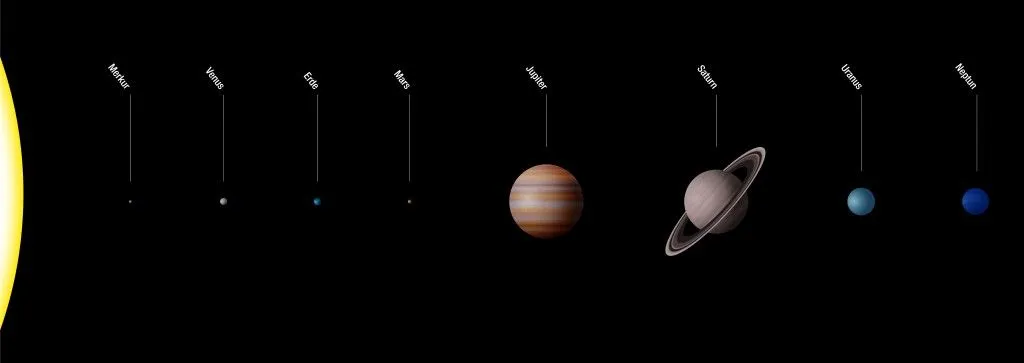
We have 8 planets (Sorry Pluto!) in our solar system, but there are far more heavenly bodies between these planets within the orbit of the Sun. One of these is a dwarf planet called Haumea, which is located beyond Neptune’s orbit, approximately 43 AU (6,452,000,000 km; 4,010,000,000 mi) from the Sun.
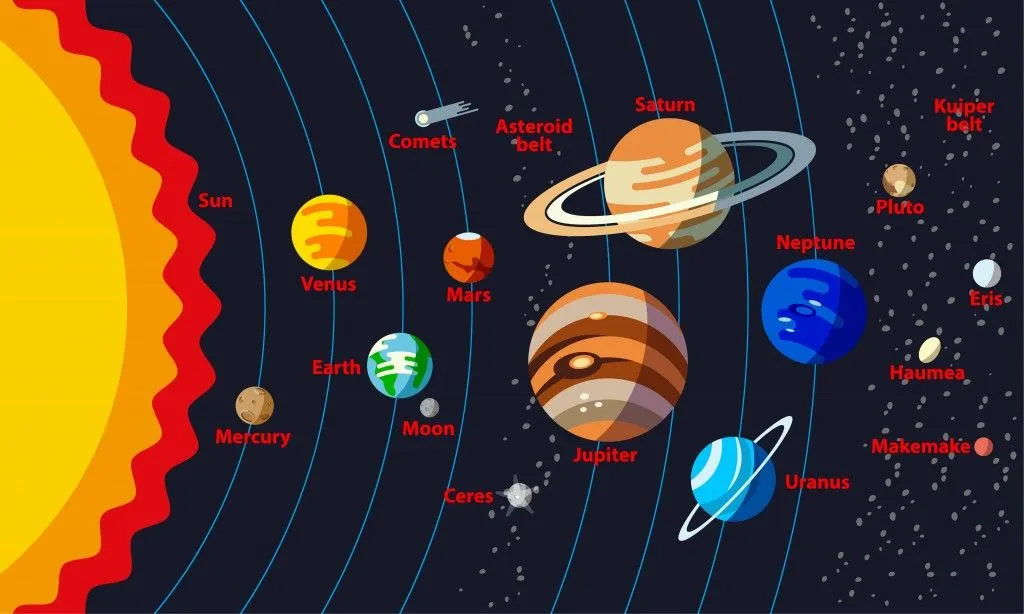
Now, let’s dive into the details of this dwarf planet.
Discovery And Classification
The discovery of Haumea is surrounded by controversy. José Luis Ortiz Moreno and his team at Spain’s Sierra Nevada Observatory found Haumea in archival images dating back to March 7, 2003, and announced their discovery in July 2005. Mike Brown and his Caltech team independently observed it on December 28, 2004 at the Mauna Kea Observatory. The Ortiz team was first to submit their report to the MPC (Minor Planet Center). However, Brown accused the Spanish team of accessing Caltech’s observation logs before their announcement, sparking a dispute. The IAU never officially listed a discoverer, though the discovery site is credited as Sierra Nevada Observatory.
Haumea is located beyond Neptune’s orbit and is a Kuiper Belt object. According to the guidelines of IAU, every classical Kuiper Belt object (in the circumstellar disc of asteroids and other celestial bodies beyond Neptune) should be named based on the mythological beings frequently associated with creation.
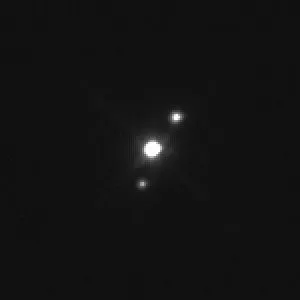
Ortiz and his team proposed the name ‘Ataecina’ after the Iberian goddess of spring, but it did not fit IAU’s criteria. ’Haumea’ was proposed by the Caltech team after the matron goddess of the Hawaiian island where their discovery was made. Haumea is a goddess of childbirth and fertility, with many children having been born from different parts of her body. The IAU chose this name in September 2008. Haumea’s two known moons are named after the goddess’ daughters—Hi’iaka and Namaka.
Haumea is a dwarf planet, a plutoid located beyond Neptune. Haumea is thought to have been large enough to have been rounded by its own gravity into an orbiting shape in hydrostatic equilibrium. It also isn’t big enough to dominate its neighborhood, a criterion that requires a celestial body to become the dominant gravitational body in its orbit; that’s why Haumea is only classified as a dwarf planet. Haumea is in an intermittent 7:12 orbital resonance with Neptune, meaning Neptune's gravity periodically influences Haumea's orbit. This resonance breaks and reforms approximately every 2.3 million years due to the precession of Haumea's orbit.
Haumea is also part of the trans-Neptune collision family (known as the Haumean family), which consists of objects with very similar orbital patterns and spectra (spectroscopy shows nearly pure white ice), suggesting that they came from a disruptive impact between two celestial bodies. The objects in this family are Haumea, its two moons, and a handful of other Kuiper Belt objects.
Who Is Haumea? The Goddess Behind The Name
You might wonder where such an unusual name comes from. Haumea is named after the Hawaiian goddess of childbirth and fertility, one of the oldest and most important deities worshipped across the Hawaiian islands. The Caltech team chose the name because their observations were made from the Mauna Kea Observatory in Hawaii, and the International Astronomical Union (IAU) requires classical Kuiper Belt objects to be named after mythological figures associated with creation.
In Hawaiian mythology, the goddess Haumea is the mother of many gods, among them Pele, the goddess of volcanoes and fire. Many of her children are said to have been born from different parts of her body. That origin story is exactly why the dwarf planet's two moons carry the names of her daughters: Hi'iaka, the patron goddess of hula, who was said to be born from Haumea's mouth, and Namaka, a water spirit said to be born from Haumea's body. The choice is a fitting one, because astronomers think the real moons and the other icy fragments of the Haumean family were themselves flung off from the dwarf planet during a violent collision, almost as though born from its body.
Orbit And Rotation
Haumea takes about 284 Earth years to make one orbit around the Sun, and has an orbital inclination of 28°. Its average distance from the Sun is about 43 AU, though its elliptical orbit brings it as close as 34.7 AU and as far as 51.5 AU. Given that Haumea is in orbital resonance with Neptune, its orbit is slightly more eccentric than its fellow members of the collisional family.
The brightest objects in the Kuiper Belt are Pluto and Makemake (both dwarf planets). Haumea is the third brightest object in this belt, with a visual magnitude of 17.3, making it possible to see it through even a large amateur telescope.
Haumea completes a rotation approximately every 3.9 hours, which makes its shape elongated. This is the fastest rotation of any known equilibrium body in our solar system and faster than any other known object larger than 100 km in diameter. Its mean orbit velocity is 16,191km/h and the average orbit distance is 6,432,011,461km.
Why Is Haumea Egg-Shaped?
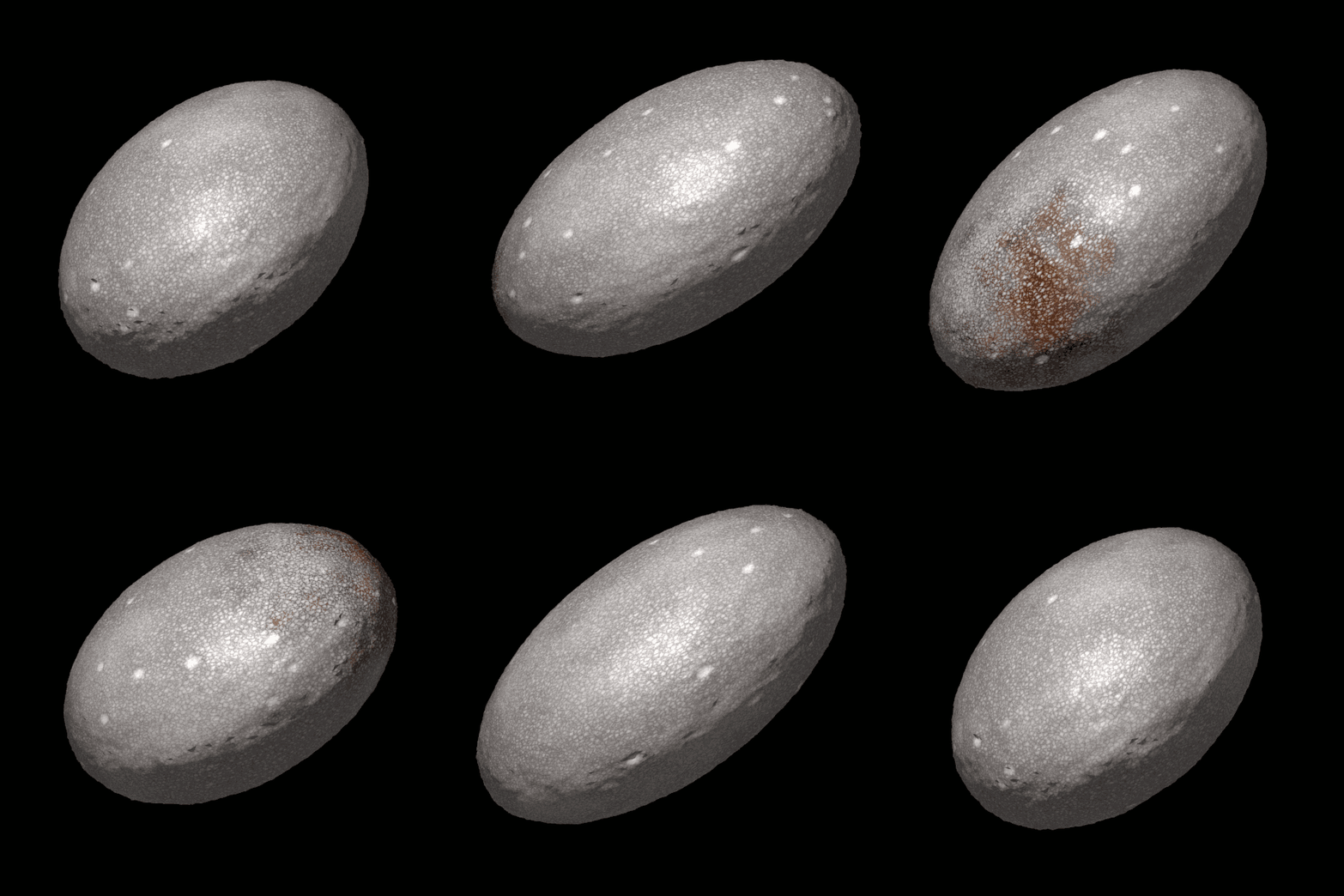
Most large bodies in the solar system, including the planets and the other dwarf planets, are very nearly round. Haumea is the odd one out, stretched into the shape of an American football or an egg. The culprit is that dizzying spin.

Haumea completes one full rotation every 3.9 hours, the fastest of any known large body in the solar system. When an object spins this quickly, centrifugal force flings material outward at the equator. On most worlds, gravity easily wins this tug-of-war and keeps the body spherical, but Haumea rotates so fast that the outward push at its equator becomes strong enough to stretch it into an elongated ellipsoid. Astronomers call this equilibrium shape a Jacobi ellipsoid, the form that a spinning fluid body settles into once it turns faster than a certain threshold.
The effect is dramatic. Haumea measures roughly 2,322 km (1,443 mi) along its longest axis but only about 1,138 km (707 mi) from pole to pole, so it is close to twice as long as it is 'tall'. If it were spinning even faster, models suggest it could distort into a dumbbell shape and eventually break apart. In other words, Haumea sits right at the edge of what a rapidly rotating body can hold together.
Physical Characteristics
Haumea rotates very rapidly, completing one rotation approximately every 3.9 hours, which makes it an elongated ellipsoid in shape. Based on a 2017 stellar occultation, the density of Haumea is approximately 1.885 g/cm3. While lower than earlier estimates, this density still indicates a differentiated interior with a rocky core composed of silicate minerals surrounded by an icy mantle. Studies suggest the rocky core has a density of about 2.68 g/cm3, with an icy shell ranging from 70 km thick at the poles to 170 km along its longest axis.
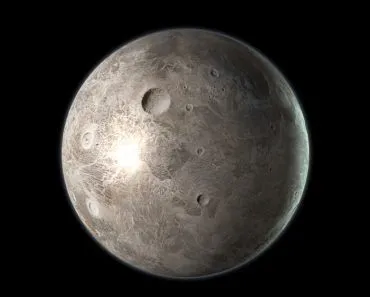
The 2017 stellar occultation provided the best measurements of Haumea’s shape and dimensions. Haumea is a triaxial ellipsoid with dimensions of approximately 2,322 × 1,704 × 1,138 km, making it roughly the size of Pluto along its longest axis and about half that at its poles. Haumea’s surface shines very brightly, as the surface is crystalline water ice!
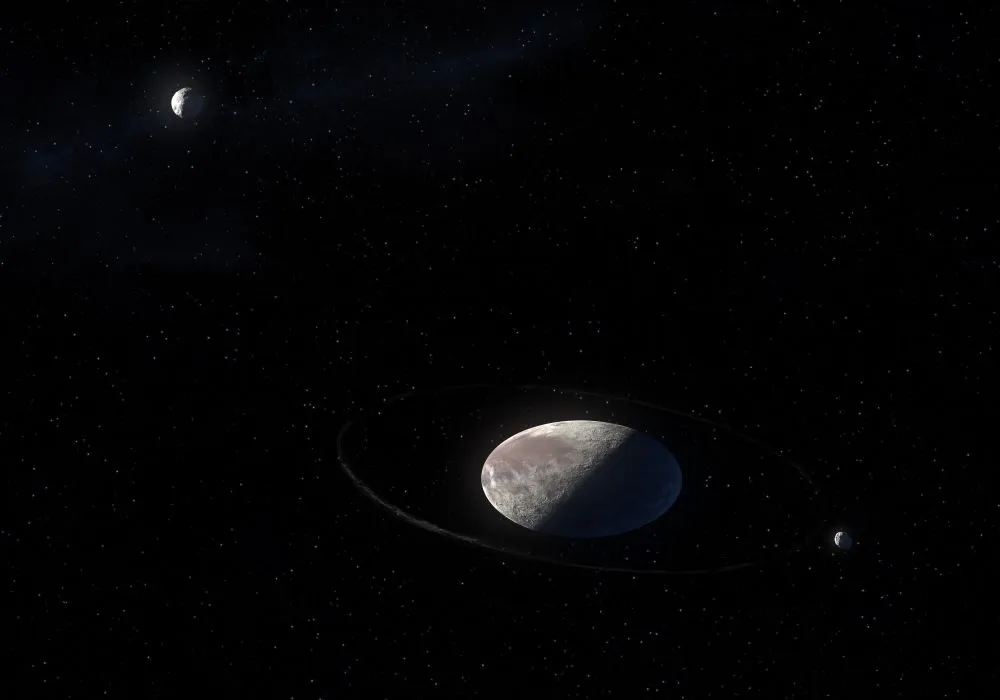
On January 21, 2017, during a stellar occultation, it was observed that Haumea has a ring around it. This ring is 70 km wide and has a radius of 2287 km. The ring plane is inclined only about 3° with respect to Haumea’s equatorial plane and approximately coincides with the orbital plane of Haumea’s larger moon, Hi’iaka. The ratio of Haumea’s rotation with the ring’s revolution is 3:1, meaning that in the time it takes for the ring to complete one revolution around the dwarf planet, Haumea completes 3 full rotations!
Computer-generated model of Haumea and its ring (Photo Credit : Tomruen/Wikimedia Commons)
Of Haumea’s two satellites, Hi’iaka is the larger and brighter one; it has a mean diameter of about 370 km and orbits Haumea in a nearly circular orbit every 49.5 days. Namaka, the inner and smaller satellite, is about 1/10th the mass of Hi’iaka (with a diameter of about 150 km) and orbits Haumea in a highly elliptical manner, completing one orbit every 18 days.
What Color Is Haumea?
If you could stand on Haumea, the first thing you would notice is the glare. Its surface is coated in crystalline water ice and reflects light much like fresh snow, with an albedo (a measure of reflectivity) somewhere between 0.6 and 0.8. Recent estimates place it near 0.66, meaning the surface bounces back roughly two-thirds of the sunlight that reaches it. In visible light, Haumea is essentially bright white, and studies suggest that between two-thirds and four-fifths of its surface is nearly pure crystalline water ice.
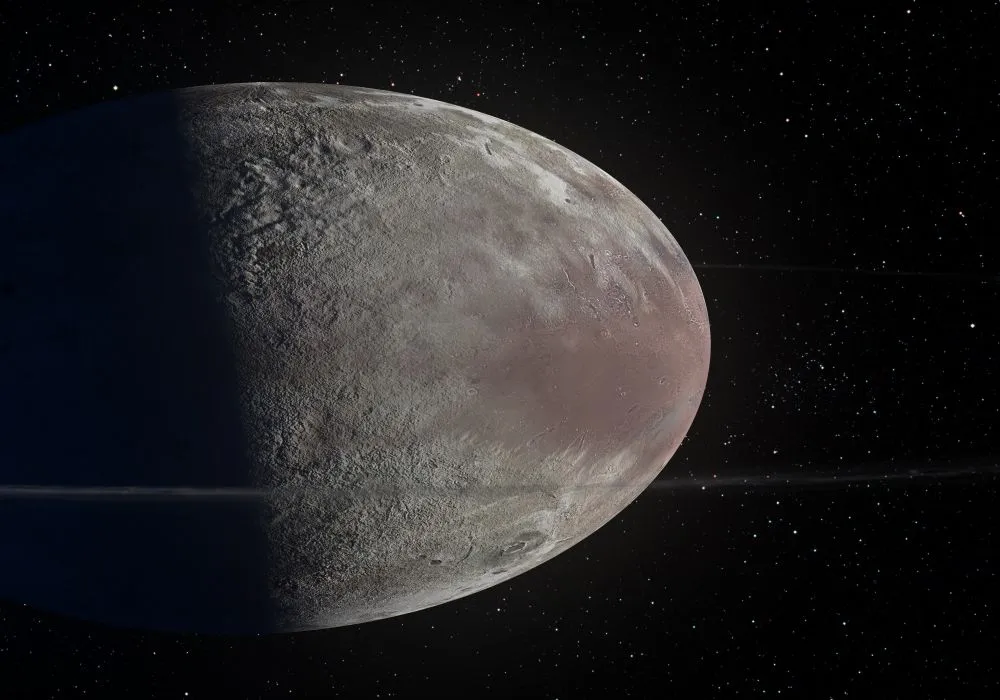
Haumea is not uniformly white, though. In September 2009, Pedro Lacerda and his colleagues tracked the dwarf planet's brightness as it rotated and found a large, darker and redder region on its otherwise pale surface, nicknamed the Dark Red Spot. Compared with the surrounding ice, this patch appears richer in minerals and organic (carbon-bearing) compounds, and it may be a scar left by an ancient impact. So while the short answer to 'what color is Haumea?' is a brilliant, icy white, its most intriguing feature is that single reddish blemish standing out against the snow.
Closing Thoughts
Haumea is certainly a peculiar celestial object in the Kuiper Belt. Its highly unusual rotation and rings make it an exciting celestial body to study. The surface is coated in crystalline water ice, making it extremely cold. However, a 2022 NASA study using computer simulations found that Haumea may have once sustained a subsurface liquid water ocean for approximately 250 million years, heated by radioactive decay in its rocky core. The study also proposed a revised origin story for the Haumean family: rather than forming from a single collision, the family members may have been flung off as Haumea differentiated internally and spun faster over time. While no mission to Haumea has been launched yet, continued stellar occultation observations and improved imaging techniques will help refine our understanding of this unusual dwarf planet.
References (click to expand)
- Haumea.
- Haumea.
- Ortiz, J. L., Santos-Sanz, P., Sicardy, B., Benedetti-Rossi, G., Bérard, D., Morales, N., … Iglesias-Marzoa, R. (2017, October). The size, shape, density and ring of the dwarf planet Haumea from a stellar occultation. Nature. Springer Science and Business Media LLC.
- Egg-shaped Haumea has a ring | EarthSky.
- Lockwood, A. C., Brown, M. E., & Stansberry, J. (2014, March 2). The Size and Shape of the Oblong Dwarf Planet Haumea. Earth, Moon, and Planets. Springer Science and Business Media LLC.
- NASA Studies Origins of 'Weird' Solar System Object: Dwarf Planet Haumea (2022). NASA.
- Spot Discovered On Dwarf Planet Haumea Shows Up Red And Rich With Organics. ScienceDaily.
- Haumea (mythology). Wikipedia.