Table of Contents (click to expand)
The difference between mass and weight is that mass is the amount of matter in an object, while weight is the force of gravity acting on that mass. Mass stays the same everywhere and is measured in kilograms; weight changes with gravity and is measured in newtons. A 60 kg person has the same mass on Earth and the Moon, but weighs about six times less on the Moon.
In our vernacular, “mass” and “weight” are terms that are often seamlessly interchanged, but technically, they are anything but twins. In scientific terminology, “weight” and “mass” represent distinct and rigid definitions. So… what’s the difference?
“Mass” is defined as the amount of matter that an object contains. While “weight” represents the force that a mass-containing body exerts on another body purely under the influence of gravity. Mass is impervious to the forces of gravity, weight is the embodiment of this force itself.
Mass
Mass is defined as the amount of matter that an object contains. However, due to the ambiguity surrounding the definition of matter itself, this definition greets a lot of criticism. A more concise and accepted way of defining mass is to define it in terms of inertia.
The inertia of an object can be defined as its resistance to being accelerated or moved when prodded by an external force or continuing to be in a state of motion unless its motion is hindered by another external force.

The higher the mass, the more difficult it is to displace or stop matter in its tracks. Larger rocks are not only harder to push or lift, but they also require more firepower to contain their motion than smaller, lighter rocks. The standard unit of mass is the kilogram (kg).
One peculiar characteristic of mass is that it is constant, regardless of its position in space. The law of gravity tells us that two objects are attracted towards each other with a force proportional to the product of their masses. However, the force itself has no effect on the magnitude of their mass. A 60 kg block on Earth is still 60 kg on Mars, on Saturn, or in any remote corner of our indifferent universe.

Of course, I haven’t considered the effects of special relativity, where mass tends to increase due to an addition of excess matter or energy when it moves at relativistic velocities or speeds close to the speed of light. Boring into those depths would be beyond the scope of this article.
Weight
Conventional wisdom suggests that the weight of an object indicates how heavy it is. This is why we often witness mass and weight being synonymously used in general or daily accounts. However, technically, weight represents the force that a mass-containing body exerts on another body purely under the influence of gravity.
Whereas mass is impervious to the forces of gravity, weight is the embodiment of this force itself. It is the magnitude of gravitational force by which an object is pulled towards another. Because weight is a force, its unit of measurement is the standard SI unit of force: the newton (N). For a better perspective, weight is the force that our mass exerts on Earth.
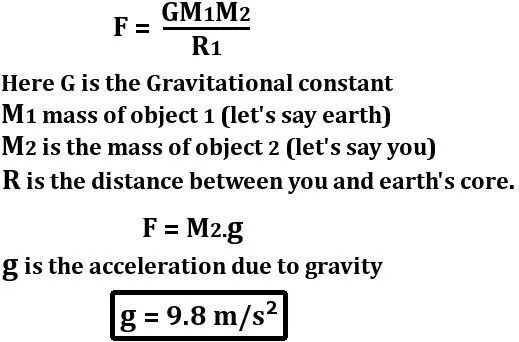
The above result reduces the law of gravity to Newton’s second law of motion: F = ma. Every object of mass m constantly falls towards Earth at an acceleration g. It denotes the acceleration due to Earth’s gravity; that magnitude is roughly 9.8 meters per second squared (the formally defined standard gravity is 9.80665 m/s2).
The magnitude of acceleration is different for different celestial bodies, as it depends upon the mass of the body in question. For instance, the Moon’s surface gravity is about 1.62 meters per second squared. This is why objects weigh roughly one-sixth of what they weigh on Earth.
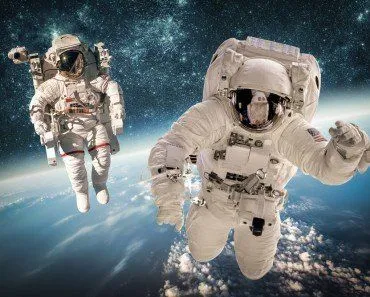
Thus, an astronaut with a mass of 90 kg weighs 90 × 9.8 = 882 newtons on Earth, but he or she weighs 90 × 1.62 = 145.8 newtons on the Moon. On a more massive body, the same object would weigh far more. Strictly speaking, Jupiter and Saturn don’t have solid surfaces to stand on, but in Jupiter’s upper cloud layer (g ≈ 24.8 m/s2) a 90 kg astronaut would tip the scales at about 2,230 newtons, more than twice their Earth weight.
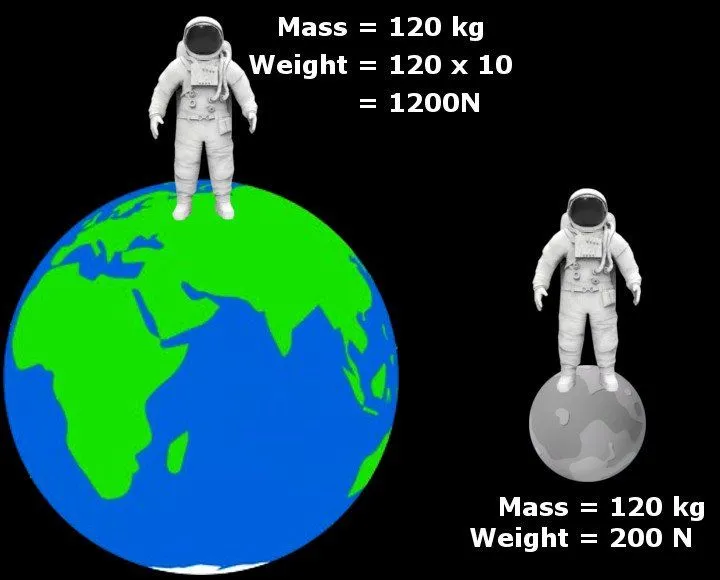
Note that the astronaut’s mass remains the same throughout this strange experiment (i.e., 90 kilograms). However, the apparatus he carries, a weighing machine, wouldn’t agree. It would produce highly inaccurate results on the Moon… but why?
How Do We Obtain Mass From Weight?
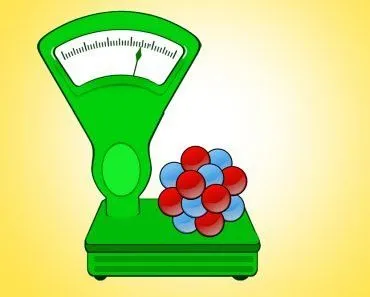
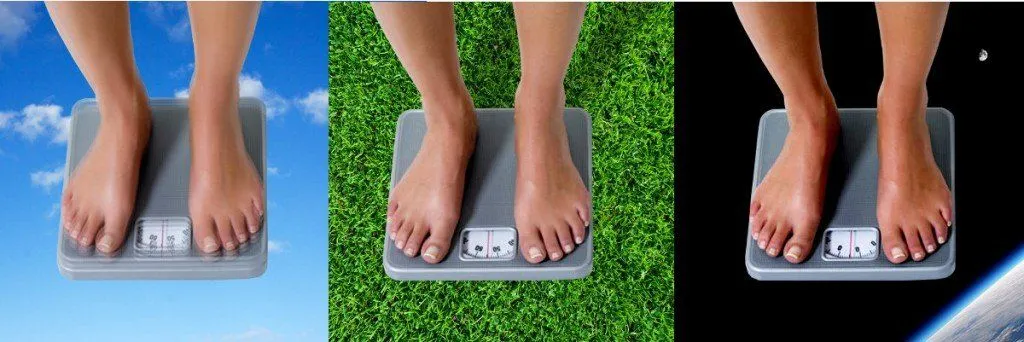
Weighing machines are instruments that measure the mass of an object by measuring the equal and opposite force that the Earth exerts on us in response to the force we exert on it as we stand on its surface. In science jargon, this force is termed the Normal force.

Weighing machines measure the normal force generated by Earth, but they are calibrated in such a way that they divide this force by 9.8 and give an approximation of our mass (m= F/g).
Therefore, carrying a weighing scale calibrated to Earth’s gravity will produce erroneous results on, say, Mars or the Moon. This mechanism also renders them useless in free fall or space, as the free fall forces the weighing scale to fall at the same rate as we do; there is no normal force produced and the needle remains unmoved.
Similarly, floating in space without any surface below it causes the needle to stand callous and erect under the digit zero.
Another instrument that can measure mass is the beam balance. The ingenious yet highly simple mechanism of a beam balance is such that it can be used to measure mass regardless of its position in space. However, the mass depicted by a beam balance is still not objective.
In a sense, one can conclude that, akin to a weighing scale, a beam balance finds an unknown mass only by comparing it to a known one (it is calibrated to a fixed known mass). For most of modern history, the standard unit of mass, one kilogram, corresponded to a platinum-iridium cylinder reposing in a highly secure vault near Paris, known as the International Prototype of the Kilogram.

That changed on 20 May 2019, when the kilogram was officially redefined. Instead of relying on a single physical object that could be scratched, contaminated or drift in mass, the kilogram is now defined in terms of the Planck constant, fixed at exactly 6.62607015 × 10⁻³⁴ joule-seconds. The redefinition is realized in practice using a precision instrument called the Kibble balance, which links mass to electromagnetic force, and the result is a kilogram that is the same everywhere in the universe, no vault required.
So the next time someone mutters “I weigh 90 pounds” at small talk, delight in your newly minted scientific knowledge, take a deep breath, and with a tender smile (regardless of how condescending it sounds) correct them. After all, knowledge is the greatest gift one can share, even if it gets you hurled out of the party.