A Matrioshka brain is a proposed megastructure, a star-sized supercomputer that harnesses nearly all of a star’s energy for computation. Proposed by Robert Bradbury in 1997, it nests layer upon layer of Dyson spheres around a star, each shell reusing the waste heat of the one inside it. Bradbury named it after the nesting Russian Matryoshka dolls.
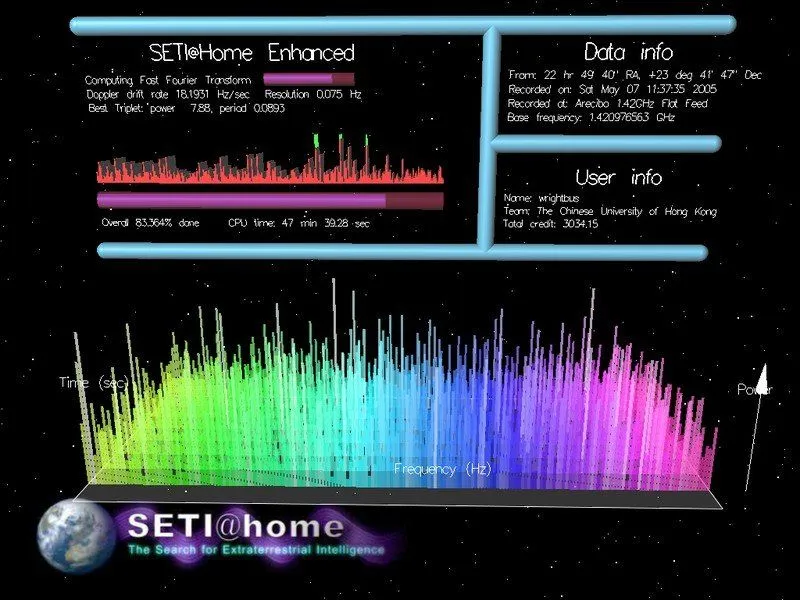
Do you know that your computer can help in finding aliens? It may sound strange, but it’s true. For more than two decades, the SETI (search for extraterrestrial intelligence) effort ran an application called SETI@home for doing just that! Now, that didn’t actually mean that you could just download the application and discover little green men right at home, but what this application did was allow the SETI researchers to use your computer (when it was not in use) to crunch data in an effort to find extraterrestrial intelligence. The volunteer project went into hibernation in 2020, but the idea it embodied is exactly what we need next.
Matrioshka Brain
The idea behind this technique is pretty brilliant. Instead of burning hundreds of thousands of dollars to buy supercomputers for processing vast amount of cosmological data, they simply distribute processing power throughout computers all around the globe. You can go to their site, download this application and let SETI researchers use your computer for processing whenever it’s idle. Basically, it turns the entire Internet into a giant supercomputer!
What if we need processing prowess that won’t be satisfied by the arrays of all the computers on Earth used in conjunction? In that scenario, we would need to think beyond our planetary resources to derive the power needed for such computations. For example, what if we could encapsulate the entire sun to build a supercomputer? Well, that’s the main idea behind the Matrioshka brain!
A Matrioshka brain is a proposed megastructure that can extract immense computational capacity from our proximate star. The Matrioshka brain model is heavily inspired by the theoretical Dyson sphere. Robert Bradbury, who proposed this concept, derived the name from the nesting Russian Matryoshka dolls.

The Need For Matrioshka Brain
With our steady progress in scientific thinking, we have discovered a number of apparently dependable methods for inspecting the world around us. We have learned what the Earth is made of and how to tinker with it to fulfill our needs. For instance, we extract fossil fuels from the earth to power our industries.
However, what we have learned and developed technologically thus far is likely to become insufficient if our needs continue to grow rapidly, while our earthly resources fall short. At this point, we could be left with no choice but to expand and explore beyond our planet. One hypothesis is that the needs of advanced civilizations of the future will require them to gulp much more energy than their predecessors, which will lead to the creation of megastructures like a Dyson sphere, which would encompass a star (the Sun, in our case) to harness the enormous amounts of energy contained there.
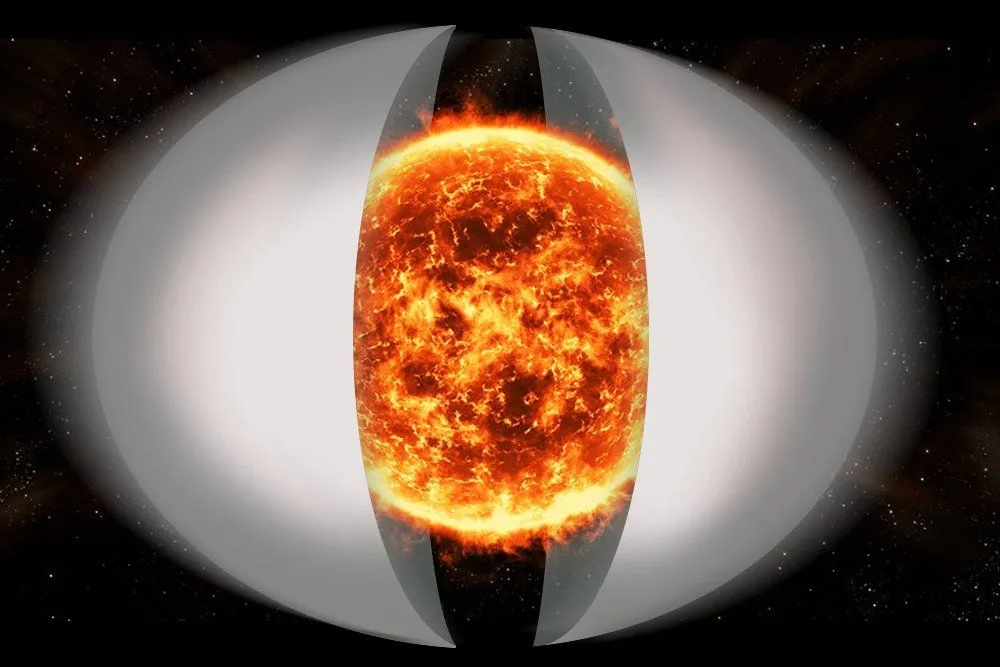
Freeman Dyson, who originally conceptualized Dyson spheres, saw this sphere as a potential place to live. What Robert Bradbury came up with was an extension to this idea: what if a Dyson sphere was transformed into a supercomputer, the most powerful computing machine in the universe?
Bradbury’s Matrioshka Brain
Bradbury first floated the idea in 1997, and later laid it out in detail in an essay for the anthology “Year Million: Science at the Far Edge of Knowledge” (edited by Damien Broderick). He envisioned that in the future we might develop the technology to build a set of nested star shells orbiting the Sun, similar to a Dyson swarm. Like Russian Matryoshka dolls, wherein the dolls are nested inside other dolls, i.e. smaller dolls fitted inside larger dolls, he saw this megastructure formed from layers upon layers of Dyson spheres encompassing the sun to harness its energy and power the giant supercomputer. This design is why he called it “Matrioshka Brain”.
To work as a super-giant computer, a Matrioshka brain would take power from the star and spread it through the network of encompassing shells. One shell would acquire as much energy as it could from the star and would then transfer the unused energy to another larger processing shell surrounding it. This would repeat until all the energy was consumed. The inner shells would run at a temperature close to that of the star, while the outermost shell would radiate at a temperature approaching that of cold interstellar space, only a few degrees above the cosmic microwave background.
Matrioshka Brain Vs. Dyson Sphere: What’s The Difference?
If a Matrioshka brain is built out of Dyson spheres, how is it any different from one? The distinction comes down to purpose and architecture. A Dyson sphere (or the more practical Dyson swarm) is, at its heart, an energy-collection structure. Freeman Dyson imagined a shell or swarm of collectors wrapped around a star to capture its light, and that harvested energy could then be put to any use at all, from powering industry to providing living space.

A Matrioshka brain takes that harvested starlight and spends nearly all of it on a single task: computation. More importantly, it is not one shell but many. Bradbury’s design nests one Dyson sphere inside another, like the Russian dolls it is named after, so a Matrioshka brain is effectively made from multiple Dyson spheres rather than being an alternative to one.
That nesting is what makes it so efficient. Each shell runs its processors on the light it receives and then radiates its own waste heat outward, where the next, cooler shell catches that heat and puts it to work computing all over again. A lone Dyson sphere would dump most of its waste heat straight into space. A Matrioshka brain, by cascading that heat through layer after layer at ever-lower temperatures, keeps extracting useful work until the outermost shell is barely warmer than deep space. In short, every Matrioshka brain contains Dyson spheres, but not every Dyson sphere is a Matrioshka brain.
What Is Computronium, And How Powerful Would A Matrioshka Brain Be?
To turn a star’s output into thought, you need matter that is exceptionally good at computing. Futurists call this hypothetical substance computronium: material engineered right down to the atomic scale so that as much of its mass as possible is devoted to processing information. The shells of a Matrioshka brain would be built from computronium, effectively converting raw sunlight into calculations.
Just how much calculating are we talking about? The Sun radiates roughly 3.8 × 1026 watts of power, and a Matrioshka brain is designed to capture very nearly all of it. Set that against the tens of watts a typical laptop draws, or even the tens of megawatts consumed by the largest supercomputers on Earth, and the gulf becomes almost impossible to picture. Bradbury estimated that the first Matrioshka brain could out-compute every machine humanity has ever built, many times over. Because it wrings useful computation out of a star’s energy right down to the thermodynamic limit, a Matrioshka brain is often described as roughly the most powerful computer the laws of physics would permit around a single star.
Matrioshka Brain Vs. Jupiter Brain
The Matrioshka brain has a smaller cousin: the Jupiter brain. Described by researcher Anders Sandberg in a 1999 paper playfully titled “Daily Life Among the Jupiter Brains”, it is a computer roughly the size of a planet rather than a star. The two designs pull in opposite directions. A Matrioshka brain chases sheer capacity, swallowing an entire star’s energy to run as many calculations as physically possible, even if a signal takes minutes or hours to travel from one shell to the next.

A Jupiter brain instead optimizes for speed. Because information cannot travel faster than light, a computer the size of a star has a built-in lag: its far-flung parts simply cannot exchange signals quickly. Packing the computing matter into a compact, planet-sized body keeps those distances short, so signals cross it with minimal delay. The trade-off is that a Jupiter brain has far less raw energy to draw on than a star-girdling Matrioshka brain. Put simply, one design is optimized for how much it can think, the other for how fast it can think.
In Pursuit Of Matrioshka Brain
It goes without saying that the scale of engineering and the quantity of resources required for such an ambitious project is beyond what humans can currently muster. One of the methods of implementing Matrioshka brain would be through ‘self-replicating’ machines, as proposed by George Dvorsky.
Interestingly, the first tentative steps have already been taken in this direction. In 2009, entrepreneurs Peter Diamandis and Eric Anderson founded a company called Planetary Resources to develop the technology for mining asteroids, the kind of off-world resource extraction any megastructure would eventually demand. The venture struggled to raise funding and was acquired by the blockchain firm ConsenSys in 2018, but the engineering questions it tackled remain very much alive. Another company, Made In Space, pioneered 3D printing technology that works in microgravity, with the long-term goal of factories that could one day replicate themselves in outer space. It was acquired by Redwire in 2020 and continues to build manufacturing hardware for the International Space Station.
However, assessing the current pace of progress, Bradbury opined that humans would be able to build a megastructure roughly by 2250. He feared that in the process of building it, we may exhaust all the silicon from Venus, assuming that silicon would be one of the important raw materials. That being said, if we are successful, the first Matrioshka brain would have a processing capacity in excess of one million times the capacity of the billions of computers we currently have on Earth, combined!
References (click to expand)
- Matrioshka Brains - Robert J. Bradbury.
- Dyson Spheres and Matrioshka Brains: Cultural Structures in the Universe.
- Malthusian Catastrophes - MIT Mystery Hunt.
- As Moore's law ends, brain-like computers begin - Stanford.
- IRAS-Based Whole-Sky Upper Limit on Dyson Spheres - The Astrophysical Journal.
- The Physics of Information Processing Superobjects: Daily Life Among the Jupiter Brains - Journal of Evolution and Technology.
- Matrioshka brain - Wikipedia.
- Solar luminosity - Wikipedia.