A balloon in space would almost certainly pop on its own before you ever got a pin near it. With no surrounding atmospheric pressure pushing back, the high-pressure air inside expands rapidly, stretches the rubber past its elastic limit, and bursts in under a second. And because there is no air to carry sound waves, the burst itself is completely silent.
Whether you are a veteran astronomer or a child looking up at the stars, outer space holds a fascination for everyone who gazes into the void. This intriguing vacuum also inspires people to wonder what happens out there. For example, what would happen if a nuclear bomb went off in space? How long could you survive without a spacesuit? And, perhaps most importantly, what would happen if you popped a balloon in space?
Well, maybe that last one doesn’t intrigue everyone, but enough people enjoy physics (or at least the loud destruction of balloons) for this article to intrigue a few of you… so what would happen to a balloon popping out there in the cosmic darkness?

Short answer: Due to the lack of external air pressure, the balloon would continue to expand and almost instantly pop all on its own!
Air Pressure In A Vacuum
The interesting thing about this question isn’t what would happen if you popped a balloon in space, but whether you would even be the one to do the “popping”. When you blow up a balloon on Earth, the air pushed into the balloon is at a higher pressure than the air that surrounds it (1 atm). This greater pressure is what “inflates” the balloon in the first place. As more atmospheric air is pushed into a restricted place, the number of collisions between air molecules will increase, thus creating more pressure, and pushing the walls of the balloon outwards.
On Earth, when you blow up a balloon past a certain point, it will pop because the molecules of the latex have limited elasticity, and will eventually succumb to the pressure of the air inside. That is the moment when the balloon blows up in your face and pops loud enough to wake up the neighbors.
However, in space, there is no external air pressure (1 atm) pushing back on every surface of the balloon, so when a person blows air into the balloon itself, that air has nothing hold it in except the rubber walls. The air molecules in this space balloon would expand at an extremely rapid rate, quickly pushing the rubber walls past their elasticity limits, causing the balloon to explode.
In fact, as soon as you took an inflated balloon from the pressurized cabin (of a spaceship, one would imagine), it would take less than one second for the pressurized air inside the balloon to expand (having no resistance) and explode. The air molecules inside the balloon would be moving at roughly the speed of sound, or slightly faster. Once the balloon explodes, those molecules would move at a slightly lower velocity and continue into the vacuum of space until they bump into another molecule that slows or diverts its path.
The rubber shards of the balloon would similarly fly away in a straight line from the point of explosion, in the opposite direction of the first break in the rubber. As mentioned above, the question isn’t whether you can pop a balloon in space; it’s whether you would have a chance to before air pressure and physics did the job for you!
What About The Satisfying Pop?
Most people poke pins into balloons for that satisfying “POP”, either to wake up a napping child at a birthday party or simply scare the heck out of the chaperones at a school dance. However, in space, would you still get that rewarding bang when the air molecules rushed outwards to the edges of space?
Unfortunately, no. There would be no popping sound in this space-balloon experiment, as sound waves require a medium to move through. That medium is usually air or water (at least on Earth), and neither of these are present in outer space.
When you look at a balloon on Earth, it seems rather harmless and calm. However, the air molecules inside are desperate to get out. In fact, when you stick a pin in the balloon, the air molecules expand at the speed of sound, or even faster! When this air blows past our ears, it is in the form of a pressure wave that our ears perceive as a bang, just like the terrifying bang when a jet blows through the sound barrier above your head! In space, the air molecules would still expand outward, but without any air in a vacuum, there is no “sound barrier” to break, per se, so it would be a completely silent pop.
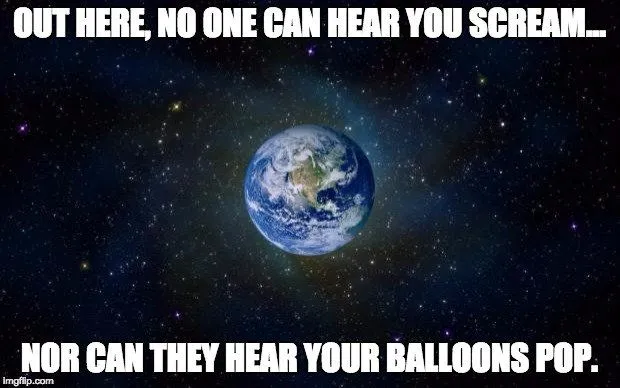
There are a lot of logistics to traveling into space, blowing up a balloon in an airlock, and then going for a spacewalk to see what happens. Fortunately, you have us to do the heavy lifting (or theorizing) for you!
Why Is There No Air In Space In The First Place?
All of this hinges on one thing: space has no air to push back on the balloon. But why not? If our planet is wrapped in a thick blanket of breathable gas, why does it simply stop a little way up, leaving an empty void above?
The short answer is gravity. The air around you has mass, and Earth’s gravity pulls every molecule of it downward, just as it pulls on you. That is why the atmosphere is densest at the surface and thins out as you climb. The lower layers are squeezed by the weight of all the air sitting on top of them, while the upper layers have almost nothing pressing down. According to the U.S. National Oceanic and Atmospheric Administration, roughly 99% of the atmosphere sits within the lowest 30 km (about 19 miles) of altitude. Go higher and the gas keeps thinning until there is so little of it left that we call it a vacuum.
It is tempting to picture the vacuum of space as a giant sucking force that should yank our air away, but that is not how it works. A vacuum doesn’t pull on anything; it is simply a region with nothing in it. The reason our atmosphere stays put is that Earth’s gravity is strong enough to hold onto it. A few stray molecules at the very top do trickle off into space over time, but the planet replaces and retains far more than it loses. Worlds with weaker gravity hang on less tightly. Mars, for instance, has less than half of Earth’s mass, and its atmosphere is only about one-hundredth as dense as ours. So the empty space that pops our balloon is really just the place where Earth’s gravitational grip on its air finally runs out.
Can A Balloon Actually Reach Space?
Plenty of people don’t imagine carrying a balloon up in a spaceship at all. They simply wonder what happens if you let go of one and it drifts up into the sky. Could it keep rising all the way to space? The disappointing-but-fascinating answer is no, it cannot. It pops long before it gets there.

An ordinary party balloon filled with helium rises because it is lighter than the air around it. As it climbs, the surrounding air pressure drops, so the helium inside expands and the balloon swells. Long before it leaves the dense lower atmosphere, the stretched latex reaches its limit and bursts, typically somewhere around 10 km (roughly 6 miles) up. Purpose-built weather balloons are tougher and only partly filled, so they have a lot of room to expand. They routinely climb to about 35 km (22 miles), ballooning from roughly 2 m across at launch to as much as 8 m before they finally rupture, according to the University Corporation for Atmospheric Research. NASA’s giant scientific balloons go higher still, reaching around 49 km (close to 160,000 feet), where the air is 100 to 200 times thinner than at the ground.
Impressive as that is, none of it counts as “space.” The widely used boundary, the Kármán line, sits at 100 km (about 62 miles), and a free balloon can never get there. Once a balloon’s expanded gas is no denser than the wisp-thin air outside it, it stops rising, and it almost always tears apart well before that point anyway. The most famous reminder of those limits is “Lawnchair Larry.” In 1982, Larry Walters tied 42 helium-filled weather balloons to a patio chair over Los Angeles and rose to roughly 16,000 feet (about 4,900 m) before shooting some of the balloons with a pellet gun to come back down, a stunt now recorded by Guinness World Records.
What About A Helium Balloon?
Since helium is what makes a balloon float in the first place, you might expect a helium balloon to behave differently from an air-filled one out in the vacuum. It doesn’t, at least not in the way most people guess.
First, the floating. A helium balloon rises on Earth only because the surrounding air is heavier than the helium, so the denser air is pulled down around it and shoves the lighter balloon up. That is buoyancy, and it needs a fluid (here, air) to work. In the vacuum of space there is no surrounding air to do the shoving, so there is no “up” for the balloon to float toward. It would just hang wherever you released it (and drift along whatever path you nudged it on), not bob upward like it does at a birthday party.
Second, the popping. Take an inflated helium balloon out of a pressurized cabin into the vacuum and it bursts just as fast as an air-filled one, for the exact reason described earlier: with nothing pressing back, the gas inside rushes to expand and stretches the rubber past its breaking point in under a second. What sets that limit is the elastic strength of the latex, not which gas is inside it. Helium’s lightness only matters when there is an atmosphere to be buoyant against. Strip the atmosphere away, and a helium balloon is simply a thin rubber shell holding pressurized gas, doomed to the same silent, instantaneous pop as any other balloon in space.
References (click to expand)
- What Is Atmospheric Pressure? | NASA - www.nasa.gov
- Atmospheric Pressure - National Geographic Society. National Geographic
- Shock Waves - for How Things Fly. The Smithsonian Institution
- Air Pressure - www.unc.edu:80
- Why Does the Atmosphere Not Drift off Into Space? - NOAA NESDIS
- Exploring the Atmosphere with Weather Balloons - UCAR Center for Science Education
- Scientific Balloon FAQs - NASA
- Lawnchair Larry - Guinness World Records