T-minus means “Time minus,” the time remaining on NASA’s official launch countdown clock, where T-0 is liftoff. It’s distinct from L-minus (Launch minus), the real-world wall clock to launch. T-time can pause during planned holds; L-time never does. Both reach zero at the same instant.
I pay close attention to the ground staff and the astronauts (if it’s a spacecraft) and their actions and words leading up to the rocket’s liftoff. However, when I began watching videos of the rocket launch, I was often puzzled by the newsman’s countdown of “T-minus 10, 9, 8…” until take-off.

I understood it was a countdown to the rocket launch, but it took me a while to figure out why they sometimes refer to it as “T-minus” or even “L-minus.”

You may already know that both “T-minus” and “L-minus” are countdowns to a rocket launch, but there is an interesting difference between the two that you may not be aware of.
What Does T Minus Mean?
NASA is known for its iconic “T-minus” countdowns before rocket launches. It starts with “T-minus 10 hours” and then counts down to “T-minus 9 hours,” “T-minus 5 hours,” “T-minus 55 minutes,” and so on. The countdown continues until the last 10 seconds before launch, where the announcer says, “T-minus 10, 9, 8…. 3, 2, 1 and take off!”

Another countdown term used in mission planning is “E-minus,” which refers to a specific event during the mission.
What Does The “T” In “T-minus” Stand For?
In a NASA countdown to a rocket launch, “T-minus” simply means “Time minus”: T stands for Time, and T-0 is the moment of liftoff. So “T-minus 10” means the clock is ten seconds (or ten minutes, hours, days, depending on context) before that instant. Technically, the T clock is the main sequence countdown that serves as a synchronization signal for the devices and procedures that must be completed before, during, and after launch.
You’ll occasionally see writeups claiming the “T” can stand for “test.” In modern NASA, military, and commercial launch usage, that isn’t how it’s defined. T is always Time. The reason T-minus exists as a separate clock at all is what makes it interesting: planned holds.
The “E” in “E-minus” stands for “encounter” or “event.” This term is used in space missions, i.e., when a satellite is already in space. If, for example, a satellite collided with a comet in 5 hours, NASA ground staff would formulate the countdown to this encounter as “E-minus 5 hours.”
What Is The Difference Between “T-minus” And “L-minus”?
“T-minus” is the time left on the official countdown clock as managed by the launch team. Crucially, this clock is allowed to pause: a NASA or SpaceX launch schedule has built-in holds (commonly at T-20 minutes, T-9 minutes, etc.) where the count is intentionally frozen so engineers can poll “go/no-go,” top off cryogenic fuels, or work problems. During those holds, T-time stops; when the count resumes, it picks up exactly where it left off.
“L-minus,” by contrast, stands for Launch minus, the literal wall-clock time remaining until the planned launch moment (L-0). The L clock keeps ticking no matter what the launch team does; it never pauses. If a hold delays the count by 30 minutes, T-time freezes but L-time keeps running.
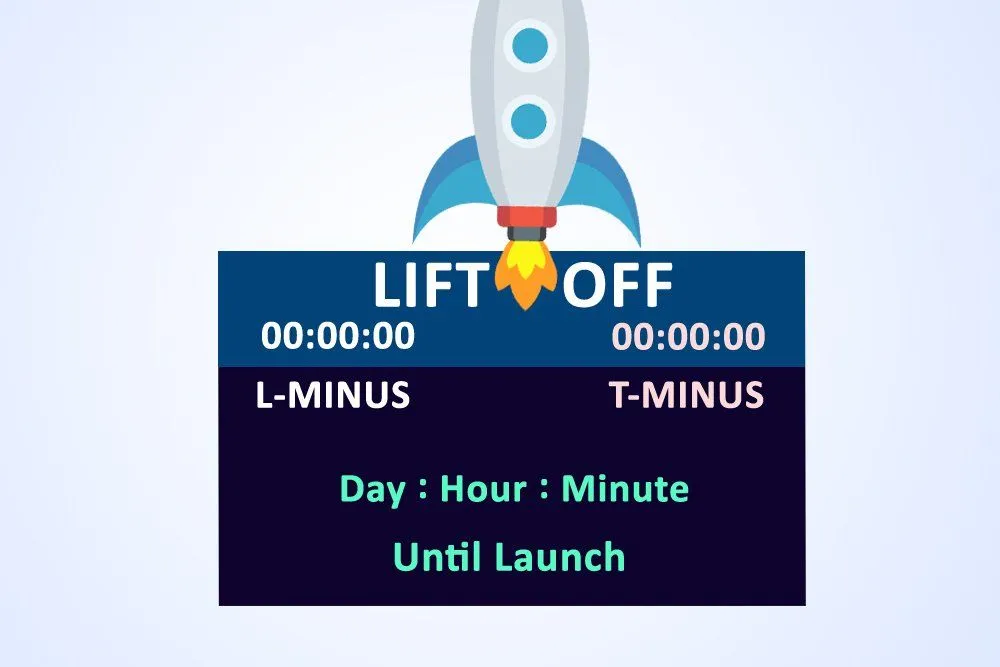
Under a nominal, hold-free countdown, both clocks run in lockstep and reach zero together. When there are holds, the difference between the two clocks at any moment equals the total time spent on hold so far.
What Does “T-minus 2 Days” Mean?
Here’s the part that trips a lot of people up: T-minus isn’t only about that breathless final “10, 9, 8…” in seconds. The “T” clock counts down in whatever unit the moment calls for. Early in the flow it’s expressed in days and hours, then minutes, and only right at the end in seconds. So “T-minus 2 days” simply means the launch (T-0) is two days away, “T-minus 24 hours” means one day to go, and “T-minus 30 minutes” means half an hour to liftoff. The unit changes; the meaning doesn’t. It’s always “this much time before T-0.”
You can see this in NASA’s own published timelines. For the Artemis I countdown, NASA lists built-in holds at points like L-8 hours, 40 minutes and L-40 minutes, which shows that these launch clocks are routinely tracked in hours and minutes long before the dramatic final seconds. A countdown that opens at “T-minus 10 hours” and ticks down to “T-minus 55 minutes” is using exactly the same convention as the last ten seconds, just at a coarser scale.
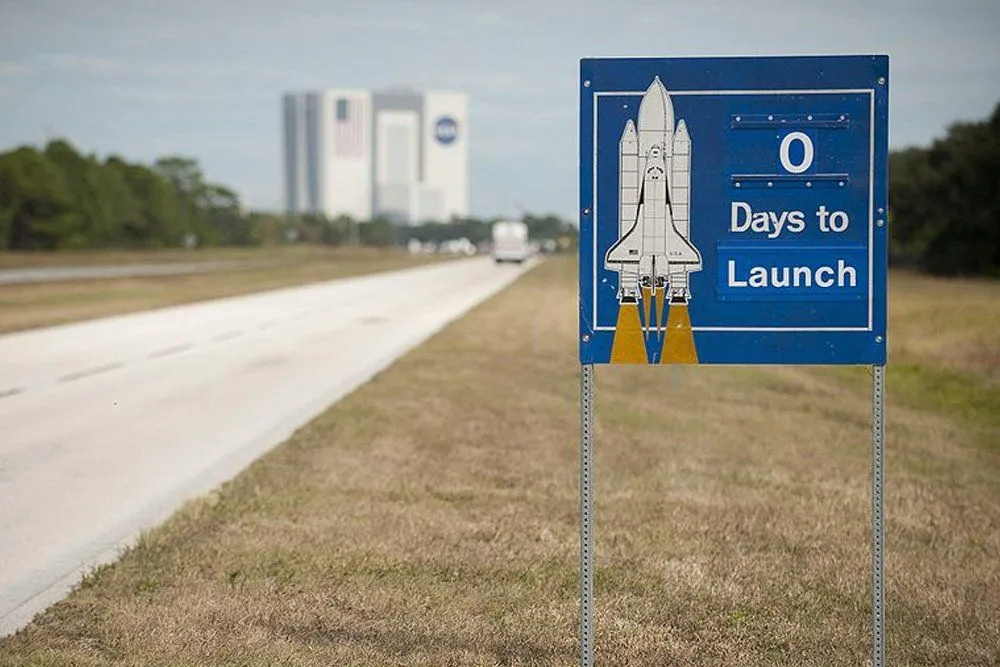
This is also why you now see “T-minus” far from any launch pad. The phrase escaped NASA and entered everyday English back in the 1960s, and people happily borrow it for any sort of countdown to an anticipated event. You’ll spot a company posting “T-minus 2 days until launch” for a new product, or a friend texting “T-minus 1 day before we leave for Europe.” The number after “T-minus” is still just the time remaining; the only thing that has changed is that the “event” is no longer a rocket.
What Happens After T-0? Meet “T-plus”
If T-minus counts down to liftoff, what does the clock do after the rocket leaves the pad? It doesn’t just stop at zero. The instant the count hits T-0 and the rocket clears the tower, the clock starts running the other way and the “minus” becomes a “plus.” So “T-plus 90 seconds” means 90 seconds after liftoff, and mission teams use these T-plus times to track every in-flight milestone, from booster separation to spacecraft deployment into orbit.

For longer flights, this forward-running clock has its own name: Mission Elapsed Time (MET). As NASA describes it, MET is a continuous counter of days, hours, minutes, and seconds that begins at the exact moment of launch. A reading written as 2:03:45:18 MET therefore means it has been 2 days, 3 hours, 45 minutes, and 18 seconds since the rocket left the ground. NASA used Mission Elapsed Time through the Mercury, Gemini, Apollo, and Space Shuttle eras, and Artemis II is set to use it as a primary timeline reference too.
The clever part is why mission planners bother with this “minus, then plus” system. Because every event is scheduled relative to liftoff rather than to a fixed wall-clock time, a launch can slip by hours or even days without anyone having to rewrite the flight plan. T-plus 6 hours is T-plus 6 hours whether the rocket left on Monday or Thursday.
Last Updated By: Ashish Tiwari