Table of Contents (click to expand)
If Earth had rings like Saturn, they would arc over the equator and stay visible day and night. So close to the Sun, icy rings would vaporize, so Earth’s ring would likely be rock. It would brighten the sky and cast a shadow that cools the opposite hemisphere’s winter. Earth probably did wear a brief ring after the Moon-forming impact, and a 2024 study even proposes one around 466 million years ago.
We’re so used to the presence of that grayish-white orb hanging up in the sky that it’s almost impossible to imagine anything else seated in that prime position. Just imagine, what would it be like if you looked up in the night sky and, instead of the Moon, you saw a purple triangle or a green hexagon?
Or maybe even… a ring?
Well, this might surprise you, but at one point in the development of our planet…
Earth Had A Ring Too!
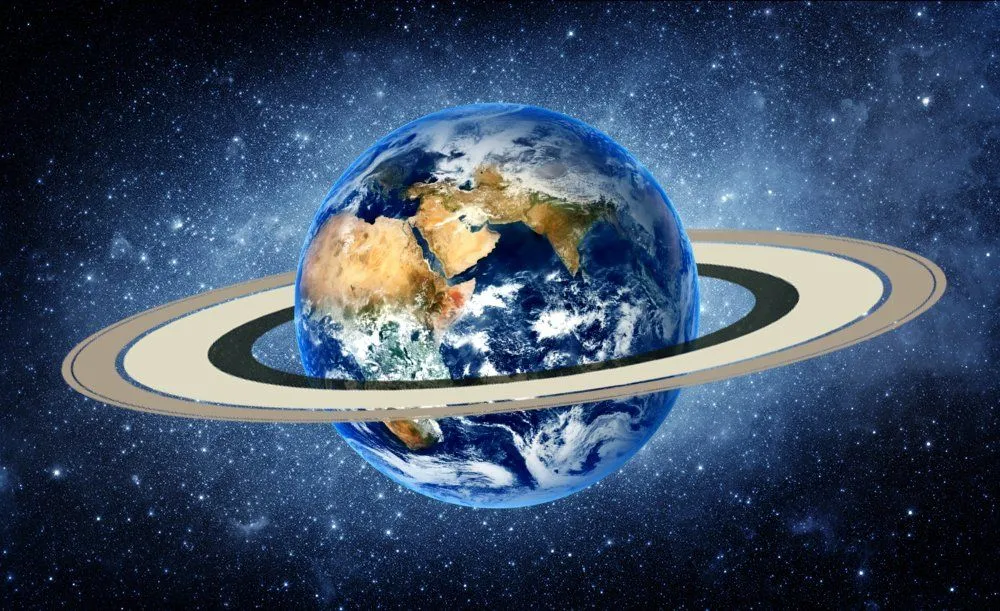
Crazy as that may sound, billions of years ago, Earth probably did have a ring! Scientists believe that this unusual ring first appeared during the formation of the Moon. It is surmised that around 4.5 billion years ago, a Mars-sized body named Theia collided with the young Earth, and as a result of this collision of two celestial objects, a huge amount of debris was thrown out into space.
This debris then settled into an orbit around Earth, forming a temporary ring around our planet. This ring (made from the leftovers of the collision) gradually came together into a single huge chunk of mass to become the Moon we see today hanging in the night sky.
That ancient ring is long gone, but Earth may have worn another one far more recently. In a 2024 study published in Earth and Planetary Science Letters, geologists led by Andrew Tomkins at Monash University proposed that an asteroid strayed inside Earth’s Roche limit roughly 466 million years ago and was torn apart by tidal forces, leaving a debris ring above the equator. The clue is a strange cluster of impact craters from that era, all sitting within 30 degrees of the equator even though most of Earth’s ancient crust lies elsewhere. The team also floats the idea (still a hypothesis, not settled fact) that the ring’s shadow may have nudged the planet into one of the coldest stretches in the last 500 million years, the Hirnantian icehouse.
The Roche limit, by the way, is the distance inside which a planet’s tidal pull overwhelms a smaller body’s own gravity and rips it apart. It is exactly why rings tend to form close to a planet: stray too near, and any moon or asteroid is shredded into a band of orbiting rubble rather than left whole.
What If There Were Rings Around Earth?
Just for the sake of argument, let’s assume that Earth also had rings like Saturn. First off, the rings would look quite different from Saturn’s rings. You see, Saturn’s rings are not made of single, stand-alone discs. In fact, they are a collection of ice and dust particles orbiting tightly around the planet. However, things out there (around Saturn’s position) are quite cold, because they’re so far away from the Sun. Therefore, Saturn’s rings cannot be transposed on Earth as they are, as the Sun’s rays would burn them up, and they would disappear in no time.
We could, however, have a ring made of rock. It wouldn’t be as shiny as Saturn’s icy disc, but it sure would last longer against the Sun’s rays. So, Earth has a ring. Now what?
Appearance Of The Ring
The first question that comes to mind is how such a ring would look to an Earth-bound individual. More importantly, would it even be visible in the first place?
Yes, a ring around Earth would be clearly visible. It’s highly likely that such a ring would run parallel to the Equator; therefore, its appearance would depend on your location on Earth. For instance, for a person standing in a place near the Equator (the Equator passes through a number of countries, including Uganda, Kenya, Colombia etc.), it would look like a shiny line arcing from horizon to horizon.
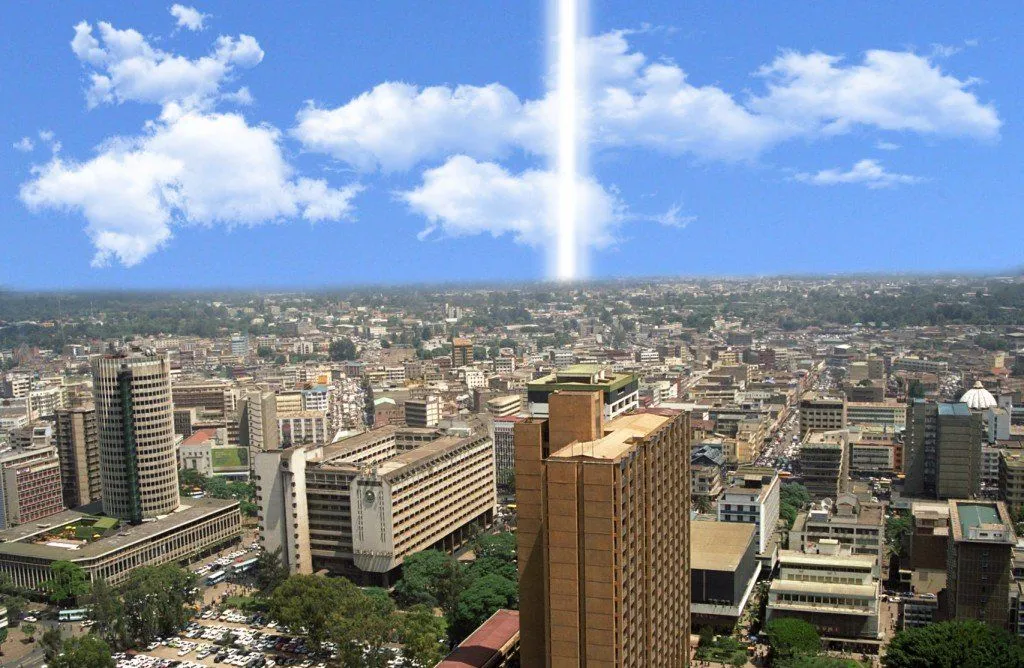
If you moved away from the Equator, the rings would start to spread out across the sky. At a certain vantage point away from the Equator, the rings would appear rather close to the horizon, making for a spectacular visual.

Effect On The Natural Lighting Of Earth
The Moon is a solid structure made of rocky materials, which aren’t the ideal choice for the reflection of light. Still, the Moon appears so bright and well-lit at night, thanks to the powerful sunshine that it reflects onto Earth. Rings would also reflect sunlight in the same manner, but the effects would be much more pronounced.
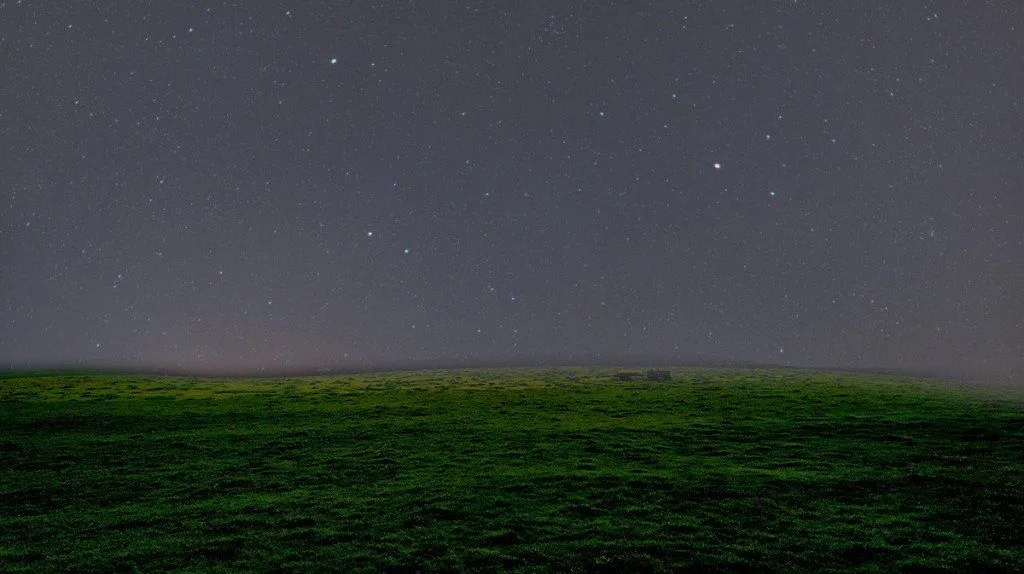
The combined effect of both the Moon and rings’ reflection of sunlight would be such that the night sky would be lit up far more than it is today and would never be as absolutely black as it presently is. This scenario would also make the life of astronomers and star-gazers particularly difficult, as stars wouldn’t be as clearly visible.
Colder Winters
On the other extreme, rings around Earth would seriously impact the amount of sunlight reaching Earth by blocking some of it. Therefore, during summer in the Northern Hemisphere, the rings’ shadows would be cast on the Southern Hemisphere (where it’s winter). This would block some of the much-needed warmth of the Sun, leading to colder winters in both hemispheres.
So, How Many Rings Does Earth Have Today?
After all that daydreaming, let’s settle the question plenty of people actually type into their search bars. How many rings does Earth have right now? Zero. No band of rock arcs over the equator, and nothing like Saturn’s glittering disc hangs above our heads. Among the planets, NASA lists rings around the four giant planets: Jupiter, Saturn, Uranus and Neptune. And none of the other three, by the way, comes close to Saturn’s showpiece.

Why does Earth miss out? Size plays a big part. Rings are born when something wanders inside a planet’s Roche limit and gets shredded, and because Earth is so much smaller than Saturn, the zone where that can happen around our planet is much smaller too. The object also has to arrive at just the right speed, or it simply crashes into the planet or escapes. Even then, it has to be the kind of body held together by its own gravity rather than by chemical bonds, as physicists at the University of Illinois explain.
That said, Earth isn’t completely ring-less in every sense. According to NASA, our planet orbits the Sun inside a giant ring of dust. Asteroids in the asteroid belt constantly crash into each other, and the dust they shed drifts inward toward the Sun, unless Earth’s gravity nudges it aside and into our planet’s orbital path. Scientists identified this dusty band in the mid-1990s. The catch is that it circles the Sun, not Earth, so it doesn’t arc across our sky the way a Saturn-style ring would.
Will Earth ever get rings of its own? Not from the Moon, at least. Laser beams bounced off reflectors left by Apollo astronauts show that the Moon is drifting away from us by about 3.8 centimeters (1.5 inches) a year, heading away from the Roche limit rather than toward it. Mars is the rocky planet to watch. Its moon Phobos is creeping closer to the Red Planet by about 1.8 meters (6 feet) every hundred years, and NASA expects it to either crash into Mars or break up into a ring within about 50 million years. Researchers at Purdue University even suggest Mars may have cycled between moons and rings several times over billions of years. So if you want to see a ringed rocky planet, you’ll need a lot of patience.
All in all, Saturn-like rings might make our Earth look slightly prettier than it does now, but looking at the potential downsides that they would entail, I’m immensely pleased that the cosmos haven’t ‘put a ring on it’.
References (click to expand)
- What Would Earth's Skies Look Like With Saturn's Rings? The Planetary Society
- Rings Around Earth? | Physics Van | UIUC. The University of Illinois Urbana-Champaign
- Tomkins, Martin & Cawood (2024). Evidence Suggesting That Earth Had a Ring in the Ordovician. Earth and Planetary Science Letters
- Earth May Have Had a Ring System 466 Million Years Ago. Monash University
- What if Earth really did have rings? - Bad Astronomy : Bad Astronomy - blogs.discovermagazine.com:80
- What If Earth Had Rings? - Science | HowStuffWorks. HowStuffWorks
- Solar System: Facts. NASA Science
- What Scientists Found After Sifting Through Dust in the Solar System. NASA
- The Apollo Experiment That Keeps on Giving. NASA
- Phobos. NASA Science
- Does Mars Have Rings? Not Right Now, but Maybe One Day. Purdue University