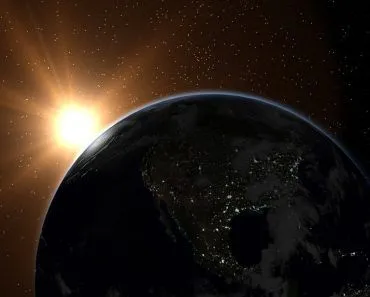
If the Sun suddenly disappeared, the planets would continue in their orbits and eventually leave the solar system. Life on Earth would become very difficult, as the planet would freeze and the atmosphere would disappear.
We’re so used to the environmental conditions that surround us (e.g., oxygen and other gases, water, sunlight and even dust) that we almost always take them for granted. Our temperament is basically stating, “Where’s oxygen going to be if not on Earth?” or “How can the Sun NOT provide light to our planet?” and so on.
However, just for the sake of conversation, have you ever wondered what would it be like if the Sun just… disappeared? Poof! Just like that… What would happen to the comets, satellites, planets, and other celestial bodies of the solar system? More importantly (and selfishly), what would happen to us?
Significance Of The Sun
The sun is a gigantic star that sits right in the middle of our solar system. It’s a huge ball of fire that continues ‘burning’, due to its constituent elements, and it is by far the most important source of energy to sustain life on Earth. Not just Earth, but all the other celestial bodies of our solar system are locked in elliptical orbits around the Sun. It’s fair to say that the Sun is the supreme power of the solar system, keeping everything in a state of calm and tranquility.
No Sun Scenario
As mentioned earlier, planets and other celestial bodies revolve around the Sun in elliptical orbits. To be more precise, all planets are in a state of continuous free fall towards the Sun. Hence, if the Sun magically disappeared from within the solar system, every planet would simply continue with its forward motion and eventually race off into interstellar space, no longer bent into an orbit. Consider this: Earth revolves around the Sun at a staggering speed of about 67,000 miles per hour (107,000 km/h). The moment the Sun’s gravitational pull was gone, the Earth would shoot off along that tangent at the same speed!
One subtle catch: gravity itself travels at the speed of light. So even though the Sun was “gone,” Earth would keep orbiting normally for about 8 minutes and 20 seconds — the same time it takes the Sun’s final photons to reach us — before suddenly being released to drift in a straight line.
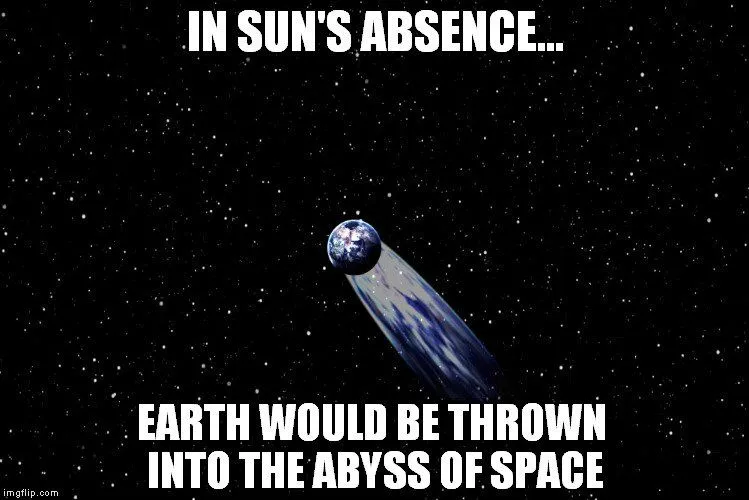
They would go on and on through the darkness of space; it would be hundreds of years before another object came into their vicinity.
Earth’s State Of Affairs
The above section explained the physical state of the various planets revolving around Sun, including Earth, but what about the living organisms on Earth.
First of all, you should know that Earth wouldn’t go dark instantly. You see, light from the Sun takes around 8 minutes to reach our planet. Therefore, it would take precisely that long before every last bit of sunshine arrived on our planet before Earth was plunged in total darkness (there would still be artificial light and the stars would still shine, though). If you’re on the side of the planet that’s facing away from the Sun (i.e. it’s nighttime), the moon would go dark too, as it would no longer have the Sun’s light to reflect.
Also, it just so happens that our planet is rather good at retaining heat; so stuff wouldn’t freeze right away either.
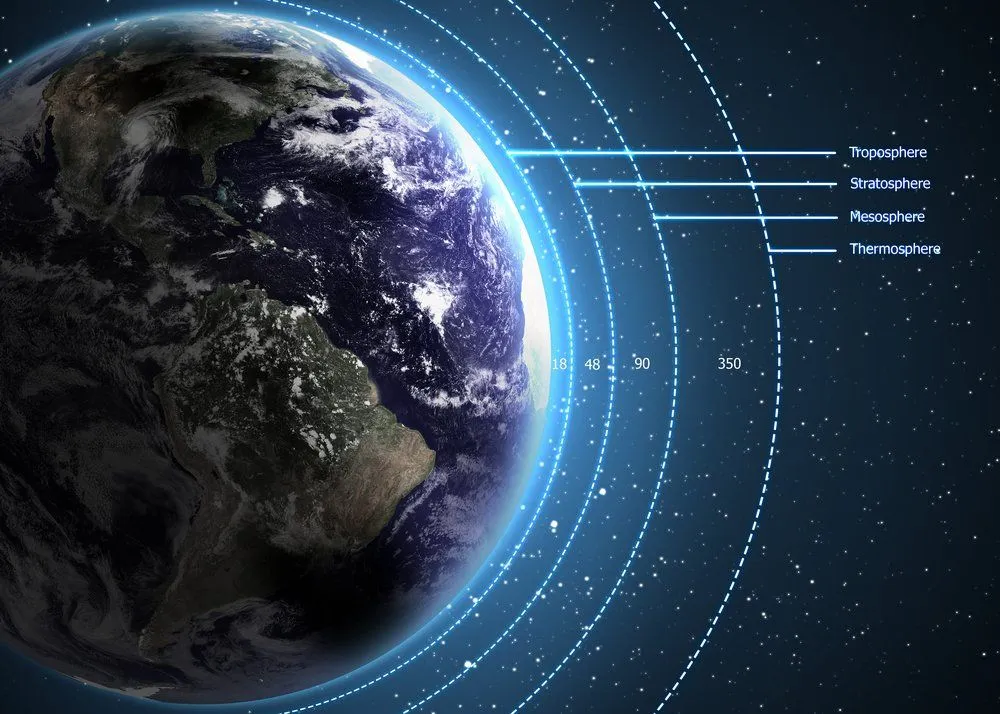
However, that doesn’t mean we would be kept warm eternally in the Sun’s absence. According to Caltech planetary scientist David Stevenson, the global average surface temperature would crash below 0 °F (-18 °C) within about a week, fall to roughly -100 °F (-73 °C) by the end of the first year, and only after millions of years would the planet approach a final equilibrium of about -400 °F (-240 °C) — set by the slow trickle of heat still leaking out of Earth’s core. Long before that, around -109 °F (-78 °C), carbon dioxide would start snowing out of the sky as dry ice. Oxygen and nitrogen, whose freezing points are far lower (-218 °C and -210 °C respectively), would stay gaseous for far longer. Eventually, though, almost the entire atmosphere would condense onto the ground, leaving the surface utterly exposed to the cosmic radiation that whips through space.
Life on such a frozen, atmosphere-lacking planet would undoubtedly be very, very difficult. Most living organisms would perish, but not all. The strange ecosystems that already cluster around deep-sea hydrothermal vents — tube worms, shrimp, vent crabs, and a host of chemosynthetic bacteria — could carry on for a remarkably long time, because they live off heat and chemicals from Earth’s interior, not sunlight. With a layer of sea ice acting as a giant insulating blanket, the water in the deep ocean could even stay liquid for hundreds of thousands of years. As far as humanity is concerned, we’d have to clump together in large, closely-held (in the real sense of the word) groups around nuclear fission reactors and geothermal plants — and, if commercial fusion ever arrives, fusion reactors — while we figured out ways to survive without a sun!
In other words, life on Earth won’t end immediately in case the Sun disappeared… it would take a little longer than that!
What Would Happen To The Water Cycle Without The Sun?
Here’s a consequence that’s easy to overlook: the water cycle would grind to a halt. You see, the constant circulation of water between the oceans, the sky and the land isn’t self-sustaining. It runs on solar energy. As the U.S. Geological Survey’s Water Science School puts it, “The sun is what makes the water cycle work,” because the Sun supplies the heat that drives evaporation, lifting water vapor off the oceans and into the atmosphere.

Take away the Sun and you remove the engine. With no solar heating, evaporation slows and then stops altogether. No rising water vapor means no clouds, which means no condensation, no rain or snow falling back to the surface (precipitation), and no rivers carrying that water back to the sea (runoff). The Sun also stirs the winds that push weather systems around the globe, so even that mixing would die down. In short, the whole loop seizes up.
And it wouldn’t just pause; it would freeze solid. As the surface temperature plunged (recall it would drop below 0 °C within a week), the oceans, lakes and rivers would lock up under thickening ice from the top down. The water on Earth wouldn’t go anywhere, but it would stop moving through the cycle that makes rain, rivers and fresh drinking water possible in the first place.
What If The Sun Disappeared For Only A Few Seconds?
This is the version of the question people ask most: not a permanent vanishing, but a brief one. What would happen if the Sun blinked out for 5 seconds, or even just 1 second, and then popped straight back into place? The reassuring (and slightly mind-bending) answer is that nothing at all would happen to us, and we would never even know it had occurred.
The reason comes straight back to the speed limit of the universe. Both the Sun’s light and the Sun’s gravity reach us only after a delay of about 8 minutes and 20 seconds, the time it takes them to cross the roughly 150 million kilometers (93 million miles) between us. Gravity is not instantaneous either: Einstein’s general relativity says gravitational effects travel at the speed of light, a prediction now backed up by the gravitational waves detected by LIGO. As astronomer Jeff Mangum of the National Radio Astronomy Observatory puts it, we “would not notice it until about 8 minutes and 20 seconds after it had happened.”
So if the Sun winked out for just 1 or 5 seconds, the gap in the stream of light and gravity would be far too short to ever reach us before the Sun returned. The “off” signal and the “on” signal would chase each other across space only a few seconds apart, and by the time that 8-minute-old news arrived, the Sun would already have been shining steadily again for ages. Earth would keep orbiting and keep being lit without the slightest hiccup. The Sun would have to stay gone for longer than that 8-minute window before anyone saw so much as a flicker in the sky.
References (click to expand)
- Sunless Earth - What if? (xkcd). xkcd
- What Would Earth Be Like Without the Sun? - Wonderopolis. wonderopolis.org
- What if the sun disappeared? FInd out | Space - EarthSky. earthsky.org
- Here's what would happen if the sun disappeared right now | Business Insider India - www.businessinsider.in:80
- The Sun and the Water Cycle. USGS Water Science School
- If the Sun Suddenly Disappeared, Would We Notice It Immediately? National Radio Astronomy Observatory
- How long would it take to feel the absence of the Sun's gravity? Astronomy Magazine