Table of Contents (click to expand)
- Quick Facts About White Dwarfs
- Discovery And Classification
- Formation Of White Dwarfs
- Will The Sun Become A White Dwarf?
- How Hot Is A White Dwarf, And What Is It Made Of?
- What Color Is A White Dwarf?
- What Happens After A White Dwarf? The Black Dwarf Endpoint
- How Long Do White Dwarfs Last?
- Eventual Fate And Orbiting Planets
- Famous White Dwarfs You Can Find
A white dwarf is the dense, Earth-sized remnant of a low-to-medium-mass star (roughly 0.5–8 solar masses) that has exhausted its nuclear fuel. It packs about the mass of the Sun into a volume the size of Earth, no longer fuses elements, and cools slowly over trillions of years. The closest known white dwarf is Sirius B, 8.6 light-years away.
Stars are some of the most fascinating objects in our universe. Packed with enormous energy, they come in varying sizes, masses and forms. They are a key component in the development of life on a habitable planet, without which the necessary building blocks could not exist.
Star-forming nebulae produce high- and low-mass stars, after which the star’s life develops through various evolutionary stages. Every star faces an inevitable collapse as it runs out of fuel to burn. Although this isn’t sudden, they show clear signs and change in incredible ways that signal the “end of their run”.
When mid-sized stars, like our Sun, run out of burning fuel, their remnants take a form based on their mass. One of the forms it could take is of a White Dwarf, where the star becomes very dense, as a massive star (like the Sun) gets compressed into a smaller volume (perhaps the size of Earth). White dwarfs have low luminosity, which comes from the stored thermal energy that gets emitted. The closest white dwarf to the Sun is Sirius B, located 8.6 light-years away.
Quick Facts About White Dwarfs
If you only have a minute, here are the headline numbers and properties that define a typical white dwarf. Each is unpacked in detail later in the article.
- Surface temperature: roughly 4,000 K (3,700 °C / 6,700 °F) at the cool, ancient end, to over 100,000 K (99,700 °C / 179,500 °F) for the very youngest. Most observed white dwarfs sit between about 8,000 K and 40,000 K.
- Color: shifts with cooling, from a brilliant blue-white at birth through white, yellow, and orange to a deep red over billions of years.
- Mass: about 0.5 to 1.4 solar masses (roughly 1 to 2.8 × 1030 kg). The upper cap is the Chandrasekhar limit at roughly 1.4 M☉.
- Radius: close to Earth's, typically around 5,000 to 10,000 km. Counterintuitively, heavier white dwarfs are smaller, because degenerate matter behaves that way.
- Density: on the order of 109 kg/m3, roughly a million times the density of water. A teaspoonful would weigh about as much as a small car.
- Surface gravity: around 100,000 times Earth's.
- Composition: for most, a carbon-and-oxygen core wrapped in thin shells of helium and hydrogen. Low-mass examples can be helium-dominated; the heaviest have cores of oxygen, neon, and magnesium.
- Luminosity: roughly 0.0001 to 0.01 times that of the Sun, fading further as the star cools.
- Lifespan: trillions of years in any meaningful sense. Theoretical cooling to a black dwarf takes around 1015 years, so none has actually finished yet.
- Nearest known white dwarf: Sirius B, 8.6 light-years away in Canis Major.
Discovery And Classification
A white dwarf was first discovered by William Herschel on January 31, 1783. This was in the triple star system in 40 Eridani, which has a very bright main-sequence star called 40 Eridani A. This star was orbited by a white dwarf called 40 Eridani B.
White dwarfs hold a completely separate place in the Hertzsprung-Russell diagram, and are found near the left bottom of the chart. The Hertzsprung-Russell diagram is a graph that is plotted with the brightness of the star on one side and its color index on the other, this helps in differentiating the different kinds of stars present in the universe.
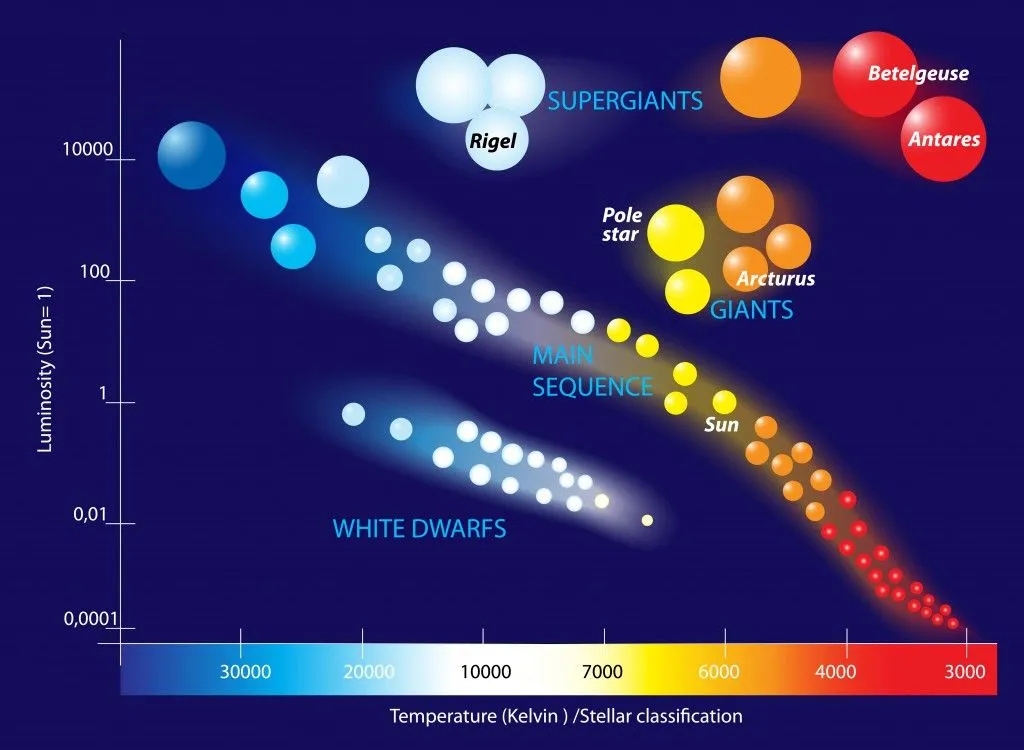
White dwarfs are classified as D (which stands for Degenerate) in the modern classification. These stars have considerably shrunk in size, are cooling down and they no longer undergo any nuclear fusion. These white dwarfs are further classified into subdivisions of D, indicating their spectral type (light bands that identify atoms and molecules of elements).
These subdivisions are:
- DA- The atmosphere of these stars is abundant with hydrogen, which is indicated by the presence of Balmer hydrogen in their spectral lines.
- DB- The atmosphere of these stars is abundant with helium, which is indicated by the presence of neutral helium (He I) in their spectral lines.
- DO- The atmosphere of these stars is abundant with helium, which is indicated by the presence of ionized helium (He II) in their spectral lines.
- DQ- The atmosphere of these stars is abundant with carbon, which is indicated by the presence of atomic or molecular carbon in their spectral lines.
- DZ- The atmosphere of these stars is abundant with metals, which is indicated by the presence of metal in their spectral lines.
- DC- There is no indication of any of the categories above, as the spectral lines are not strong.
- DX- Spectral lines are not clear enough to categorize.
Formation Of White Dwarfs
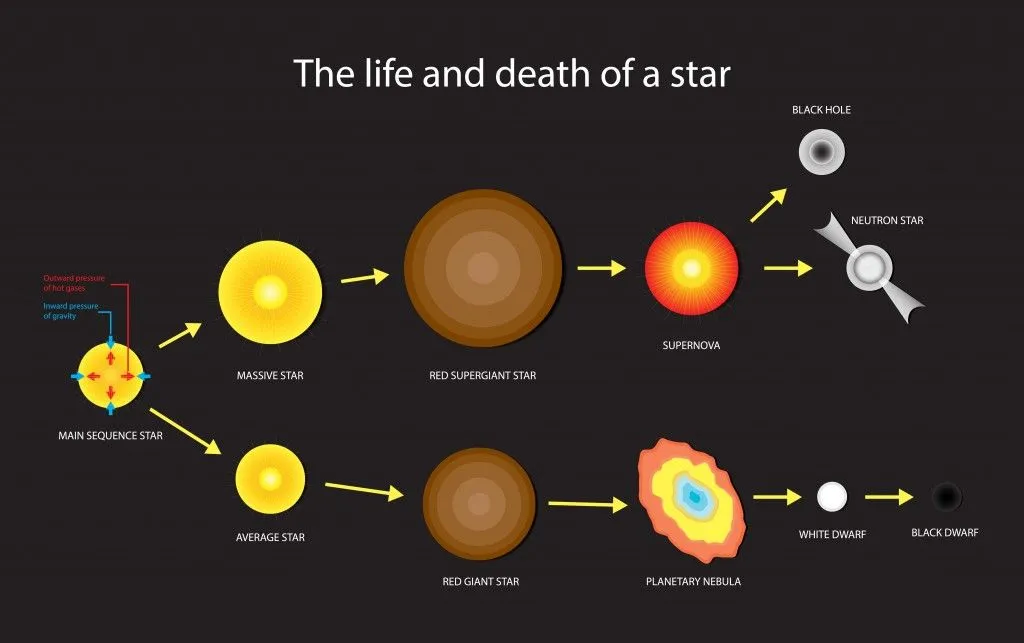
When stars with initial masses of roughly 0.5 to 8 M☉ (Solar mass) reach the end of their stellar evolution, they become white dwarfs. Stars heavier than about 8 M☉ generally end their lives as neutron stars or black holes instead, while objects below ~0.08 M☉ are brown dwarfs that never fuse hydrogen at all. The initial mass dictates the eventual composition of the white dwarf — the star sheds much of its original material as a planetary nebula before settling down. The different progenitor categories are as follows:
Stars With Very Low Mass
In the case of a main-sequence star with a mass less than 0.5 M☉, the helium does not fuse to its core because it doesn’t get hot enough. Such a white dwarf would take more time than the current age of the universe (approximately 13.8 billion years) to burn off all its hydrogen and become a blue dwarf.
Stars With Low To Medium Mass
The vast majority of observed white dwarfs belong to this category. Stars with masses ranging from 0.5 to 0.8 M☉ (much like our sun) have cores that become hot enough for helium to fuse into oxygen and carbon. This type of star goes through fusion reactions when it nears its end, but has a core made up of carbon and oxygen, which does not go through fusion reactions. The outer shell is hydrogen, which burns with an inner helium-burning shell. The star expels all of this exterior material, creating a planetary nebula and in turn creating the carbon-oxygen core white dwarfs.
A crucial property of white dwarfs is the Chandrasekhar limit — the maximum mass a white dwarf can sustain, approximately 1.4 solar masses (1.4 M☉). This limit, formulated by Indian-born astrophysicist Subrahmanyan Chandrasekhar in 1930, arises because electron degeneracy pressure can only support so much mass against gravitational collapse. If a white dwarf accretes matter from a companion star and exceeds this limit, it can undergo thermonuclear explosion as a Type Ia supernova — one of the brightest events in the universe. Type Ia supernovae are used as "standard candles" for measuring cosmic distances and were instrumental in the 1998 discovery that the universe's expansion is accelerating.
Will The Sun Become A White Dwarf?
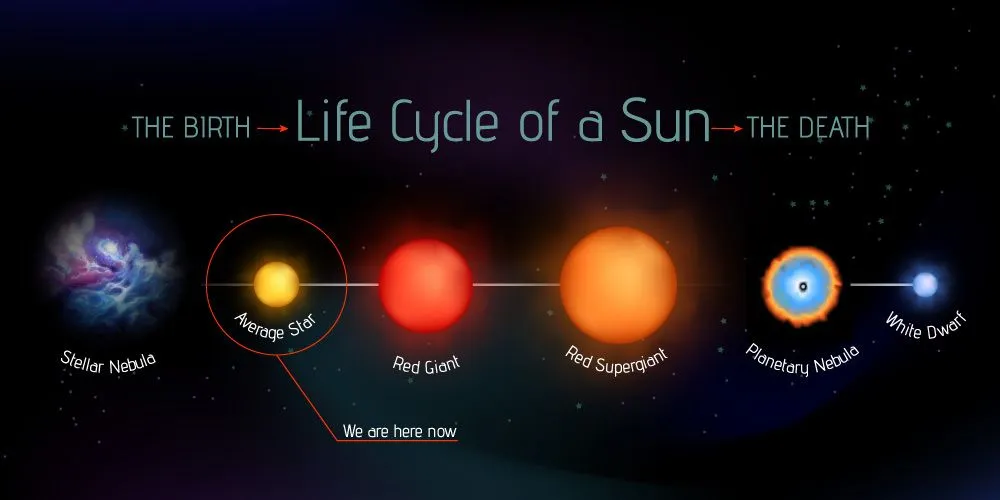
Yes, the Sun will eventually become a white dwarf, and we can be fairly specific about both the "when" and the "how". With a present mass of 1 M☉, our Sun sits comfortably inside the 0.5 to 8 M☉ range that ends life as a white dwarf, rather than as a neutron star or a black hole.
The timeline, very roughly, looks like this:
- Today (4.6 billion years old): hydrogen fusion in the core, business as usual. According to NASA, the Sun is a little less than halfway through its roughly 10-billion-year main-sequence lifetime.
- In about 5 billion years: the core runs out of hydrogen, fusion shifts to a shell around the core, and the Sun swells into a red giant. It expands so dramatically that it engulfs Mercury and Venus, and very possibly a heavily roasted Earth.
- About a billion years after that: helium fusion takes over in the core, producing carbon and oxygen, while the outer layers continue to puff outward and shed mass into space.
- Around 7 to 8 billion years from now: the bloated outer envelope is gently ejected as a planetary nebula, leaving behind the bare carbon-oxygen core.
- That bare core is the white dwarf, packing roughly 0.5 to 0.6 M☉ of the Sun's original mass into a sphere about the size of Earth.
So the Sun does not turn into a white dwarf overnight. The white dwarf is what remains after the Sun has finished its red giant phase and shed most of its outer mass into space. And no, the Sun is not a white dwarf right now. It is an ordinary main-sequence star with billions of stable years still ahead of it.
How Hot Is A White Dwarf, And What Is It Made Of?
The "white" in "white dwarf" is a clue. These stellar leftovers are extraordinarily hot at birth, with surface temperatures spanning from a few thousand kelvin in the coolest, oldest examples to over 100,000 K in the very youngest. Compare that to the Sun's surface, which sits at a relatively cool 5,778 K (5,505 °C / 9,941 °F), and you start to see why a freshly born white dwarf glows such a brilliant blue-white in spite of being so small.
And it stays hot for a very long time. With no fusion to replenish the heat, a white dwarf is essentially a giant cooling ember. It radiates away its stored thermal energy through a thin atmosphere of hydrogen or helium, taking billions of years to fade from blue-white through yellow to red.
What is actually inside? For most white dwarfs, the answer is a tightly packed mixture of carbon and oxygen, the ashes of helium fusion in the star's red giant phase. According to Britannica, this carbon-oxygen core is wrapped in a thin envelope of helium and, in most cases, an even thinner outer layer of hydrogen. Lower-mass white dwarfs (below about 0.5 M☉) may be composed mostly of helium, while higher-mass ones (above about 1.05 M☉) can have cores made of oxygen, neon, and magnesium.
The numbers that follow from squeezing a star into a planet are staggering:
- Mass: roughly that of the Sun (about 2 × 1030 kg), compressed into the volume of Earth.
- Density: on the order of 109 kg/m3, or roughly a million times the density of water. A single teaspoonful of white-dwarf matter would weigh about as much as a small car.
- Surface gravity: around 100,000 times Earth's. A 70 kg person would weigh the equivalent of roughly 7,000 tonnes if they could stand on its surface.
What keeps this dense ball from collapsing any further? Not heat, and not fusion, but a quantum-mechanical effect called electron degeneracy pressure. Electrons obey the Pauli exclusion principle, which forbids any two of them from occupying the same quantum state. Squeeze them tightly enough and they push back hard, propping the entire star up against the relentless inward pull of its own gravity. It is, in essence, quantum mechanics holding up a star.
What Color Is A White Dwarf?
Color, in stars, is a direct readout of surface temperature, and white dwarfs cover most of the visible spectrum across their very long lives. A freshly minted white dwarf, just emerging from the cast-off envelope of a dying red giant, can have a surface temperature above 100,000 K. At those extremes it glows a brilliant blue-white, similar to the flash of an arc weld. That stage is where the word "white" in "white dwarf" comes from: the first examples that astronomers identified (Sirius B and 40 Eridani B among them) are still hot enough to look white in a telescope.
As thermal energy leaks away, the surface cools, and the color shifts in a predictable sequence:
- Blue-white (above ~30,000 K): the youngest white dwarfs, glowing in the ultraviolet as well as the visible.
- White (~10,000 to 30,000 K): the range most observed white dwarfs fall into, and the source of their name.
- Yellow (~6,000 to 8,000 K): a Sun-like color, reached after several billion years of cooling.
- Orange to red (~3,000 to 5,000 K): the oldest and dimmest white dwarfs currently known, billions of years older still.
The coolest white dwarfs found so far sit at around 4,000 K. None has yet faded to true darkness, because, as NASA's Imagine the Universe explainer points out, the universe simply has not existed for long enough. That is also why "black dwarf" is, for now, a theoretical category rather than an observed one. Every white dwarf in the sky today still has at least some color, however faint.
What Happens After A White Dwarf? The Black Dwarf Endpoint
Once a white dwarf has settled into existence, it has nothing left to do but cool down. There is no fusion to keep going, no fuel to burn, no further collapse. The only available process is the slow leak of stored heat into space.
As a white dwarf cools, it shifts color in a predictable way. Newborns can glow at over 100,000 K and appear blue-white. They fade through white, then yellow, then orange, and finally red as the surface temperature drops over billions of years. Eventually, after a stretch of time that makes the current age of the universe look like a moment, a white dwarf dims to the point where it no longer emits meaningful visible light. At that point it becomes what astronomers call a black dwarf: cold, inert, and almost completely dark.
There is a catch, though: no black dwarf actually exists yet. The universe is only about 13.8 billion years old, while the time required for a white dwarf to fully cool into a black dwarf is estimated at roughly 1015 years (a quadrillion years, around 100,000 times the current age of the universe). So every white dwarf in the sky today, including the very first ones formed shortly after the cosmic dark ages ended, is still nowhere near the end of its cooling track.
A few interesting things happen along the way:
- The interior crystallizes. As the carbon-oxygen plasma inside a white dwarf cools below a critical temperature, it freezes into a crystalline lattice. ESA's Gaia mission confirmed this in 2019, spotting the tell-tale signature in hundreds of thousands of white dwarfs and validating a 50-year-old prediction that Sun-like stars turn solid after they die.
- Cooling slows dramatically over time. The hotter a white dwarf is, the faster it radiates. As it dims, each subsequent drop in temperature takes longer than the last, which is why the final stretch toward "black dwarf" status drags on for so absurdly long.
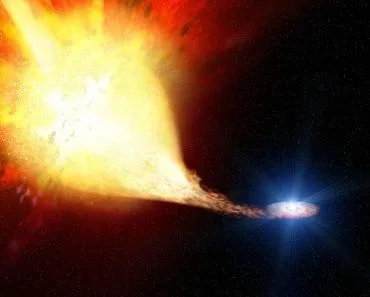
- A white dwarf with a close companion can short-circuit the whole process by siphoning material off its partner and exploding as a Type Ia supernova long before it ever finishes cooling.
So while "black dwarf" is the formal endpoint for an isolated white dwarf, in practice a white dwarf just sits there, glowing fainter and fainter, for a span of time so long that the present age of the universe is barely a flicker in comparison.
How Long Do White Dwarfs Last?
For practical purposes, a white dwarf lasts essentially forever. There is no fuel to run out of, no further collapse to fall into. The only thing left for it to do is slowly leak its stored heat into space.
That cooling unfolds over a span of time that is genuinely hard to put in human perspective. The best current estimate is that a typical white dwarf takes around 1015 years (a quadrillion) to cool from its blazing 100,000 K birth temperature down to a temperature so low that it stops emitting meaningful visible light, the theoretical "black dwarf" state. That is roughly 100,000 times the present age of the universe (13.8 billion years).
Because the universe is so young by comparison, no white dwarf has actually finished cooling. Even the very first ones, born not long after the first stars began to die some 13 billion years ago, are still glowing today, just very dimly.
Cooling is also not a steady process. It is rapid early on, when the surface is hottest and radiates most fiercely, and slows down dramatically as the temperature drops. Roughly speaking, the journey looks like this:
- First few hundred million years: the surface temperature drops from over 100,000 K down to a few tens of thousands of kelvin. The white dwarf glows blue-white and emits strongly in the ultraviolet.
- 1 to 5 billion years in: the surface cools below 10,000 K, the color drifts from white through yellow and toward orange.
- Beyond about 5 billion years: the interior starts to crystallize as the carbon-and-oxygen plasma freezes into a lattice. ESA's Gaia mission confirmed this freezing in 2019, validating a 50-year-old theoretical prediction.
- 1014 to 1015 years: the surface dims into the deep infrared and the star approaches its theoretical black-dwarf endpoint. No real example exists.
A close companion can short-circuit the whole sequence. If a white dwarf siphons gas off a binary partner and crosses the Chandrasekhar limit, it can detonate as a Type Ia supernova, ending its life in seconds rather than trillions of years. That is the fate currently expected for IK Pegasi B (see below), the nearest known supernova candidate to Earth.
So, in short: an isolated white dwarf effectively lasts for the rest of cosmic time. Its "death" is, in any meaningful sense, beyond the horizon of the observable universe's future.
Eventual Fate And Orbiting Planets
Even as a white dwarf cools quietly toward its eventual black dwarf state, the space around it is not always empty. Many white dwarfs are still tied to remnants of the planetary systems they were born with, and their long, slow afterlife can be surprisingly eventful.
While the extreme conditions around a white dwarf — tidal locking, prior red giant engulfment, and intense gravity — make habitability challenging, recent research has painted a more optimistic picture. A 2025 study found that certain rare white dwarfs undergoing neon-22 distillation can maintain stable habitable zones for up to 10 billion years — comparable to our Sun’s entire main-sequence lifetime. Researchers at the Florida Institute of Technology showed in 2025 that white dwarfs can power both photosynthesis and UV-driven abiogenesis simultaneously in their habitable zones.
In 2024, NASA’s James Webb Space Telescope (JWST) directly imaged candidate giant exoplanets orbiting white dwarfs for the first time — planets of 1-7 Jupiter masses at distances similar to Jupiter and Saturn in our own solar system. JWST also performed the first spectroscopy of a white dwarf debris disk and observed white dwarfs still actively consuming remnants of their planetary systems billions of years after formation. While no confirmed Earth-like planet has been found in a white dwarf habitable zone yet, the possibility is no longer considered implausible.
Famous White Dwarfs You Can Find
White dwarfs are common. Astronomers have cataloged hundreds of thousands of them in our galaxy. A handful, though, stand out for their proximity, their place in scientific history, or what they tell us about how stars actually die. Here are five worth knowing about.
Sirius B (8.6 light-years away, in Canis Major)
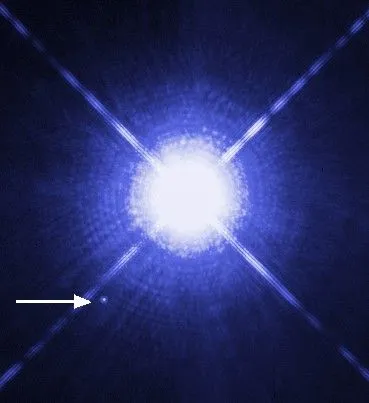
The closest known white dwarf, and the faint companion to Sirius A, the brightest star in our night sky. Friedrich Bessel predicted its existence in 1844 from a slight wobble in Sirius A's motion. It was directly observed in 1862 by American telescope-maker Alvan Graham Clark. With about 1 M☉ packed into a radius of only ~5,800 km (slightly smaller than Earth), Sirius B is the textbook example of degenerate matter.
Procyon B (11.5 light-years away, in Canis Minor)
The companion to Procyon, the eighth-brightest star in the sky. Procyon B is a faint DQZ-class white dwarf of about 0.6 M☉ and a radius of roughly 8,600 km. It is larger than Sirius B despite being similar in mass, an oddity that astronomers are still working to fully explain. Its existence was suspected by Bessel for the same reason as Sirius B, and it was visually confirmed in 1896.
40 Eridani B (16.3 light-years away, in Eridanus)
The first white dwarf ever spotted, observed by William Herschel on January 31, 1783. Its true nature as a stellar remnant was not recognized until 1910, when astronomers realized that a faint star could not be white unless it was very small. It sits in a triple-star system alongside a K-type main-sequence star (40 Eridani A) and a red dwarf (40 Eridani C). Of all known white dwarfs, this is the most accessible to amateur observers with a small telescope.
Van Maanen 2 (14.1 light-years away, in Pisces)
The closest known isolated white dwarf, with no stellar companion. It was discovered in 1917 by Dutch-American astronomer Adriaan van Maanen, and was the third white dwarf ever identified. At about 0.68 M☉ packed into just 1% of the Sun's radius, it is exceptionally compact. A 1917 spectroscopic plate of Van Maanen 2 was later reinterpreted as the earliest evidence of an exoplanetary system, with chemical signatures consistent with debris from a destroyed planet falling onto the star.
IK Pegasi B (154 light-years away, in Pegasus)
The nearest known Type Ia supernova candidate. IK Pegasi B is a massive white dwarf of about 1.15 M☉, uncomfortably close to the Chandrasekhar limit, in a binary with a sub-giant companion. As that companion eventually puffs up and dumps gas onto IK Pegasi B, the white dwarf is expected to cross the limit and detonate. Astronomers do not expect this for at least another 1.9 billion years, by which point the system will also have drifted considerably farther from Earth.
References (click to expand)
- White dwarf star. Encyclopaedia Britannica.
- Types of Stars. NASA Science.
- Types of Stars. NASA Science.
- Table 1. Mapping of TT spectral types and tt subtypes. The Space Telescope Science Institute
- White Dwarfs - Imagine the Universe! - NASA. The National Aeronautics and Space Administration
- Chandrasekhar limit. Britannica.
- JWST makes rare detection of 2 exoplanets orbiting dead stars. Space.com (2024).
- White dwarf stars could create long-lived habitable zones. Phys.org (2025).
- Study reveals white dwarfs could host life-supporting planets. Phys.org (2025).
- Sun: Facts. NASA Science.
- Gaia reveals how Sun-like stars turn solid after their demise. European Space Agency (2019).
- Sirius B. Chandra X-ray Observatory.
- Procyon. Wikipedia.
- 40 Eridani. Wikipedia.
- Overlooked Treasure: The First Evidence of Exoplanets. NASA JPL.
- Van Maanen 2. Wikipedia.
- IK Pegasi. Wikipedia.