Table of Contents (click to expand)
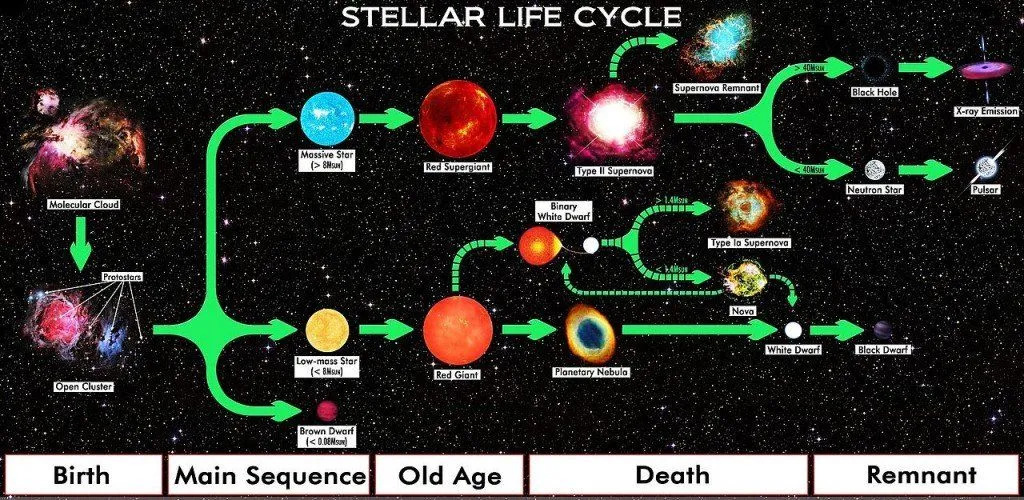
A star forms when gas in a nebula collapses under gravity until its core is hot enough to fuse hydrogen, beginning the long main-sequence stage (roughly 10 billion years for the Sun). When the core's hydrogen runs out, the star swells into a red giant or supergiant and dies: low-mass stars leave a white dwarf, while massive stars explode as supernovae, leaving a neutron star or black hole.
Stars are one of the most unique celestial objects in the Universe, even though there are trillions of them out there! They are self-luminous and usually made of hot plasma bound together by a powerful gravitational force. A star shines brightly due to the thermonuclear reaction occurring in its core between hydrogen and helium. The brightness of stars is not always the same and varies according to the what stage of the star’s evolution it is at.
Now, let’s take a closer look at stellar evolution.
Stellar Evolution
The birth of a star occurs when nebulous clouds of hydrogen and helium gas coalesce under the force of gravity. A shockwave from a nearby supernova is often required to start the gases congregating together and becoming denser. Star formation usually occurs in gaseous nebulae, where the density of the nebula is great enough for hydrogen atoms to chemically bond to form molecular hydrogen. Nebulae are often called “stellar nurseries” because they contain enough material to produce several million stars, which leads to the formation of star clusters.
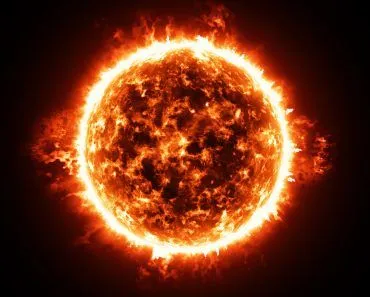
The dense packets of the gas contract further, due to gravity, while accumulating more material from the cloud. The contraction heats the material, causing an outward pressure that slows down the rate of gravitational contraction. This state of balance is known as hydrostatic equilibrium. Contraction comes to a complete stop when the core of a protostar (the name often given to a young star) becomes hot enough for hydrogen to fuse, a process known as nuclear fusion. At this stage, the protostar becomes what is known as a main sequence star, and it spends the bulk of its life here. The Sun, an average main sequence star, has been fusing hydrogen for about 4.6 billion years and has roughly 5 billion years left before it runs low on core hydrogen.
Hydrogen gas is what predominantly burns inside stars. It is the simplest form of an atom, containing one positively charged particle (the proton) and one negatively charged particle (the electron) orbiting around it. These stars can act as a stellar furnace, causing the remaining hydrogen atoms to smash into one another. At core temperatures above roughly 10 million °C (the Sun’s core runs at about 15 million °C), the nuclei fuse to form helium (4He). During fusion, some of the protons are converted into neutral particles called neutrons, in a process called radioactive decay (beta decay). The energy released during fusion heats the star further, causing even more protons to fuse. Nuclear fusion continues in this sustainable fashion for anywhere from a few million to many billions of years, in some low-mass stars far longer than the current 13.8-billion-year age of the universe.
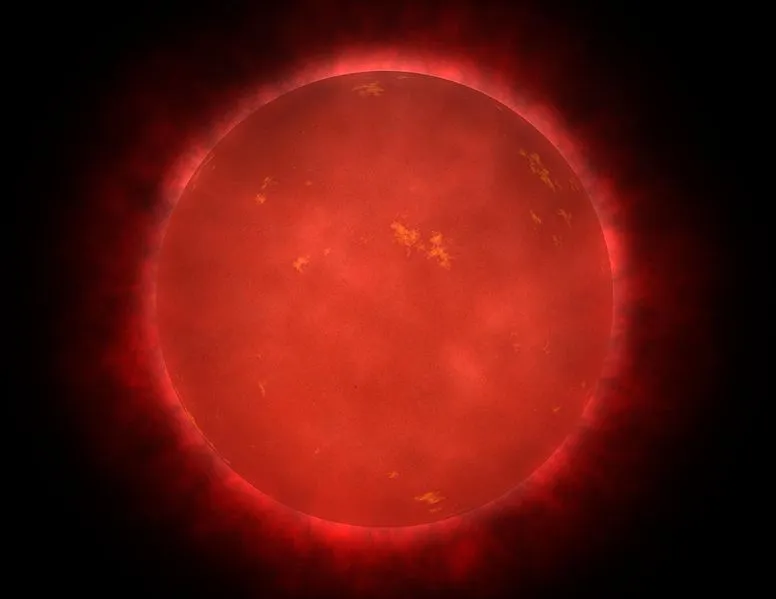
Contrary to expectations, the smallest stars, called red dwarfs, actually live the longest, with main sequence lifetimes estimated at up to about 10 trillion years (far longer than the current 13.8-billion-year age of the universe). Despite having more hydrogen fuel, massive stars (giants, supergiants and hypergiants) burn through their supply quickly because the stellar core is hotter and under much greater pressure from the weight of its outer layers. Smaller stars also make more efficient use of their fuel, as it is circulated throughout the volume of the star via convective heat transport. In stars massive enough to heat their cores past about 100 million °C, the helium produced in nuclear fusion reactions begins to fuse into heavier elements, building up carbon, oxygen and neon; each successive step demands a still hotter core, and only the most massive stars climb all the way to iron. Elements heavier than iron, such as lead, gold and uranium, may be formed by the rapid absorption of neutrons, which then beta decay into protons. This is called the r-process, short for the `rapid neutron capture’ process, which is believed to occur in the violent event of a supernova.
Neutron Stars And Blackholes
Stars eventually run out of material to burn. This first occurs in the star’s core, which is the most massive part of the star. The core begins to gravitationally collapse, creating extreme pressures and temperatures. The heat generated by the core triggers fusion in the outer layers of the star, where hydrogen fuel remains. As a result, these outer layers expand to dissipate the heat being generated, becoming massive and highly luminous. This is called the “red giant phase”. Stars smaller than about 0.5 solar masses skip the red giant phase, as they cannot become hot enough. In a Sun-like star, the contraction of the stellar core gently sheds the bloated outer layers of the star, which drift away as a glowing planetary nebula. The core stops contracting once the density reaches a point where stellar electrons are prevented from moving any closer together. This physical law is called the Pauli Exclusion Principle. The core remains in this electron-degenerate state called a white dwarf, gradually cooling over many billions of years to become a black dwarf. Electron degeneracy pressure can only support a white dwarf up to about 1.4 times the mass of the Sun, a ceiling known as the Chandrasekhar limit, after the physicist Subrahmanyan Chandrasekhar who calculated it in 1930. Stars that begin life below roughly 8 solar masses end up here, which is why the Sun is destined to become a white dwarf.
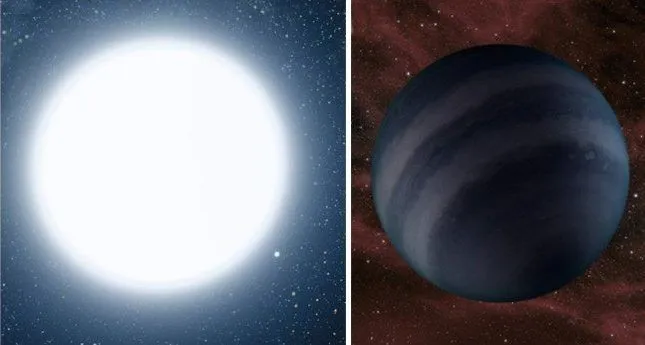
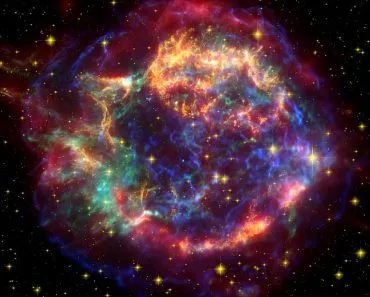
Stars that start out heavier than roughly 8 solar masses meet a far more violent end. Their cores keep fusing elements until they build an inert iron core, which cannot release energy through fusion. When that core exceeds the Chandrasekhar limit, it collapses in a fraction of a second and the outer layers rebound in a titanic explosion called a supernova, briefly outshining an entire galaxy.
What the core leaves behind depends on its mass. If the collapsing core settles below about 3 solar masses (a ceiling called the Tolman-Oppenheimer-Volkoff limit), neutron degeneracy pressure halts the collapse and the result is a neutron star, a city-sized object so dense that a teaspoon of its material would weigh billions of tons. If the core is heavier than that, not even neutron degeneracy pressure can resist gravity, and the collapse continues without limit, forming a black hole. In practice, stars born with more than about 20 solar masses are the ones most likely to end as black holes.