Table of Contents (click to expand)
Ceres is the largest body in the asteroid belt between Mars and Jupiter, and the only dwarf planet in the inner solar system. About 940 km (584 mi) across, it is rich in water ice and hides a salty subsurface reservoir, making it a key target in the search for past life.
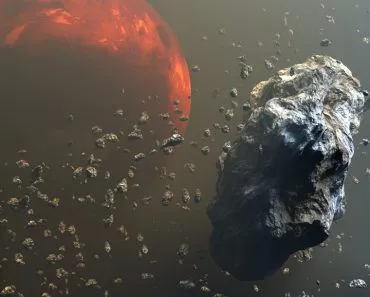
The space between Mars and Jupiter is peculiar; it is inhabited by a large swath of asteroids, dwarf planets and other celestial objects. This ring of celestial bodies is called the Asteroid Belt and consists of about 0.7 to 1.7 million celestial bodies with a diameter of more than 1 km (0.6 mi). Surprisingly, the total mass of all bodies in the asteroid belt is only about 4% of the Moon’s mass.
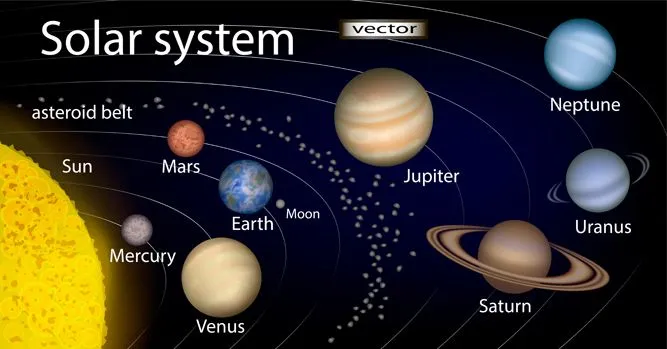
The largest body in this belt is also the only dwarf planet lying within the orbit of Neptune: a dwarf planet named Ceres. Recent missions by NASA have made it possible to learn a lot more about this rocky dwarf, a celestial body that was once considered to be a legitimate solar system planet.
Discovery And Classification
Ceres: A Comet?
The first theorization of this planet lying between the orbits of Mars and Jupiter dates back to 1772 by Johann Elert Bode, but it wasn’t until 1801 that the Italian Catholic priest Giuseppe Piazzi formally discovered Ceres. Initially, Piazzi theorized the discovery as a comet, but later realized that the object could be something much bigger as the movement was slow and uniform.
Due to an illness, however, the position of the newly discovered celestial body was lost to Piazzi and Ceres had orbited itself in front of the Sun, which made its rediscovery quite difficult. An efficient method was devised by Carl Friedrich Gauss, a German mathematician in correspondence with Piazzi, to track it down again; Ceres was recovered in a matter of weeks.
Ceres: An Asteroid?
Ceres gets its name from the Roman Goddess of Agriculture – Cerere, a name proposed by Piazzi himself. Ceres has seen itself categorized into various classes of celestial objects from time to time, as it was initially categorized as a planet. During the 1860s, the difference between asteroids and planets was accepted, and Ceres was dethroned from its planetary throne.
Ceres: A Dwarf Planet?
It wasn’t until 2006 that Ceres earned the title it still holds today, the ‘dwarf planet’. Suggested by the International Astronomical Union, new guidelines for what constitutes a ‘planet’ were passed. This criterion requires a celestial body to be the following to be considered a planet:
- Has enough mass to overcome forces to reach a hydrostatic equilibrium, making it nearly round in shape.
- It should orbit a star and shouldn’t be a star itself, while also not being a satellite of another planet.
- It should clear its neighborhood of its orbit and should be the dominant body in its orbit.
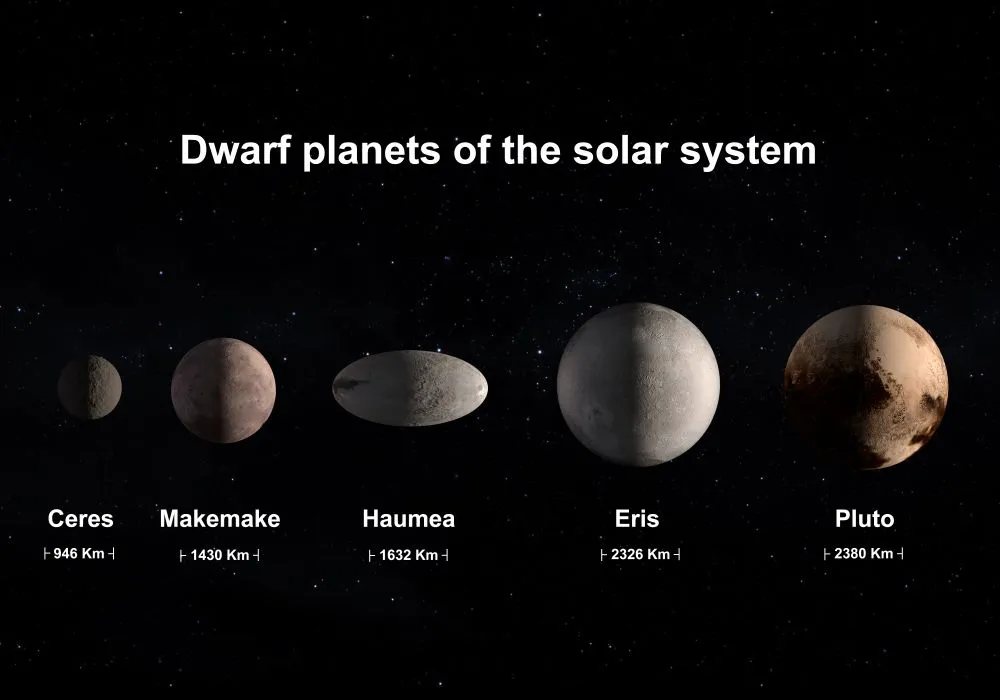
Although Ceres clears the first two criteria, it fails to clear its orbit and is not the dominant body, as it shares the orbit with many other asteroids. This makes Ceres fall into the second category, as a dwarf planet. Ceres shares this category with other famous dwarfs in our solar system, including Pluto, Eris, Makemake, Haumea, etc.
Characteristics And Formation Of Ceres
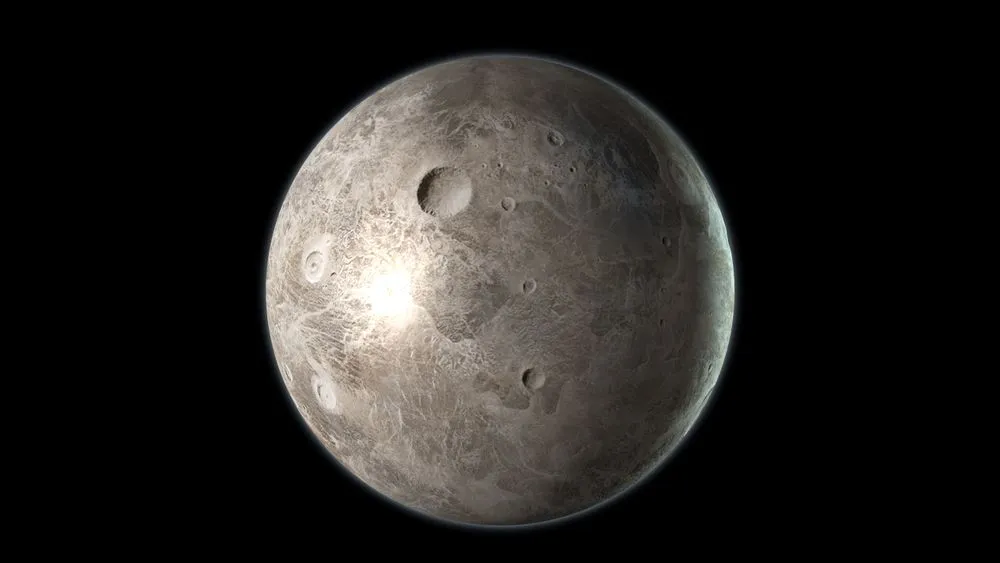
Ceres is one of the most water-rich celestial objects in the inner solar system; in fact, NASA notes that if as much as 25% of Ceres is water, then it holds more water than Earth does. Ceres has a mean radius of around 296 miles (476 km), and water (locked up mostly as ice) is available in large quantities. It is quite small; for example, if Earth were the size of a nickel, Ceres would be a small poppy seed. Ceres orbits 2.8 AU (Astronomical Units, where 1 AU = the distance of the Earth from the Sun) from the Sun, and sunlight takes roughly 23 minutes to reach it. It takes 1,682 Earth days to complete one orbit around the Sun, which is roughly 4.6 Earth years. The length of its day, however, is much shorter than Earth’s, as it completes one rotation in just over 9 hours. Ceres has no moons orbiting it and also exists without any rings.
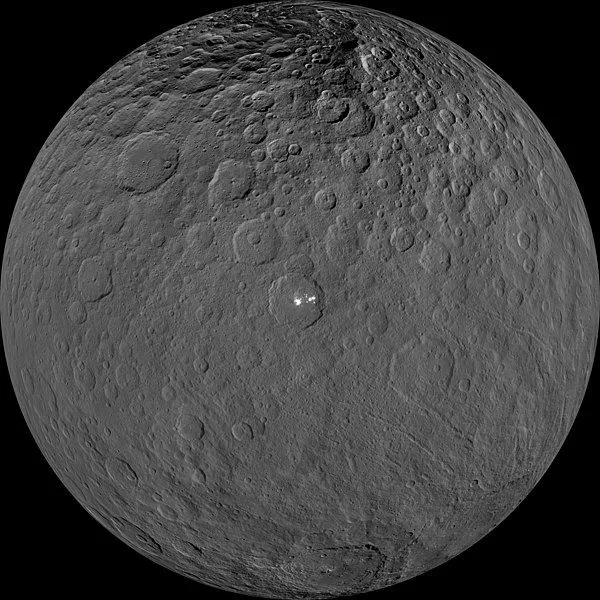
Ceres originated with the rest of the Solar system sometime around 4.5 billion years ago, and is likely to have been formed and then migrated in from the giant planar orbits of Jupiter and Saturn; it finally reached the asteroid belt around 4 billion years ago. It is called an “embryonic planet” because it didn’t quite finish its formation. This formation was prevented by the massive gravity exerted by Jupiter at the time of its origination. Ceres has an icy mantle and a solid core with as much as 25% of its composition being water.
Dawn Sheds Light On Ceres
The Dawn space mission was intended to explore the asteroid belt and visit the two biggest celestial objects of that region, Vesta and Ceres. The spacecraft was launched in 2007, studying Vesta first and then arriving at Ceres, where it slipped into orbit on March 6, 2015. It reached its first dedicated science orbit, at an altitude of about 13,500 km (8,400 mi) above the surface, on April 23, 2015.
Dawn provided in-depth information about the dwarf planet as it orbited Ceres from March 2015 until it ran out of fuel and fell silent in late October 2018. It circled the planet at progressively lower altitudes, mapping the craters, formations and poles of the dwarf planet, and became the first mission to orbit a dwarf planet.
The atmosphere of Ceres is very thin and contains evidence of water vapor within it. This is likely due to vapor production by ice volcanoes or the sublimation (the transition from solid to gas without going through a liquid phase) of surface ice. Ceres also lacks a global magnetic field.
The surface of Ceres is covered with countless craters, but they are relatively small. The craters are no larger than 175 miles (280 km) wide, which is odd, as the planet is housed in the asteroid belt and would have been hit by many large celestial objects over its 4.5 billion years of existence. This relative lack of impact damage might be due to the icy terrain below the surface, as it would have evened out the large depressions, or perhaps ice volcanoes removed or covered up the craters created by large asteroids.
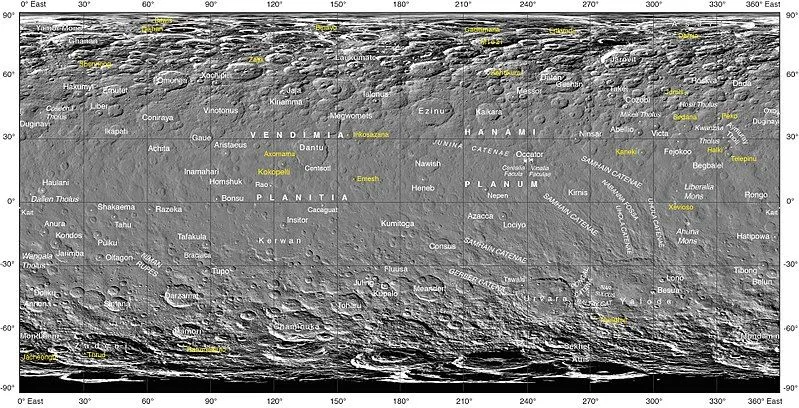
The crust of Ceres is rocky and laced with salts, but these are unlike regular table salt (sodium chloride). One of Dawn’s most striking discoveries was a cluster of dazzlingly bright spots inside the 92 km (57 mi) wide Occator crater. After analyzing them in detail, scientists reported in 2020 that these faculae are mostly sodium carbonate (a soda-ash type salt), left behind when briny water rose up through fractures and evaporated. The brine appears to come from a reservoir of salty water roughly 40 km (25 mi) deep and hundreds of kilometers wide, and because the salts still hold water, the liquid must have reached the surface in the geologically recent past, meaning Ceres may still be an active, evolving world rather than a dead rock.
Exploration For Life At Ceres
Ceres is a peculiar hunting ground for life in space, as it contains huge amounts of water, which would be essential for life to evolve, based on what we know of Earth-based life. The case grew stronger in 2017, when Dawn detected organic (carbon-based) molecules near the Ernutet crater, the kind of carbon chemistry that life relies on. Combined with a salty subsurface reservoir, that means Ceres has water, organics and a source of chemical energy, so it is at least possible that Ceres could have harbored simple life, although any such conditions would likely only suit tiny microbes.
Future landed missions to Ceres would provide a much better understanding of the possibility for life on this icy dwarf!
References (click to expand)
- Combe, J.-P., Singh, S., Johnson, K. E., McCord, T. B., De Sanctis, M. C., Ammannito, E., … Russell, C. T. (2019, January). The surface composition of Ceres’ Ezinu quadrangle analyzed by the Dawn mission. Icarus. Elsevier BV.
- Dawn at Ceres.
- Ceres: Facts.
- Mystery Solved: Bright Areas on Ceres Come From Salty Water Below. NASA/JPL.
- Raymond, C. A., et al. (2020). Impact-driven mobilization of deep crustal brines on dwarf planet Ceres. Nature Astronomy.
- Organic Material on Ceres: Insights from Visible and Infrared Space Observations. Life (MDPI), via NCBI PMC.