Table of Contents (click to expand)
- Is The Moon Moving Away From Earth?
- What Will Happen To Earth’s Tides If The Moon Goes Away?
- How Fast Is The Moon Drifting Away, And How Far Has It Gone?
- What Would Tides Be Like With No Moon At All?
- What If The Moon Were Bigger, Closer, Or Farther Away?
- Why We Don’t Need To Worry About The Moon Running Away
The moon is drifting away from Earth at about 3.8 cm per year, weakening lunar tides over geologic time. After roughly 50 billion years, Earth would tidally lock to the moon, so lunar tides would freeze in place (solar tides would still occur). But this never plays out, because the Sun will swell into a red giant and likely engulf the Earth-Moon system around 7.6 billion years from now.
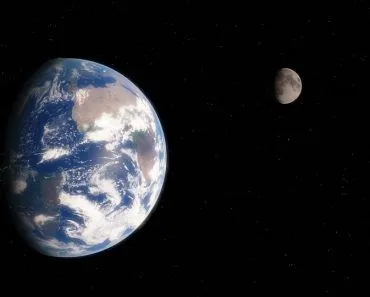
Our natural satellite – the moon – has been revolving around our home planet ever since it was first created nearly 4.51 billion years ago. The circular motion of the moon in its orbit not only gives us a glowing grey sphere that appears in our night sky, but also causes some fascinating phenomena on the surface of our planet.
One of them is tidal motion!
For those who don’t know about this, the tides that you witness in seas and oceans are all caused by the moon. This is due to the gravitational pull that the moon exerts on our planet (also called “tidal force”). This force causes Earth and all the water on its surface to ‘bulge out’ to the side that’s closest to the moon.
Is The Moon Moving Away From Earth?
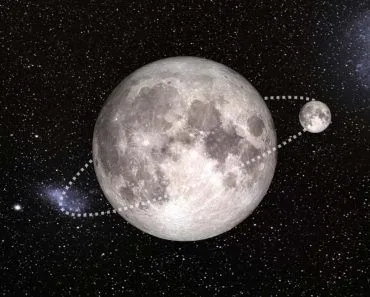
Yes, and it has been ever since it formed. Lunar Laser Ranging measurements (using mirrors left on the moon by the Apollo astronauts) show that the moon is receding from Earth at about 3.8 cm (1.5 inches) per year.
Here’s why that happens: Earth spins on its axis much faster than the moon orbits Earth. That mismatch drags the tidal bulges in Earth’s oceans slightly ahead of the moon’s position. The leading bulge’s gravity gives the moon a tiny forward tug, handing it some of Earth’s rotational angular momentum each year. The moon climbs into a larger orbit, and counter-intuitively, its orbital speed actually decreases as it does (Kepler’s third law). Meanwhile, Earth’s spin slowly grinds down.
While 3.8 centimeters per year doesn’t sound like much, over a period of many years (we’re talking billions), this value accumulates and becomes very significant.
Let’s assume that the moon’s orbit gets so big that it leaves the vicinity of Earth completely… what will happen to our planet’s tides then?
What Will Happen To Earth’s Tides If The Moon Goes Away?
It’s not quite as straightforward as it sounds. The moon won’t escape Earth’s orbit; the recession slows down and eventually stops at an equilibrium called mutual tidal locking. At the current rate, scientists predict that in around 50 billion years, Earth will have slowed its rotation enough that a single Earth day equals one lunar orbit (about 47 of today’s days long), and the moon will stop moving away (Wikipedia, Tidal locking).
At that point, the moon would still raise a tidal bulge on Earth, but because the same face of Earth would always point at the moon, that bulge would be fixed in place. Coastlines would no longer see daily lunar tides sweeping in and out. Solar tides (which are about 46% as strong as lunar tides) would still continue, though, because Earth is nowhere near tidally locking to the sun.
In other words, in 50 billion years or so, lunar tides would freeze in place; only weaker solar tides would still ebb and flow.
How Fast Is The Moon Drifting Away, And How Far Has It Gone?
The headline figure is 3.8 cm (about 1.5 inches) per year. We know it that precisely thanks to the Lunar Laser Ranging experiment, which has been running since the Apollo 11 astronauts left a reflector array on the Moon in 1969. By firing a laser pulse at those mirrors and timing the round trip, observatories can pin down the Earth-Moon distance (an average of about 385,000 km, or 239,000 mi) to within roughly 3 cm. Watching that distance creep upward year after year is how the recession rate was nailed down.

Three and a bit centimeters a year sounds trivial, but run the clock the other way and it adds up dramatically. The Moon used to be much closer, Earth used to spin much faster, and our days were far shorter. Using rhythmic patterns locked into ancient rocks, a 2018 study in the Proceedings of the National Academy of Sciences by Stephen Meyers and Alberto Malinverno reconstructed that a day on Earth lasted just over 18 hours about 1.4 billion years ago. Independent tidal rhythmites (layered tidal sediments) place the Earth-Moon separation at roughly 70% of today's value some 3.2 billion years ago, when a day ran around 13 hours.
Why does the Moon sliding outward make our days longer? Meyers put it neatly: "As the Moon moves away, the Earth is like a spinning figure skater who slows down as they stretch their arms out." The same exchange of angular momentum that pushes the Moon into a wider orbit is quietly applying the brakes to Earth's rotation. One important caveat: you cannot simply rewind the present 3.8 cm/year rate forever. Doing so naively would crash the Moon into Earth only about 1.5 billion years ago, which is impossible given that the Moon is roughly 4.5 billion years old. The rate has varied over geologic time as continents and ocean basins reshaped how tides slosh around, so the modern figure is a snapshot, not a constant. (We have a related read on what would happen if Earth's rotation sped up instead.)
What Would Tides Be Like With No Moon At All?
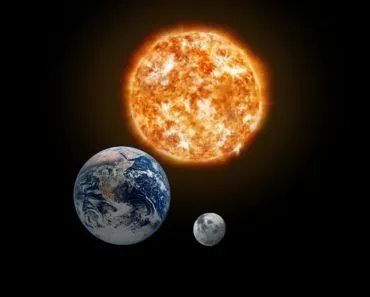
Imagine the Moon vanished tomorrow. Would the oceans simply go flat? No. The Sun raises tides too, and it always has. According to NOAA, solar tides are about half as large as lunar tides (the Sun's tide-generating force is roughly 0.46 times the Moon's). So with no Moon, the daily rise and fall would not disappear, but the average tidal range would shrink to roughly half of what coastlines see today.

The bigger change would be the loss of the spring and neap rhythm. Right now, twice a month the Sun, Moon and Earth line up (at new and full Moon) and the solar tide adds to the lunar tide, producing extra-high spring tides. A week later, with the Sun and Moon pulling at right angles, the solar bulge partly cancels the lunar one, giving us gentler neap tides. Strip the Moon out of the picture and that monthly variation vanishes. What's left is a steadier, weaker solar tide tied to the daily march of the Sun across the sky, with a small seasonal swing as Earth nears and recedes from the Sun. The dramatic spring tides that fill estuaries and the Bay of Fundy would be a thing of the past.
It is worth noting that even bodies of water without a direct connection to the open ocean feel these forces, which is why some large lakes show measurable tides of their own.
What If The Moon Were Bigger, Closer, Or Farther Away?
Plenty of readers ask the flip side of this question: not "what if the Moon left," but "what if it were more massive or sat at a different distance?" The physics gives a clean answer. A tide-generating force does not scale with simple gravity. It is proportional to the tide-raiser's mass and, crucially, to the inverse cube of the distance (mass / distance3), because tides come from the difference in pull across Earth's diameter rather than the pull itself.

So double the Moon's mass while keeping it where it is, and the tidal bulge roughly doubles. Distance is where it gets dramatic. Because of that cube, moving the Moon twice as far away would cut its tidal pull to one-eighth (23 = 8). That same inverse-cube rule is exactly why the Sun, despite being about 27 million times more massive than the Moon, raises only half the tide: it sits roughly 390 times farther away, and 3903 is nearly 59 million, which almost entirely erases its mass advantage. It is also why a so-called supermoon, when the Moon is at its closest approach, nudges tides slightly higher: a small drop in distance counts triple. So as the Moon slowly recedes over the eons, this is the dial that turns: every extra centimeter of distance very gradually weakens the tides it raises.
Why We Don’t Need To Worry About The Moon Running Away
Although the loss of lunar tides would certainly be a terrible thing, we don’t really need to worry about that, as there are other things at play too.
The sun will exhaust its core hydrogen in roughly 5 billion years and begin its red giant phase. Current models (Schröder & Smith, 2008) predict it will swell enough to engulf both Earth and the moon around 7.6 billion years from now (Schröder & Smith, MNRAS). And long before that (within about a billion years from now), rising solar luminosity is expected to boil off Earth’s oceans and end surface life as we know it.
The sun keeps burning due to a process called nuclear fusion, which is perpetually occurring inside its core. Consider this: the sun burns through 600 million tons of hydrogen every second. That’s how incredibly extensive the fusion process inside the sun truly is. You can read more about it in detail here: What happens inside the sun?
As the nuclear fusion inside the sun’s core progresses, the sun gets nearly 10% brighter every billion years. This would, in due time, wreak havoc on our planet: boil Earth’s oceans, melt the ice caps that are left, strip away the atmosphere… you name it. The moon won’t be spared either.
In a nutshell, if the moon gets away from Earth, there will be no tides on the planet. But long before that happens, it’s far more likely that both of these celestial bodies will be gobbled up by the sun!
References (click to expand)
- Tides and Gravitational Locking. The University of Rochester
- What Causes the Earth-Moon Gravitational Tidal Lock?. NRAO
- Tidal locking. Wikipedia
- Lunar Laser Ranging experiments. Wikipedia
- Schröder & Smith (2008). Distant future of the Sun and Earth revisited. MNRAS
- Tidally locked exoplanets may be more common than .... University of Washington
- Measuring the Moon's Distance. NASA Goddard Space Flight Center
- Thank the Moon for Earth's lengthening day (Meyers & Malinverno, PNAS 2018). University of Wisconsin-Madison
- What Causes Tides? NOAA National Ocean Service
- Tidal Variations - The Influence of Position and Distance. NOAA National Ocean Service
- What are spring and neap tides? NOAA National Ocean Service