Table of Contents (click to expand)
The Moon cannot support life because it has almost no atmosphere, no magnetic field, no liquid surface water, and surface temperatures that swing from around −170 °C at night to +120 °C in the day. Its weak gravity (about one-sixth of Earth's) can't hold onto a thick atmosphere, and constant solar and cosmic radiation would sterilize any organism living on its surface.
Without any atmosphere, or the ability to create one, the moon cannot provide the basic conditions for life to develop.
When you stare up into the night sky, it’s hard to miss the brightest object and our closest celestial neighbor – the moon. It has fascinated humans for thousands of years, was worshipped as a god in the past, and has inspired countless generations to wonder whether alien life may be waiting for us on our doorstep. However, with the advent of space travel, the six successful Apollo crewed lunar landings (Apollo 11, 12, 14, 15, 16, and 17, between 1969 and 1972), and our improved ability to learn about the composition of celestial bodies from Earth, we now know that the moon cannot and never has supported life.
The question, therefore, is why does the Moon contain no signs of life?
What Is The Moon?
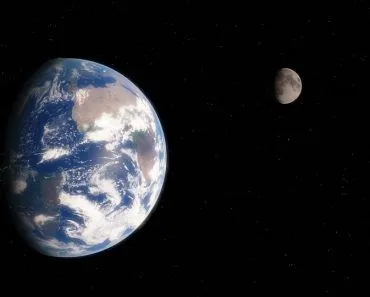
The moon is our planet’s natural satellite, orbiting Earth every 27.3 days and rotating on its own axis every 27 days. Interestingly enough, this similarity in its rotation and orbit means that the same side of the moon always faces Earth, a phenomenon called synchronous rotation. The moon is roughly 27% the size of the Earth, with a diameter of 3,474 kilometers.
There is some debate about how the moon was formed, but the prevailing theory is the giant-impact theory, which argues that in the early days of our planet’s formation, before any life had developed, another planetary body the size of Mars crashed into the young Earth, jettisoning billions of tons of elemental material into the orbit around the planet. There was so much debris that gravity was able to form and pull it together, forming what we know today as the moon. Since that point, the Moon’s orbit has regularized around our planet, so accurately that we base our calendar progression off its changing phases.
However, while the moon often feels like another planet, a moon is very different than a planetary body. The most basic difference is that a planet orbits a star, whereas a moon orbits a planet. Furthermore, in the case of Earth and its moon, the composition of the planet is different. At the center of the Earth is a dense core of heavy metals, which creates a magnetic field and a strong gravitational pull, which enables the planet to retain an atmosphere. Without our atmosphere, none of us would be here today, nor would you be reading this article!
Does The Moon Have An Atmosphere?
As mentioned above, the moon does not have the same composition as the Earth, and while some of the elements present on the moon are the same, this is likely because of the moon’s formation (the Giant-Impact Theory). In general, this difference in composition means that the moon cannot have an atmosphere because it is not geologically active. Without the release or production of gases in the core of a planetary body or moon, an atmosphere would be unable to form – atmospheres don’t happen spontaneously!
Furthermore, even if those gases were to be produced or released, the low gravity of the moon would make it difficult to hold onto those molecules. For a molecule to be released into the emptiness of space, they need to exceed the escape velocity of the planet or moon. When the sun strikes these molecules, it energizes them, and if they are moving fast enough to overcome the pull of gravity, they will escape.
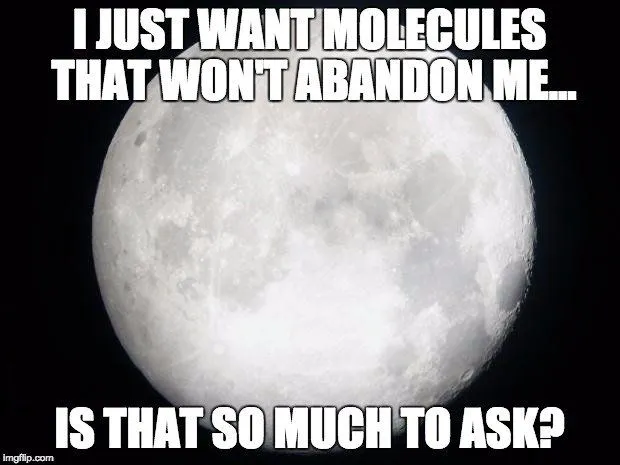
In the case of Earth’s moon, any light molecules present there would be immediately energized by the sun, due to Earth’s proximity to our star, and those molecules would escape into the emptiness of space, making the formation of an atmosphere next to impossible.
That being said, some heavy molecules are present on the surface of the moon, forming what is commonly known as an exosphere. It is extremely low in density, trillions of times less concentrated than the atmospheric molecules on Earth, but heavy molecules can be found bouncing around the surface of the moon. This is far different than an atmosphere, but there are some molecules found on our orbiting neighbor.
Is Life Impossible On The Moon?
Without an atmosphere, there is no chance for the formation of the kind of complex molecules required for life as we know it. When astronomers peer at distant exoplanets and moons, the very first thing they look for is water, or the possibility that water once existed there. Our understanding of life is Earth-centric, and water was integral to the development of life here. The Moon, however, is not entirely dry. Missions such as Chandrayaan-1 (2008) and NASA's LRO/LCROSS (2009) confirmed hydroxyl and water ice in the Moon's permanently shadowed polar craters, and India's Chandrayaan-3 Vikram lander touched down near the lunar south pole in August 2023, with its Pragyan rover detecting sulfur in the regolith. But “water somewhere on the surface” is a very long way from “liquid water available to biochemistry.”
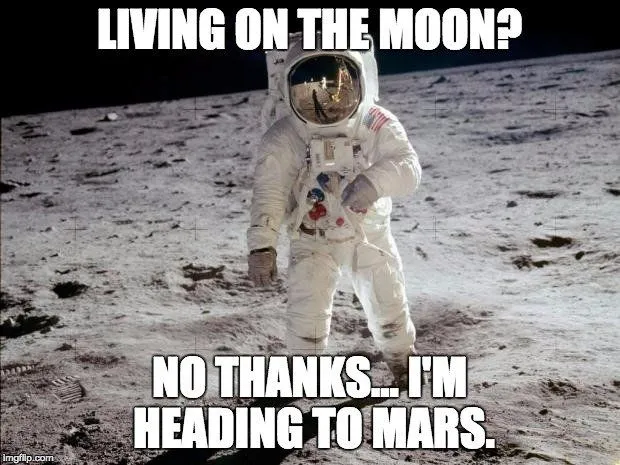
Given its history of formation, lack of an atmosphere, and classification as a “dead” rock (no plate tectonics, no volcanism), there is no feasible way for native life to develop and prosper on the Moon. That doesn't mean no life will ever be there. NASA's Artemis program is targeting a crewed return to the lunar surface (Artemis III, currently scheduled for the mid-2020s), and several space agencies are working on long-term habitats near the south pole. Any life on the Moon, however, would be life we brought with us, not something native.
One of the toughest organisms known is the tardigrade, also called the water bear, a microscopic creature found everywhere from Himalayan glaciers to deep-sea sediments. Tardigrades can survive temperature extremes, near-total dehydration, ionizing radiation, and even brief exposure to the vacuum of space. They are not, however, the only organism known to survive vacuum: bacterial spores (such as Bacillus subtilis), the lichen Xanthoria elegans, and certain seeds have also been shown to survive in low Earth orbit on dedicated experiments.
In the famous TARDIS experiment (Tardigrades in Space, 2007), researchers placed tardigrades on the outside of the European Space Agency’s FOTON-M3 satellite for about 10 days. Around 68% of the species Richtersius coronifer survived pure space vacuum, but survival dropped sharply when the animals were also exposed to unfiltered solar UV radiation (down to roughly 15% for UV-B, and almost none for the full UV-A+B). Either way, the experiment confirmed that some life can endure brief stints in space, thanks to a clever “stasis” or desiccation (cryptobiosis) strategy.
So when it comes to life potentially surviving on the Moon, tardigrades and a handful of other extremophiles are the only creatures who might pull it off, at least for short periods, and only as far as we currently know.