Table of Contents (click to expand)
Astronomers find Enceladus fascinating because this small, icy moon of Saturn hides a global, salty ocean beneath its frozen shell. Geyser-like plumes erupt from its south pole, and Cassini found they contain water, organic molecules, methane, molecular hydrogen, and phosphates, signs of possible hydrothermal vents and a potentially habitable environment.
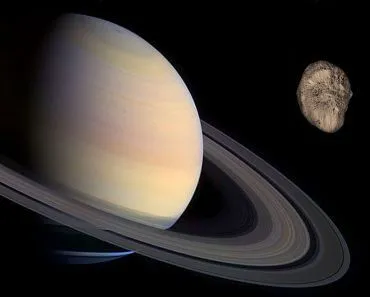
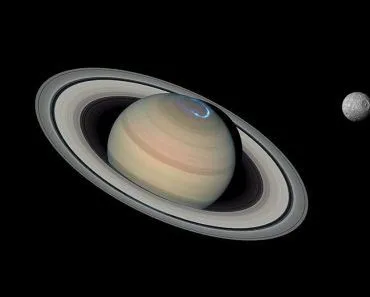
Enceladus is Saturn’s sixth-largest moon, measuring just 500 kilometers (310 miles) across, a tiny world among the 274 moons that the International Astronomical Union now recognizes around Saturn (the most of any planet). William Herschel discovered it in 1789, and despite brief flybys during NASA’s Voyager missions, little was still known about the moon in the 1980s. However, images taken during those flybys indicated that Enceladus had many secrets, which caught the interest of scientists, even though the little moon is already located near the most captivating planet in our solar system.
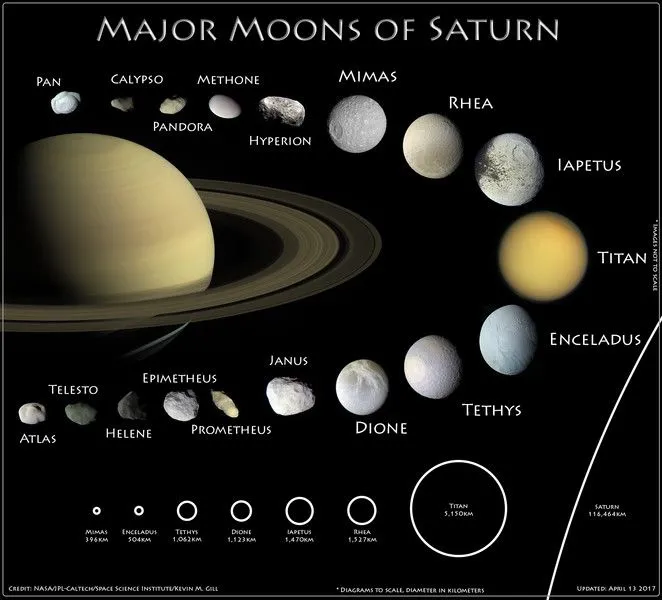
Like the first seven discovered moons of Saturn, the name was suggested by Herschel’s son, John Herschel, who chose a Greek giant, since Saturn is identified in Greek mythology with “Cronus,” the leader of the Titans. Fittingly, the geological features on Enceladus are themselves named after people and places from One Thousand and One Nights, such as Aladdin, Ali Baba, and Samarkand Sulci.
Fast-forward to 2005, when the Cassini spacecraft was sent on a mission to investigate Saturn and its system of several moons. Fortunately, Cassini was able to provide scientists with the data they wanted about Enceladus. Magnetometers aboard the spacecraft detected what seemed to be an atmosphere pushing against Saturn’s magnetic field, implying that the moon is releasing gases.
This sparked the scientific community’s interest, since they had discovered something they’d never seen before; the secrets of the icy Enceladus.
Inside Enceladus
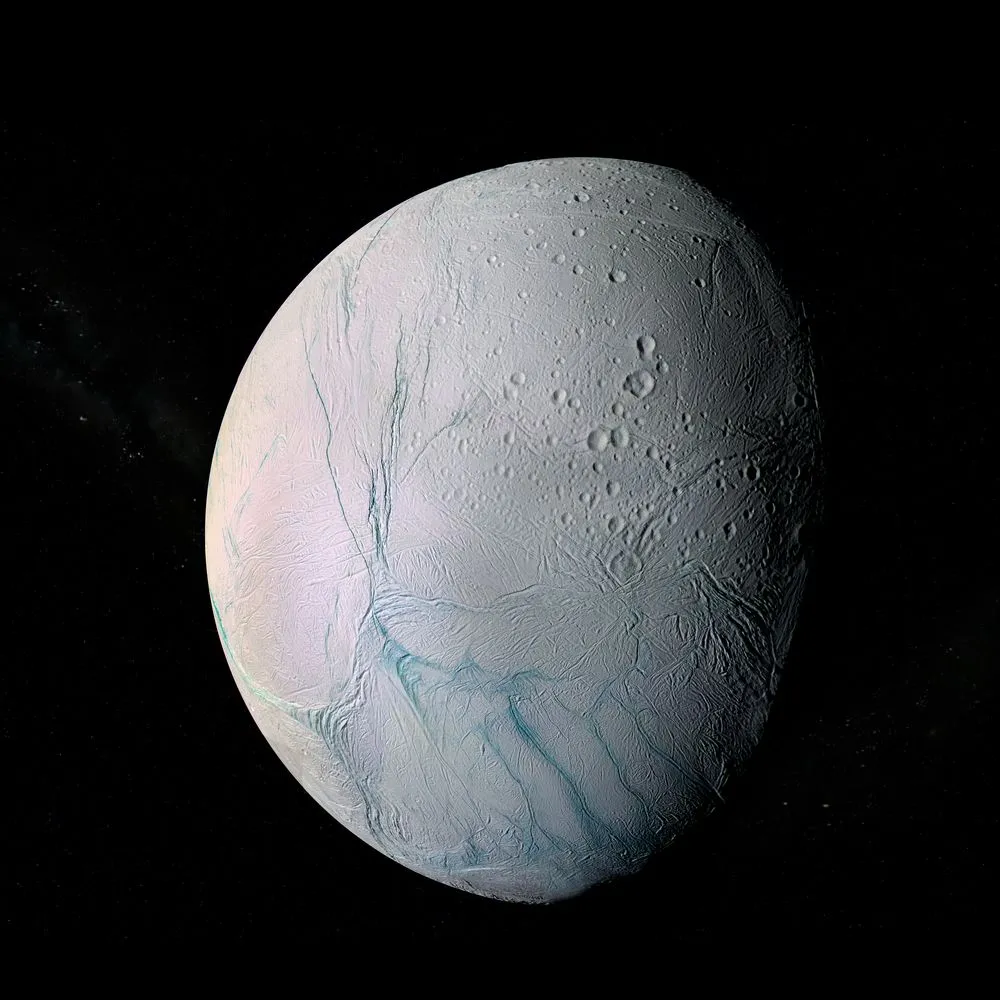
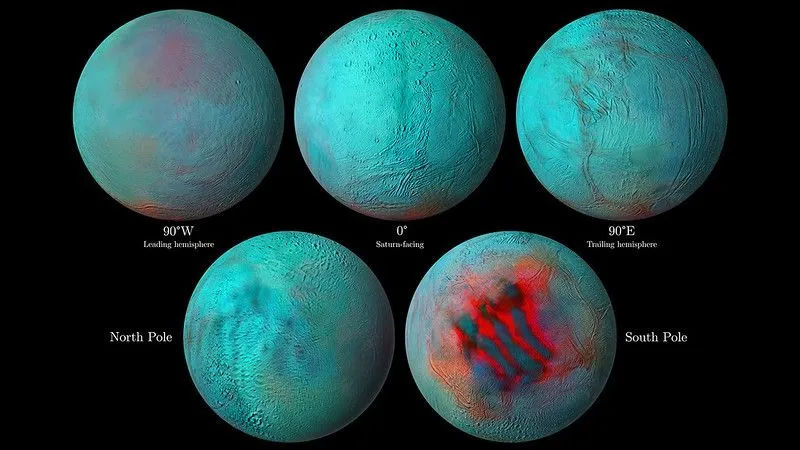
Enceladus has primarily fresh and incredibly clean ice covering its surface. It has five distinct terrains spread throughout its surface, including one of the smoothest surfaces ever observed in our solar system!
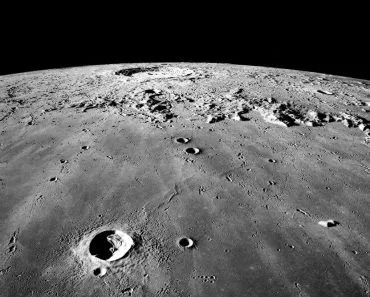
Some regions have an abundance of craters, indicating an older surface, while others have grooves that appear to be crater-free, suggesting more recent formation. As a result, it must have “Water Volcanism,” which allows for the continuous renewal of damaged surfaces. It’s as though the Moon is constantly repairing itself! Therefore, it is thought to be geologically active, with a full salty ocean world hidden beneath its icy cover.
Due to its thick coat of clean ice, Enceladus is also the most reflective body in the solar system, bouncing back almost 100% of the sunlight that hits it. Because it absorbs so little of that sunlight, its surface stays bitterly cold, with a mean temperature of about -201 degrees Celsius (-330 degrees Fahrenheit), making it one of Saturn’s coldest moons.
Cosmic Behavior And Internal Activity (Plumes)
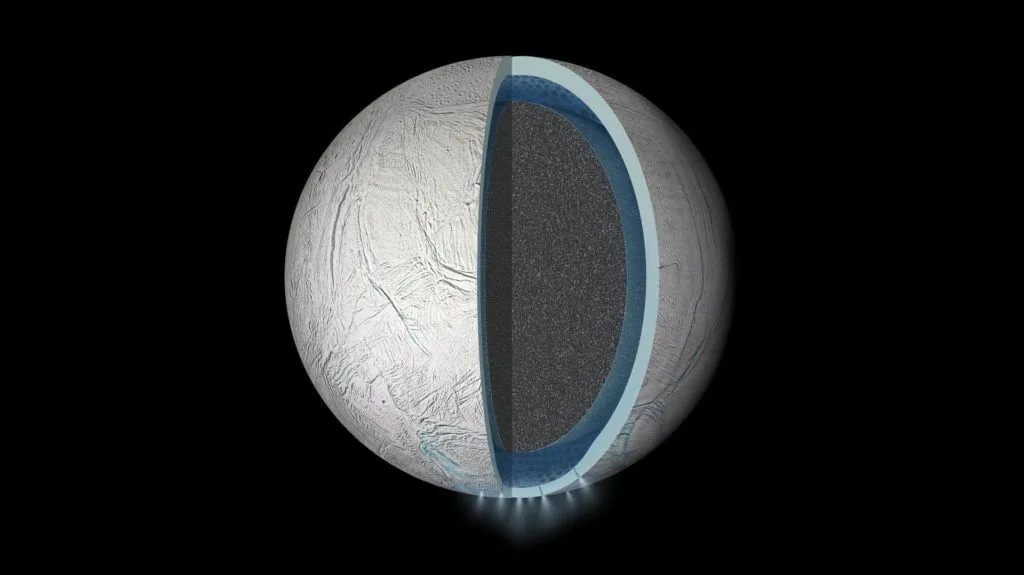
Enceladus orbits Saturn in an elliptical orbit and engages in a cosmic dance with Saturn’s other moon, Dione. As a result, it is subject to the gravitational pull from Dione and, of course, Saturn itself. These rough interactions cause a phenomenon known as tidal deformation, which forces the “Tiger Stripe” fissures in the South Pole to contract and relax constantly as it moves towards and away from Saturn. The muscle-like movement of these fissures causes water, ice grains, and gases to be ejected through the moon’s thick icy surface at around 400 meters per second (roughly 1,400 km/h, or 800 mph), comfortably faster than the speed needed to escape the little moon’s gravity.
These plumes fired from Enceladus are eventually pulled in by Saturn’s gravity, to become a portion of its E-ring. Cassini was able to gather samples of the plume particles because they are constantly spewed from Enceladus. The spacecraft’s data revealed a striking resemblance to the chemicals present around hydrothermal vents on Earth, which are located deep in the ocean where sunlight does not reach.
Potential Habitability
On Earth, these vents generate massive amounts of heat energy and organic chemicals, allowing a rich and diverse ecosystem to thrive. Some theories even suggest that they could be the first place where life developed on Earth! This is what makes Enceladus so intriguing. Across Cassini’s 13 years at Saturn (2004 to 2017), more and more evidence of a potentially habitable environment lying under Enceladus’ frozen surface was uncovered.
Silica crystals, carbon dioxide, large volumes of methane, and molecular hydrogen (H2) all contributed to the conclusion that something similar to hydrothermal vents exists inside the tiny moon’s buried, subsurface global ocean.
The case has only grown stronger since. In 2023, scientists re-examining Cassini data reported sodium phosphates in the plume grains, the first detection of phosphorus (an element essential to DNA, RNA, and cell membranes) in an ocean beyond Earth, at concentrations far higher than in Earth’s seawater. The same year, researchers using the James Webb Space Telescope mapped a single towering plume of water vapor stretching roughly 10,000 kilometers (about 6,000 miles) from the moon, and a fresh analysis of Cassini’s data turned up hydrogen cyanide, another key building block for life’s chemistry. A 2025 study of the highest-speed plume samples even found a richer mix of organic molecules than previously known. Together, these findings mean five of the six “bioessential” CHNOPS elements (carbon, hydrogen, nitrogen, oxygen, and phosphorus) have now been detected in material from Enceladus.
Scientists attempted to develop alternative explanations for why these chemicals exist on Enceladus, but none of these hypotheses fit as well. Hydrothermal vents remain the most plausible explanation for the chemistry discovered in Enceladus’ plumes.
Note: This does not imply that life exists on Enceladus, but rather that life MAY have the POTENTIAL to evolve or thrive in the environment it contains.
Conclusion And Further Investigation
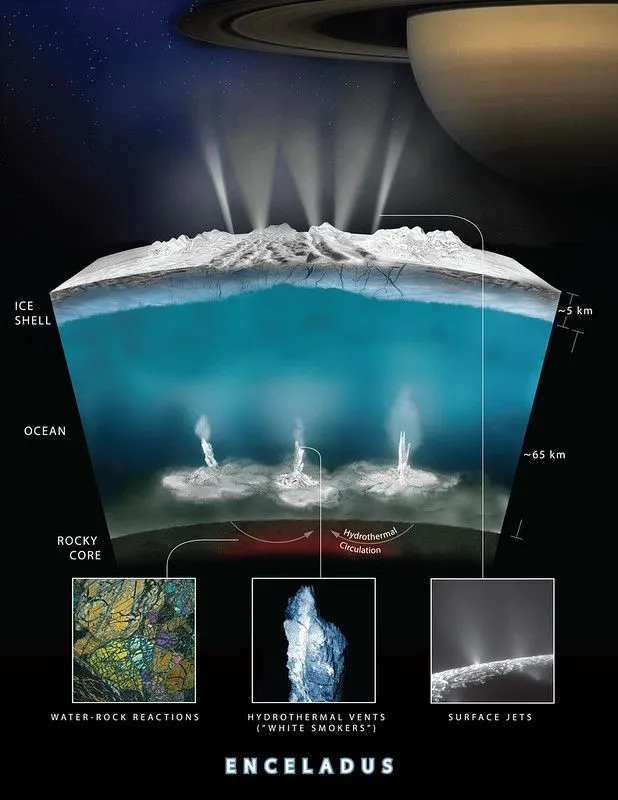
If something like these vents exists on Enceladus, there is a greater possibility that life may exist or develop on this tiny, chilly, icy moon full of magnificent mysteries. This makes Enceladus one of the most promising candidates for hosting extraterrestrial life. The next stage, according to NASA, is to send missions dedicated to searching for bio-signatures on Enceladus, and mission concepts such as an orbiter-lander that would sample the plume directly are already being studied.
As a result, Cassini has given humanity the go-ahead to look for life on this small, enigmatic moon. What might be hidden beneath the thick blanket of ice?
References (click to expand)
- Cassini at Enceladus - NASA Science. The National Aeronautics and Space Administration
- Nimmo, F., & Porco, C. (2014). Enceladus. Encyclopedia of the Solar System. Elsevier.
- Moore, P. (2005). SOLAR SYSTEM | Jupiter, Saturn and Their Moons. Encyclopedia of Geology. Elsevier.
- Neveu, M., Anbar, A. D., Davila, A. F., Glavin, D. P., MacKenzie, S. M., Phillips-Lander, C. M., … Yano, H. (2020, August 6). Returning Samples From Enceladus for Life Detection. Frontiers in Astronomy and Space Sciences. Frontiers Media SA.
- Hydrothermal Activity - NASA Science. The National Aeronautics and Space Administration
- McKay, C. P. (2008). Astrobiology. Encyclopedia of Ecology. Elsevier.
- Cassini at Enceladus: A Decade-Plus of Discovery. The National Aeronautics and Space Administration
- Postberg, F., et al. (2023). Detection of phosphates originating from Enceladus's ocean. Nature.
- Villanueva, G. L., et al. (2023). JWST molecular mapping and characterization of Enceladus' water plume feeding its torus. Nature Astronomy.
- Khawaja, N., et al. (2025). Detection of organic compounds in freshly ejected ice grains from Enceladus's ocean. Nature Astronomy.