Table of Contents (click to expand)
Mimas, Saturn's small inner moon, earns its "Death Star" nickname from the giant Herschel crater (about 139 km wide, nearly a third of the moon) that mimics the battle station in Star Wars. Its name comes from a giant in Greek mythology. In 2024, scientists found that this icy moon hides a young, liquid-water ocean roughly 20 to 30 km beneath its surface.
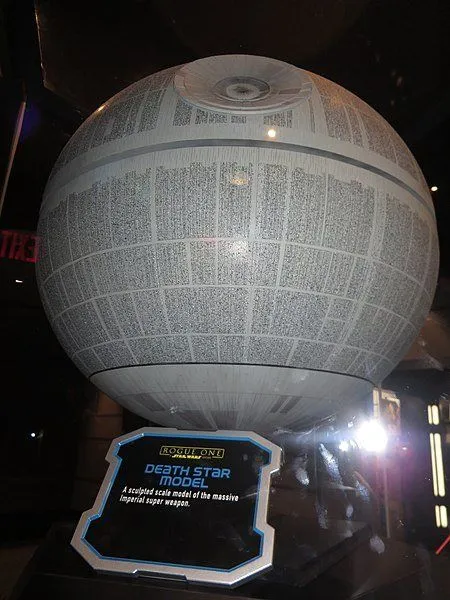
The natural satellite of Saturn, nicknamed the Death Star Moon, takes that name from the legendary movie Star Wars. The reason for the apt nickname is that the satellite has a massive crater on its surface, which bears an eerie resemblance to the space station borne from the cruel mind of Darth Vader!
Pop culture references aside, scientists have made a number of intriguing observations from the data gathered about this moon, some of which they are still working to explain. These range from a thermal map shaped like Pac-Man to a recently discovered ocean of liquid water hidden beneath the ice. Let's dive into understanding this bizarre satellite in a little more depth.
Mimas: An Overview
Mimas In Greek Mythology
The name Mimas takes its inspiration from Greek mythology. The mythological Mimas was one of the Giants, the monstrous offspring of Gaia (Earth), who rose up against the Olympian gods in the battle known as the Gigantomachy. In the most widely cited account, by the mythographer Apollodorus, Mimas was struck down by Hephaestus, the blacksmith god, who hurled missiles of red-hot metal from his forge. (Other ancient writers credit Zeus or Ares with the kill.)
Mimas itself was discovered on September 17, 1789, by the English astronomer William Herschel. It was his son, the astronomer John Herschel, who later proposed the name. In Greek mythology Saturn (the Roman counterpart of Cronus) devoured his own children, so John Herschel suggested naming Saturn's first seven moons after the Titans and Giants of Greek myth, the kin of Cronus.
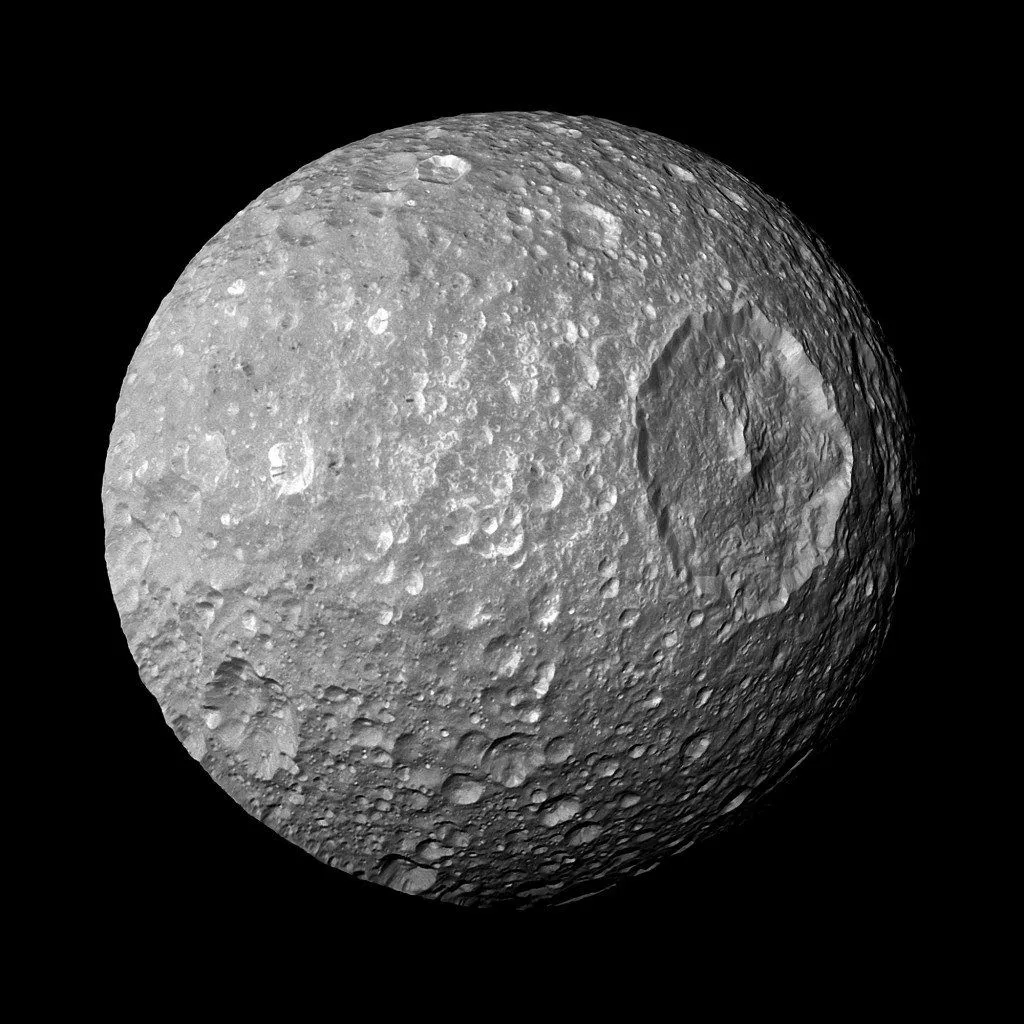
It is also referred to as Saturn I called by the International Astronomical Union, based on the fact that it is closer to Saturn than all of its natural satellites.
Mimas Moon Facts
This satellite is one of Saturn’s smallest and innermost moons, with a mean radius of 198km. It is not perfectly spherical, and tends to lean more towards an ovoidal (3D oval) shape. It is speculated that the only other substance present in Mimas apart from the rocky body is water and ice. It orbits at a mean distance of 186,000 km from Saturn and takes around 22 hours and 36 minutes to complete one orbit around Saturn. Most of Mimas’ surface has been wholly filled with impact craters, which can reach an upper limit of 40 km in diameter.
Death Star And Icy Mysteries
Mimas holds a notable distinction: alongside Saturn's moon Rhea, it has one of the most heavily cratered surfaces of any body in the solar system. Its ancient crust has been bombarded so thoroughly that newer impacts simply erase older ones.
Even though there are individual craters that are very large in diameter, those present in the South Pole are considerably smaller, with widths reaching around 20km. This drastic degree invariance in the diameters indicates that the South Pole region underwent some significant resurfacing changes.
Mimas And The Herschel Crater
The most remarkable feature on Mimas, however, is the gaping Herschel crater, which spans a large portion of the moon. At roughly 139 km (86 mi) across, the crater covers close to one-third of the moon, which itself is only about 396 km (246 mi) in diameter. Its towering walls rise about 5 km (3 mi) high, with a central peak around 6 km (4 mi) tall. To put that in perspective, a crater covering the same fraction of Earth would stretch more than 4,000 km (2,500 mi) wide. Scientists believe the impact that gouged it out very nearly shattered the moon.
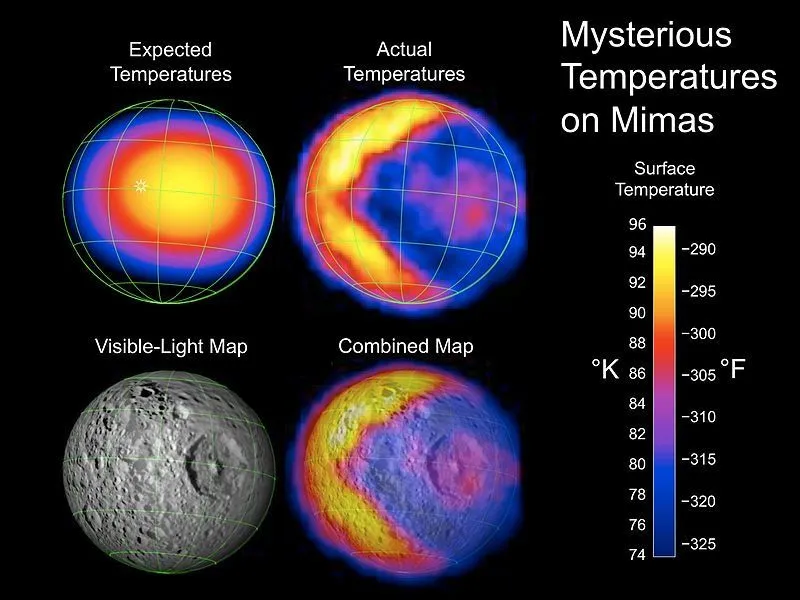
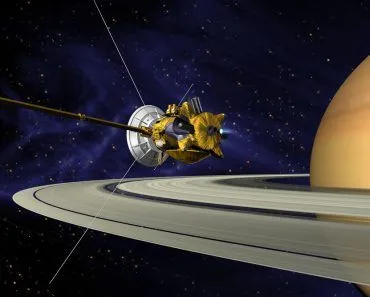
A temperature map created by NASA during the Cassini Spacecraft mission showed a peculiar pattern. The heat signature is remarkably similar to that of a Pac-Man, a shape essentially engulfing the Herschel crater. Temperatures around the Herschel crater are cooler than more distant regions of the moon, with a slightly warm spot showing up on the crater itself.
Another interesting fact about this moon is its remarkably low density! Despite the odd heat signatures, estimates put it at only about 1.15 times denser than ordinary water. This leads scientists to conclude that Mimas is composed almost entirely of water ice, with only a small fraction of rock.
However, the regions where the Pac-Man heat signature appears are thought to have a harder, more compacted icy surface, which holds heat differently from the fluffier ice elsewhere. As for its orbit, Mimas follows a slightly elliptical path, so Saturn's gravity flexes its interior and generates cyclic tidal heating. Mimas orbits closer to Saturn than its fellow moon Enceladus does.
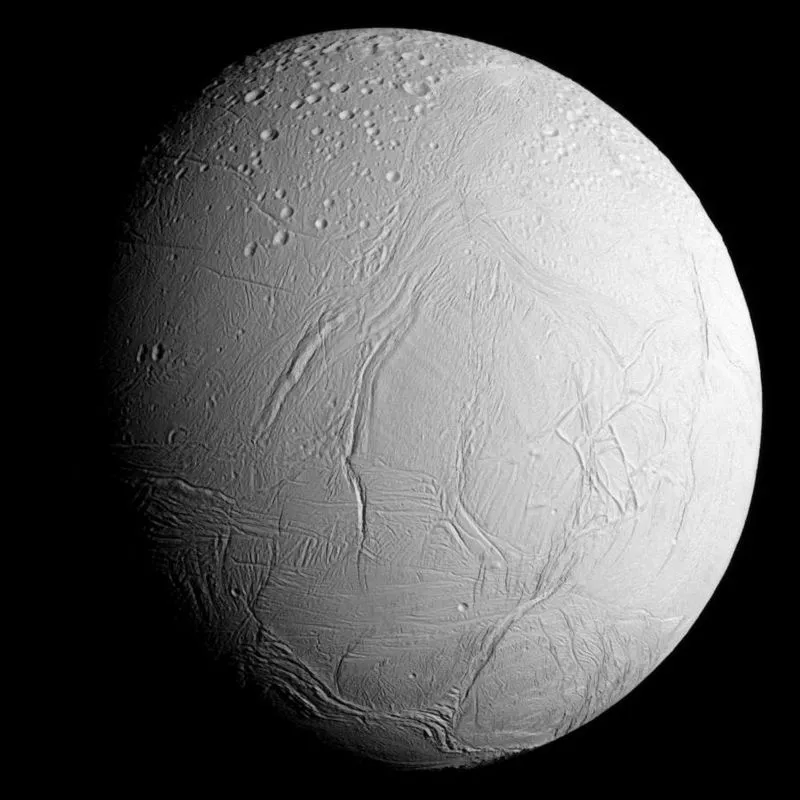
That said, Enceladus famously vents active geysers from its south pole, in stark contrast to the heavily cratered, seemingly dead surface of Mimas. This disparity gave rise to the so-called “Mimas test”: any theory of icy-moon interiors had to explain both the plumes of Enceladus and the apparently frozen-solid surface of Mimas. For years, Mimas looked like the boring sibling, with no hint of activity beneath its battered crust. As it turns out, that crust was hiding a remarkable secret.
Does Mimas Have A Hidden Ocean?
For a long time, Mimas seemed too small and too thoroughly cratered to hide anything interesting inside. That changed in February 2024, when a team led by Valéry Lainey of the Observatoire de Paris published a study in the journal Nature reporting that Mimas almost certainly conceals a global ocean of liquid water.
The team did not see the ocean directly. Instead, they tracked Mimas using images from NASA’s Cassini spacecraft and measured a tiny rocking motion in its orbit, known as libration. The size of that wobble depends on what the moon is made of inside. A solid, rocky core would produce one pattern of motion; a liquid layer sloshing beneath the crust would produce another. The numbers only made sense if Mimas hides a global ocean roughly 20 to 30 km (12 to 19 mi) beneath its icy shell.
The biggest surprise was the ocean’s age. Because the heavily cratered surface shows no cracks, ridges, or fresh ice of the kind that betray the oceans of Enceladus and Europa, the water must be a very recent arrival. The researchers estimate the ocean formed only about 5 to 15 million years ago, a blink of an eye in cosmic terms, which is why it has not yet had time to reshape the surface above it. That also neatly answers the old “Mimas test”: the moon was not lifeless after all, just early in its evolution. It makes Mimas the smallest known world to harbor a subsurface ocean, and a tantalizing new place to study how oceans, and possibly the conditions for life, can arise.
In short, Saturn's Death Star moon has gone from a cratered curiosity to one of the most intriguing small worlds in the solar system. A face that looks like a battle station, a thermal map shaped like Pac-Man, and a young ocean hidden under the ice all make Mimas a satellite that still has plenty left to teach us.