Table of Contents (click to expand)
The solar system is flat because of the conservation of angular momentum. As the original cloud of gas and dust collapsed about 4.6 billion years ago, particles with motion perpendicular to the net spin axis collided and cancelled each other out, while motion in the plane of rotation survived. The leftover material settled into a flat protoplanetary disk, and the planets formed inside it.
The flatness of our solar system can be ascribed to the law of conservation of total angular momentum. Due to this, whenever particles collide, they may move in any direction, but all the up and down motion cancels out, always following the rule that the total spin in that plane must be constant.
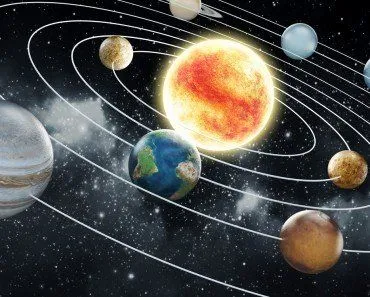
We all know that the Earth, the other planets and their moons all revolve around the Sun in elliptical orbits. However, have you ever stopped to wonder why these celestial objects move around the Sun in such a way that the Solar System appears to be lying on a plane, rather than going every which way?
We have learnt in our classes, and it is common knowledge, that nature prefers spherical orientations. From the tiniest drop of water in zero gravity to the shape of our planet, spheres are nature’s favorite shape. Even the Sun, the largest object in our cosmic neighborhood, is also – you guessed it – a sphere! So why is it that all these planets, asteroids, meteors and moons chose to lie in a plane, endlessly circling in a two-dimensional dance?
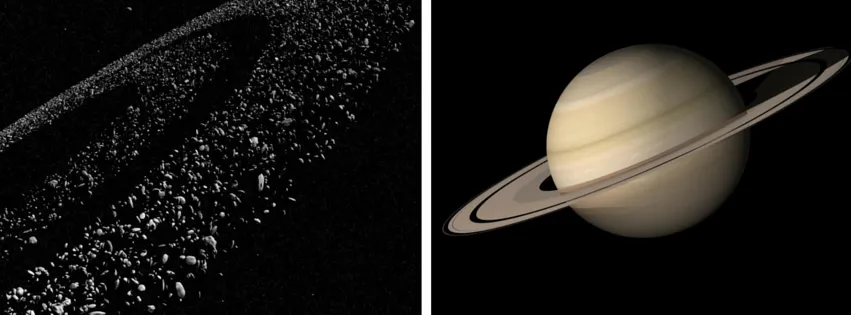
Think about Saturn’s rings, which are also disc-like. Even the asteroid belt lies in a flat plane. This is not a strange exception of our Solar System either; other galaxies billions of light-years away are oriented in a similar way. The Milky Way, our home galaxy, is a group of nebulae, stars and rocks flatly suspended in space due to mutual gravitational attraction.
The Origins Of Our Solar System
We can trace the origin of our solar system to a massive shapeless ‘blob’ of matter floating through space about 4.6 billion years ago.
The particles in this ‘blob’ gradually began to move closer due to gravity, and whenever there are multiple particles and powerful gravitational forces, there are also collisions. These collisions and the subsequent trajectories of these particles are random, making them impossible to predict. Although these objects move randomly, the one thing that remains constant is a conserved physical quantity called angular momentum (the rotational analogue of linear momentum, not a force in itself). The Solar System is an isolated system in itself. The galaxy is also an isolated system, since the gravitational effect of other cosmic objects is negligible.
In an ‘isolated system’, the total angular momentum has to be conserved.

This physical quantity is constant around a fixed axis. This axis is a point in 2-dimensional space, and in our world, which exists in 3 dimensions, this axis turns out to be a line. The system rotates along a plane that is perpendicular to the axis. Therefore, whenever particles collide, they may move in any direction, but motion perpendicular to the system's net angular-momentum vector cancels out, while motion in the plane of rotation survives because that is what the conserved spin demands. Over time, and after countless collisions, the cloud loses its freedom in the third dimension and settles into a flattened, rotating disk known as a protoplanetary disk, where the planets eventually form. Telescopes like ALMA and JWST routinely image these dusty disks around young stars (HL Tauri, TW Hydrae, and many others), and they show exactly this flat, ringed structure that theory predicts.
This is extremely fortunate for us, since we needed all those particles to come together so that planets and stars could be born. Otherwise, the same result would have been achieved, but it would have taken much more time. Furthermore, in terms of cosmological events and fans of stargazing, we wouldn’t experience eclipses nearly as often, due to the low probability of linear alignment between planets in a spherical system.
How Flat Is The Solar System, Really?
So we know why the system flattened, but just how flat did it end up? The answer is: remarkably flat, though not perfectly so. Astronomers measure this using orbital inclination, the angle by which a body's orbit is tilted away from the plane of Earth's orbit (a reference plane called the ecliptic). Earth, by definition, sits at 0°.

Using NASA's planetary data, the major planets cling impressively close to that plane. Mercury is the biggest rebel at 7.0°, but the rest are tightly packed: Venus 3.4°, Mars 1.9°, Jupiter just 1.3°, Saturn 2.5°, Uranus 0.8° and Neptune 1.8°. In other words, leaving aside Mercury's modest 7° tilt, every major planet hugs the ecliptic to within about 3.5°. Picture a vinyl record spinning on a turntable: the planets ride on its surface, never wandering far above or below it. If you shrank the solar system down to the size of a dinner plate, the planets' up-and-down wobble would be thinner than the plate itself.
Is our solar system unusually flat compared to others? Not really. Thanks to NASA's Kepler mission, astronomers have measured the tilts between planets in distant systems too. The compact, many-planet system Kepler-11, for instance, has orbits mutually inclined by only about 1°, making it even flatter than our own (where the comparable figure is around 2.3°). Flat, disk-born planetary systems, including the ones we find around faraway stars when we hunt for exoplanets, appear to be the cosmic norm, not the exception.
Why Don't The Planets Fall Into The Sun?
Here is a question that often follows close behind: if the Sun's gravity is strong enough to herd everything onto a single plane, why doesn't it simply pull the planets in and swallow them? The short answer is that the planets are falling toward the Sun, constantly. They just keep missing it.

Isaac Newton captured the idea with a famous thought experiment. Imagine a cannon on a mountaintop so tall it pokes above the air. Fire the cannonball gently and it arcs down to the ground. Fire it faster and it lands farther away. Fire it fast enough, though, and as the ball falls, the ground curves away beneath it at exactly the same rate. The ball keeps falling but never gets any closer to the surface. It is now in orbit.
An orbiting planet works the same way. Its sideways (tangential) motion, inherited from the spinning cloud it was born in, is balanced against the Sun's inward gravitational pull. Gravity bends the planet's straight-line path into a closed loop, while inertia keeps it sailing forward. A planet that suddenly lost its sideways speed really would plunge into the Sun, and one moving too fast would fly off into deep space. Our planets sit comfortably in between, which is exactly why they trace stable, repeating orbits rather than spiralling inward.
Still Not Perfect
Our Solar System is not actually a perfect plane, but is still well on its way to an ideal stage. Pluto's orbit is tilted about 17° from the main planetary plane, a legacy of its origin in the scattered Kuiper Belt and a long history of gravitational nudges from Neptune. Within the asteroid belt, most asteroids hew closely to the ecliptic, but a few large outliers, like 2 Pallas, sit at inclinations of about 35° from the main plane. Aside from these few exceptions though, the power of angular momentum has left the planets of our solar system in a tidy, predictable plane.
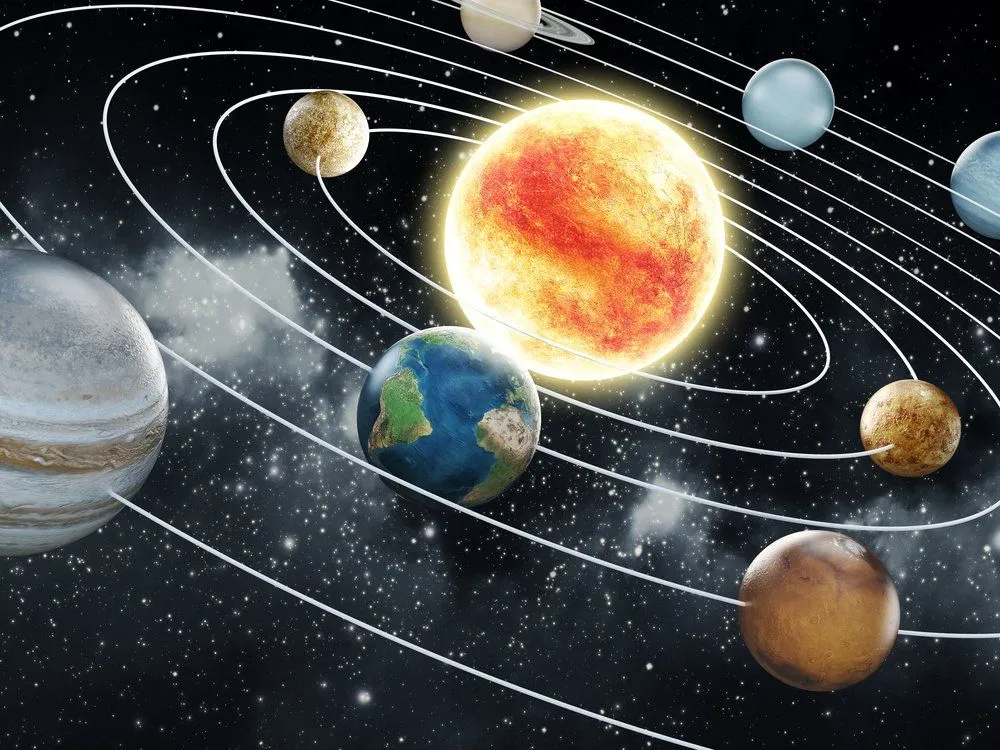
Scientists have found many solar systems in the galaxy that are even more planar than ours, while some others have huge differences between their ideal and actual planes. This variation might be because they are relatively young or have had particularly violent histories.
Our ancestors once believed that the world was flat. Little did they know that the only flat thing about the Earth's situation is the wider stage it inhabits, the disk-shaped solar system swimming in the ocean of stars.
References (click to expand)
- Our Solar System. NASA Science.
- Protoplanetary disk. Encyclopedia Britannica.
- ALMA reveals planet-forming disk around HL Tauri. ESO press release.
- Conservation of angular momentum. Wikipedia.
- minutephysics. Why is the Solar System Flat? (YouTube).
- Inclination of an orbit. Encyclopedia Britannica.
- What Is an Orbit? NASA Space Place.
- Extraordinary New Planetary System (Kepler-11). NASA Science.
- Kepler-11. Wikipedia.