If Earth’s orbit changed, the climate consequences would be enormous. Moving closer to the Sun would push surface temperatures past survivable limits, melting ice caps and boiling away oceans, while moving farther would freeze the planet. A drastic enough change in Earth’s orbital speed could even slow it into the Sun or fling it out of the solar system altogether. Earth stays in its current orbit because its orbital velocity (about 30 km/s) is precisely balanced against the Sun’s gravity.
The planet on which we live is in continuous elliptical motion around the star of our solar system, popularly known as the Sun. In addition to revolving around the sun, our planet also rotates on its own axis. Although we never realize it, the Earth is continuously moving.
After a lifetime on the planet, you’ve likely gotten used to its same old style of revolution, but have you ever thought about what it would be like if Earth changed its orbit around the sun?
Earth’s Orbit
The celestial bodies in our solar system tend to revolve around the sun, the star of our solar system. This is due to the strong gravitational pull exerted by the sun on all those celestial bodies. The planets, asteroids, and all other objects are continuously revolving around the sun in definite, mainly elliptical paths. These paths are called orbits.
Almost every object in the solar system has a definite orbit to which it sticks all the time. Also, different planets revolve with different speeds around the sun. For instance, Earth takes 365 days to complete one revolution around the sun, which is why 365 days this is the duration of 1 year on our planet.
What Does An Orbit Do?
As we discussed earlier, orbits are well-defined paths on which celestial bodies travel, but they are not just any random path. An orbit is the special compromise between two things: the Sun’s gravity pulling Earth inward, and Earth’s forward motion (its inertia) trying to fly off in a straight line. The Sun’s gravity constantly bends that straight line into a curve. If the speed and the pull are matched correctly, the curve closes up into a stable ellipse, and Earth keeps coming back around forever.
Change either side of that balance and the orbit changes. Slow Earth down too much and gravity wins; it spirals inward toward the Sun. Speed Earth up enough and it climbs to a higher, colder orbit. Add enough energy and it can leave the solar system entirely. So an orbit is less a fixed path and more a careful equilibrium between gravity and momentum.
What If Earth Changed Its Orbit?
If Earth’s orbit were suddenly altered, perhaps by a close pass of a rogue planet, a massive collision, or some hypothetical disturbance, the consequences would depend entirely on how it changed.
A simple way to think about it: imagine you throw a ball horizontally. The harder you throw it, the farther it goes before falling to the ground. If you could throw a ball at exactly 7.9 km/s near the surface (ignoring air resistance), it would keep falling around the Earth forever, that is, it would orbit. Earth does the same thing around the Sun, at about 30 km/s. Slow it down significantly and it would spiral inward and ultimately be vaporized by the Sun. Speed it up significantly and it would climb to a colder, more distant orbit, or, beyond the escape speed at our distance (about 42 km/s), be flung out of the solar system altogether.
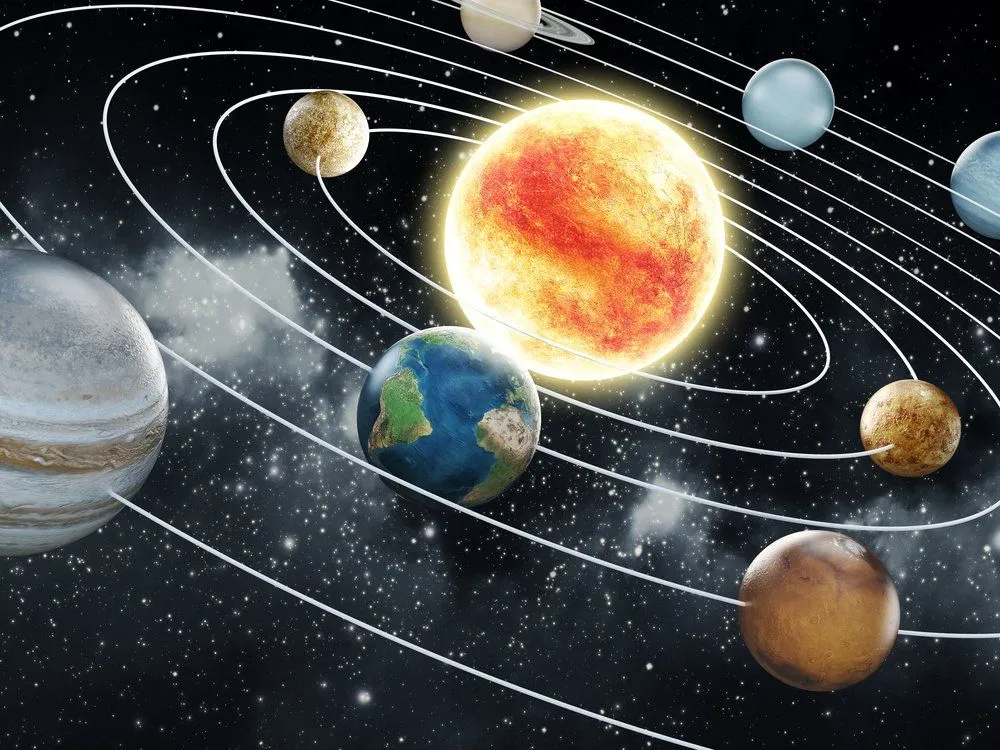
Earth is moving at roughly 30 km/s (about 18.6 miles per second), although you don’t feel it. In a sense, it really is continuously "falling" toward the Sun, but the sheer sideways speed at which it is moving means it keeps missing, looping around in an ellipse instead. If that finely tuned balance were nudged hard enough, the path of the planet would shift, and the climate consequences (good or bad) would be huge.
In short, if Earth’s orbit changed substantially, the surface conditions that life evolved for would change with it, and complex life as we know it would have a hard time hanging on.
Minor Changes In The Orbit
If Earth were to move closer to the Sun, surface temperatures would climb sharply. Glaciers and polar ice caps would melt, sea levels would rise by tens of meters, large stretches of coastline would flood, and at some point the oceans themselves would start to evaporate, the way they did on a young Venus. Move Earth farther out instead and the opposite happens: oceans freeze, the atmosphere starts losing water vapor and eventually CO2 as well, and the planet drifts toward a Mars-like deep freeze. Every year would also get noticeably longer, since by Kepler’s third law a wider orbit takes more time to complete.
Suffice it to say, we’re happy with the orbit we currently ride. The "habitable zone" around the Sun, the narrow band where liquid water can persist on a planet’s surface, runs from roughly 0.95 to 1.67 astronomical units. Earth, at 1 AU, sits comfortably near the inner edge. So Earth had better not get any ideas about wandering away from its path!
Will The Sun Eventually Swallow Earth?
Here’s the twist most people miss: Earth’s orbit doesn’t have to move for the rules of the game to change. The Sun itself will change. Right now the Sun is a middle-aged main-sequence star, calmly fusing hydrogen into helium in its core, and it has been doing so for about 4.5 billion years. NASA reckons it is a little less than halfway through that stable life, with roughly 5 billion years of hydrogen burning still left in the tank.

When the core finally runs out of hydrogen, the Sun won’t quietly switch off. It will swell into a red giant, ballooning to many times its present size as it starts burning hydrogen in a shell around its dead helium core. A detailed 2008 study by K.-P. Schröder and Robert Connon Smith, published in the Monthly Notices of the Royal Astronomical Society, puts the peak of this phase at about 7.6 billion years from now, when the Sun reaches roughly 256 times its current radius, swelling out to around 1.2 astronomical units (AU).
That radius reaches past where Earth orbits today, at 1 AU. As the Sun puffs up it also sheds mass, and a lighter Sun grips its planets more loosely, so Earth’s orbit actually drifts outward to about 1.5 AU. You might think that buys us an escape. It doesn’t. The same study finds that tidal drag from the giant Sun’s bloated atmosphere bleeds away Earth’s orbital momentum faster than the orbit can expand, and our planet is dragged in and engulfed about half a million years before the Sun reaches its largest size. Mercury and Venus are swallowed first, and Earth almost certainly follows. Long before any of that, though, the steadily brightening Sun will have boiled away the oceans and sterilized the surface, likely within the next billion years or so. After the red giant phase, the Sun puffs off its outer layers and settles down as a slowly cooling white dwarf, not the black hole that some people imagine, since it simply isn’t massive enough for that fate.
What If Earth Were Suddenly Stopped Or Flung Out Of Orbit?
So far we’ve talked about gradual changes, but search boxes are full of a more dramatic question: what if Earth were simply stopped dead in its tracks, or flung clean out of the solar system? Both are physically impossible as instant events, since no plausible force can halt a planet on a dime, but they’re a neat way to see how the gravity-versus-momentum balance really works.
Kill Earth’s sideways speed and you remove the “miss” that keeps it looping around the Sun. With nothing but gravity left, Earth would fall straight inward. Working through the orbital mechanics (treating the plunge as one half of an extremely thin ellipse), physicists find the trip would take roughly 65 days, crossing the orbit of Venus around day 41 and Mercury around day 57 before Earth vaporizes in the Sun. We dig into that doomsday timeline, and the brutal temperatures along the way, in our companion piece on what would happen if Earth stopped revolving around the Sun.
The opposite scenario, getting flung outward, is the more realistic of the two improbable cases. A passing rogue star could tug on Earth over repeated close encounters, slowly pumping energy into its orbit until the planet either climbs into the frozen outer dark or is hurled past Jupiter and ejected from the solar system entirely. A 2025 simulation study by Nathan Kaib and Sean Raymond modeled exactly this and found the odds are reassuringly small: only about a 0.2% chance of such a catastrophe over the next 5 billion years. A more familiar trigger would be a giant impact, an angle we explore in whether an asteroid could knock Earth out of its orbit. Either way, the lesson is the same: Earth’s orbit is a finely tuned equilibrium, and our continued comfort depends on nothing big enough ever coming along to upset it.
References (click to expand)
- What would happen if the rotation axis of the Earth changed .... IMAGE
- What if Earth changed its orbit? - Science | HowStuffWorks. HowStuffWorks
- What Would Happen If Earth and Mars Switched Places?. Scientific American
- Sun: Facts. NASA Science
- Distant future of the Sun and Earth revisited. Monthly Notices of the Royal Astronomical Society (Schröder & Connon Smith, 2008)
- What if Earth stopped orbiting the sun?. Phys.org
- Earth could be flung out of orbit by a passing star. Science News