Table of Contents (click to expand)
A temperature inversion is a reversal of the atmosphere’s normal pattern: instead of air cooling with altitude, a layer of warm air sits on top of cooler air near the ground. That warm cap traps the cold air (and any pollutants in it) in place. Inversions are caused by clear, calm nights, sinking high-pressure air, or cold air pooling in valleys.
If you’ve ever been to San Francisco, you’ve probably seen the famous fog that rolls in so beautifully up the coast. It’s hard to forget the chill of that fog on an unexpectedly chilly morning in June. While it makes for scenic shots of the city from the surrounding hills, have you ever wondered why that phenomenon occurs so frequently there? There are also other cities infamous for their poor air quality and smog during certain times of the year, such as Salt Lake City and Beijing.
While these are major industrial and population centers, there is actually another explanation for this, a much broader weather phenomenon known as temperature inversion.
What Is Temperature Inversion?
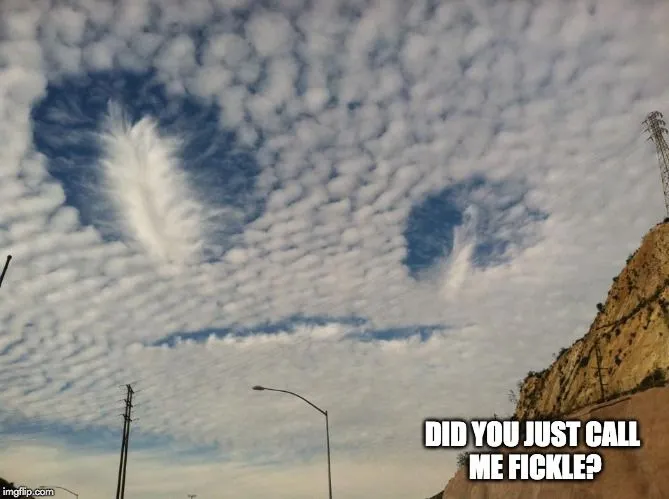
In terms of the temperature of the atmosphere in relation to the surface of the Earth, the closer to the ground, the warmer the air is. The higher you go, the thinner and colder the air becomes. This is why temperature control in airplanes is so important; the air outside at 9,100 meters (30,000 feet) is typically around -45 °C (-49 °F). However, while temperature usually flows in a smooth gradient of high temperature to low temperature as altitude increases, the atmosphere can be a fickle thing!
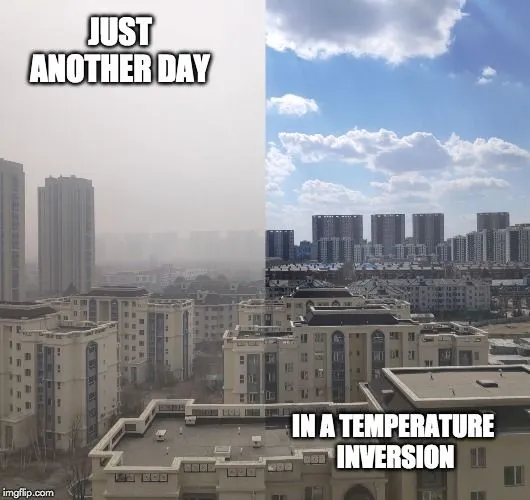
In some cases, a thin layer of the atmosphere flips this rule, so that air actually gets warmer as you climb through it instead of cooler. That is a temperature inversion: the natural gradient is turned upside down, and a band of warm air ends up perched above the cooler air near the ground. This commonly happens for a few reasons. On clear, calm nights the ground radiates away its heat and chills the air just above it, leaving warmer air higher up (a radiation inversion). Sinking air inside a high-pressure system can compress and warm as it descends, capping the cooler air below (a subsidence inversion). And there are a number of geographical conditions where inversions are more likely, such as valleys, coastal areas and certain confluences of topography, though they can technically happen anywhere. The longevity and severity of these phenomena are simply more noticeable in certain regions and cities around the world.
We explained the coastal phenomenon of San Francisco above, but there are also valley inversions, in which an area between mountains is filled with cold air that falls down the mountainside and nestles down in the valley. As the winds change, a layer of warm air may be blown directly over this wide valley or natural depression, keeping the cold air sealed in place, resulting in high levels of smog and low-quality air. Salt Lake City lies in a massive valley and regularly experiences temperature inversions that can be seriously detrimental to one’s health, particularly young children and the elderly.
There are other formations, such as the confluence of two mountain ranges, or the foothills of mountains. As cold air flows into these areas, it will often hit a dead-end and pool up against the obstructions (i.e.,the mountains), and sit there until the winds change. This can result in severe and unpredictable weather, as well as dangerous cold snaps that can last for days or weeks.
Due to the volatility of the weather and the low visibility that can be generated, understanding where temperature inversions occur, and what weather patterns may hint that they are developing, is critical to a number of industries, including for aviation. As any pilot will surely know, the appearance of an inversion from above, like a snow globe of entirely different air, is always a bit strange to navigate!
Is Temperature Inversion Dangerous?
Although temperature inversions are interesting phenomena, they can also be quite dangerous. When cold air is essentially trapped beneath a layer of warm air, the air that people breathe every day can become stagnant, and filled with pollutants and exhaust from the activity within the cold layer. Normally, warm air near the surface rises and carries smoke, exhaust and dust up and away in a process called convection. An inversion shuts that escalator off. The warm cap overhead acts like a lid, so vehicle exhaust, factory emissions, wood smoke and fine particulate matter simply accumulate in the shallow layer of cold air where we live and breathe.
This is exactly why an inversion can turn an ordinary day of city traffic into a serious air-quality emergency. The longer the warm lid stays in place, the more pollution builds up underneath it, and the haze and smog can linger until a change in wind or weather finally breaks the inversion. These episodes are especially hard on people with asthma, heart conditions or other respiratory illnesses, along with young children and the elderly. Salt Lake City, hemmed in by mountains, regularly suffers multi-day winter inversions that send its air quality plummeting, and the great London smog of December 1952, intensified by an inversion trapping coal smoke over the city, is blamed for thousands of deaths.
A Final Word
Temperature inversions tend to occur in specific regions that have ideal characteristics, but these odd phenomena could happen anywhere. As our global climate continue to increase in volatility, we all might start getting more familiar with odd weather patterns, and temperature inversions are a good place to start!
References (click to expand)
- Temperature inversion | Definition & Facts.
- Why Temperature Inversion Is Dangerous.
- Whiteman, C. D., Bian, X., & Zhong, S. (1999, August). Wintertime Evolution of the Temperature Inversion in the Colorado Plateau Basin. Journal of Applied Meteorology. American Meteorological Society.
- study of dense fog at the salt lake city international airport ....
- Lester, P. F. (1985, November). Studies of the Marine Inversion Over the San Francisco Bay Area … A Summary of the Work of Albert Miller, 1961–1978. Bulletin of the American Meteorological Society. American Meteorological Society.
- What Is An Inversion? National Weather Service, Little Rock, Arkansas (NOAA).
- The Great Smog of 1952. Met Office (UK).