Table of Contents (click to expand)
- What Is Sea Glass?
- What Is Beach Glass?
- Where Does Sea Glass Come From?
- Is Glass Natural Or Man-Made? And Where Does Glass Itself Come From?
- The Different Colors Of Sea Glass And Their Possible Origins.
- How Can You Tell Real Sea Glass From Fake?
- Where Can You Find Sea Glass? Famous Sea Glass Beaches
- Pieces Of Sea Glass Are Hard To Find!
Sea glass is the smooth, frosted glass found on ocean beaches, formed from discarded bottles, jars, and tableware that have spent decades in the surf. Wave action grinds the sharp edges round, while slightly alkaline seawater (pH ~8.1) slowly leaches soda and lime from the glass surface, leaving a matte, pitted finish. Genuine sea glass typically needs 20 to 40 years (sometimes 100+) to form.
What Is Sea Glass?
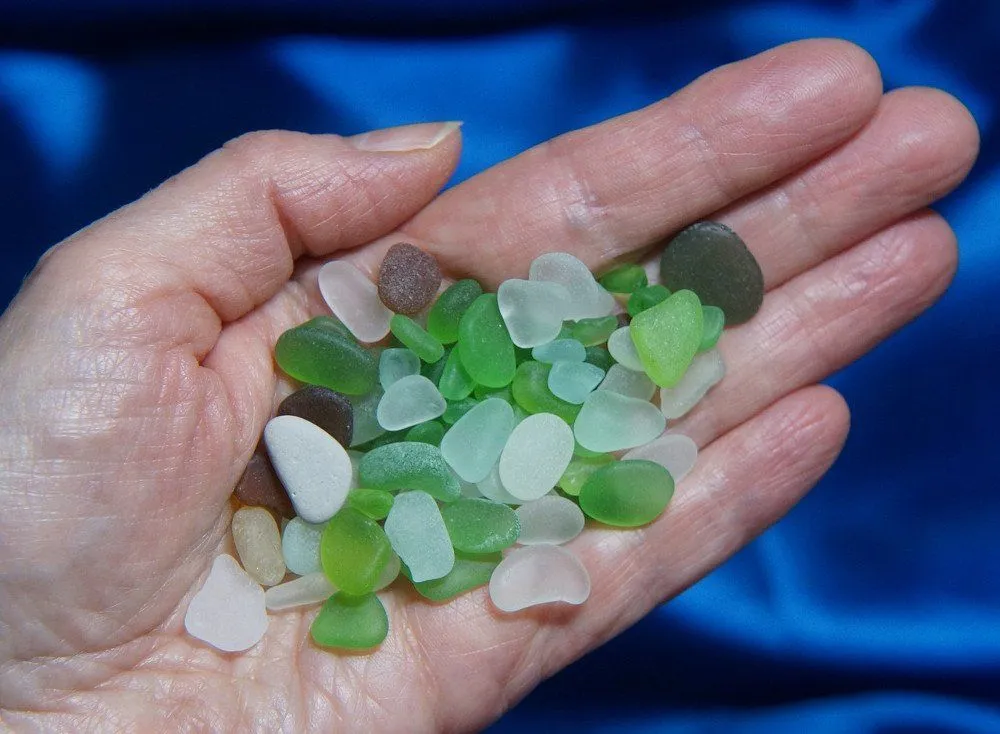
The term ‘sea glass’ is used to refer to the small pieces of glass that are typically found on beaches along bays, seas and oceans, but they can also be found on the banks of large rivers. Sea glass is weathered both physically and chemically due to the constant tumbling action of waves over an extended period of time.
What Is Beach Glass?
The term ‘sea glass’ is sometimes used interchangeably with ‘beach glass’, but the two are actually different, despite being quite similar superficially. Unlike sea glass (which comes from saline water of the seas), beach glass comes from freshwater sources, and typically has a less frosted appearance and a different pH balance than real sea glass. However, in most practical situations, these terms can be used interchangeably (Source).
Although sea glass can be found on beaches all over the world, the beaches of the northeast United States, northeast England, Mexico, Hawaii, Puerto Rico, Italy and Australia are particularly well known for their wealth of sea glass.
Where Does Sea Glass Come From?
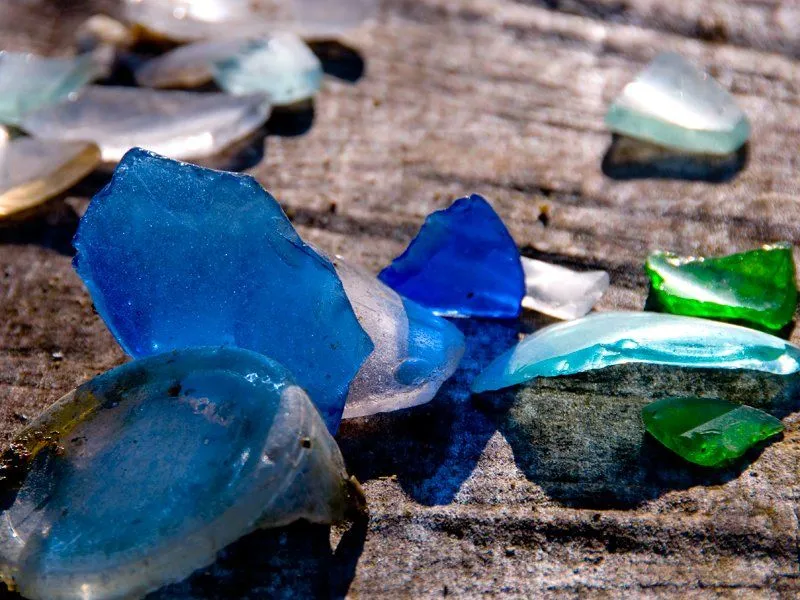
Naturally occurring sea glass (sometimes colloquially referred to as “genuine sea glass”) begins its journey in the form of discarded articles of glass, such as bottles, tableware, pieces of household items lost in natural disasters and even shipwrecks, which are tossed on the shore as the result various human activities.
For instance, when you party on a cruise liner in the middle of the ocean and casually chuck used, empty glass bottles into the water, these discarded pieces of glass don’t just disappear in the depths. They are tossed and turned, whacked and smacked, thrown and caught by the tides. They are weathered by sand, salt and other elements of the seas, causing the sharp edges of the glass objects to disappear, giving way to a smooth, polished surface and a frosty appearance.
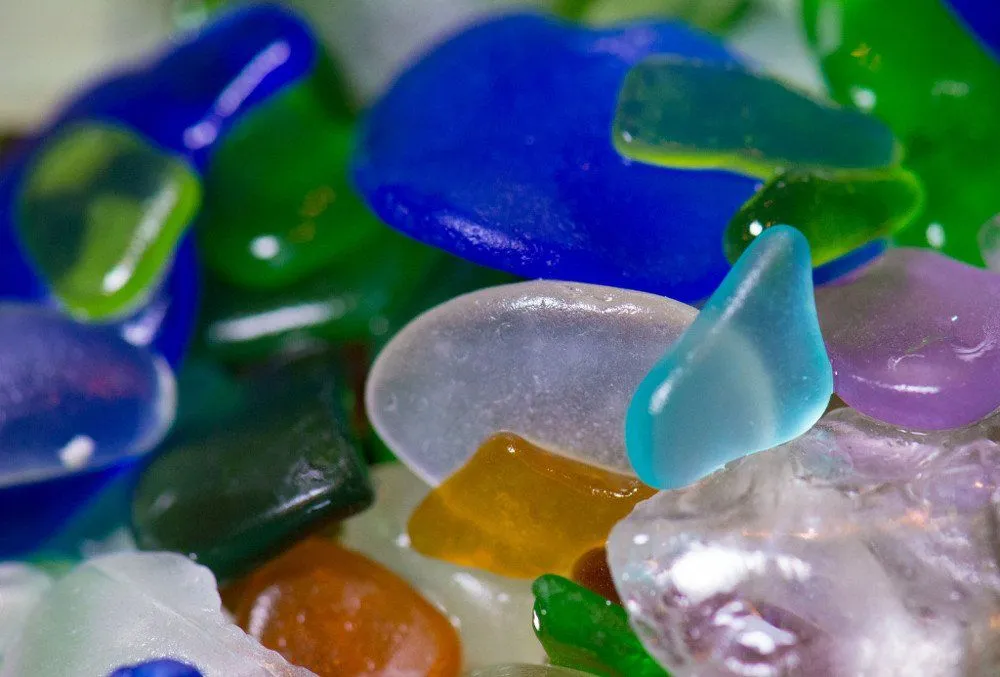
The final product is smooth, frosted glass pieces (often taking on a round or oval shape) that can appear almost gem-like. They’re harmless to handle and often used in crafts or jewelry. Each piece of sea glass is unique, owing to the random and unpredictable ways it was shaped by the environment.
Two things produce that signature frosted look, and they happen on different timescales. The first is purely mechanical: waves tumble the shard against sand and pebbles, knocking off sharp edges and pitting the surface, essentially nature running a rock tumbler in slow motion. The second is chemical: seawater is slightly alkaline (pH around 8.1), and over decades it slowly leaches out the soda (sodium) and lime (calcium) components of soda-lime glass, leaving the silica skeleton behind as a microscopically porous, matte crust. Warmer water and higher salinity speed the chemistry up; cold, fresh, or low-energy water slows it down.
This combination is why genuine sea glass usually needs 20 to 40 years in the surf to mature, and pieces from old shipwrecks or 19th-century dump sites can be over a century old. Anything that looks too uniformly frosted, too jewel-bright, and too colorful is almost certainly tumbled in a workshop, not by the sea.
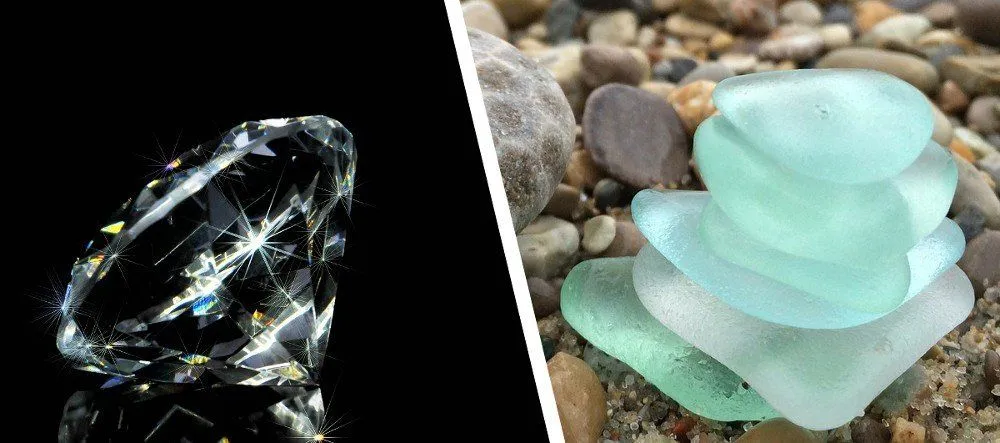
It’s often said about sea glass that as far as its “manufacturing process” is concerned, it is the opposite of diamonds, because diamonds are produced by nature and polished by man, whereas (naturally occurring) sea glass is produced by humans but polished by nature.
Artificial sea glass, on the other hand, can be formed in a workshop, factory or even a rock tumbler (very rare). This artificial variety is made from sheets of glass that are cut up and placed in an acid bath or a rock tumbler. People also make artificial sea glass from recycled glass bottles; enthusiastic collectors actually look for particularly old bottles to make artificial sea glass.
Unlike natural sea glass (which is rarely available in colors like yellow, cobalt blue, purple, orange, red, turquoise, “black” or Vaseline), artificial sea glass can be easily found in almost every color. This is a surefire way to verify whether a piece of sea glass you’re looking at is natural or artificially produced.
Is Glass Natural Or Man-Made? And Where Does Glass Itself Come From?
Before glass can ever become sea glass, it first has to be glass, and that raises a question people search for all the time: is glass natural, and where does it come from in the first place? The bottle that eventually washes up on a beach is firmly man-made. Most everyday glass is soda-lime glass, which is roughly 70% silica (from sand), about 15% soda (sodium oxide, supplied by soda ash) and around 9% lime (calcium oxide, from limestone), all melted together at close to 1,500 °C (2,730 °F). The soda lowers the temperature at which the sand melts, while the lime keeps the finished glass from slowly dissolving in water. If you want the full recipe, we have a whole article on how glass is made from ordinary sand.

So manufactured glass is something humans make out of natural minerals. But glass also forms in nature with no help from us at all. Obsidian is volcanic glass: when silica-rich lava cools so quickly that crystals never get the chance to grow, the result is a smooth, glassy rock. Lightning can manage it too, fusing sand into branching glass tubes called fulgurites, and meteorite impacts melt and fling out rock that hardens into glassy blobs called tektites. Sea glass sits right at the meeting point of both stories: it starts out as glass we manufactured, then gets reshaped over decades by the very natural forces (water, sand and time) that also build glass entirely from scratch.
The Different Colors Of Sea Glass And Their Possible Origins.
Sea glass comes in a variety of colors, and each hue may have a unique source or origin. Here’s a list of some frequently encountered sea glass colors:
- Clear/White: This common color usually originates from old soda, medicine, or liquor bottles.
- Brown: This is another common color of sea glass which typically comes from beer, whiskey, or medicine bottles.
- Green: This color might come from early to mid-1900s soda bottles, or from wine, fruit jar, and baking powder containers.
- Blue: Cobalt blue is found less commonly and is often from medicine bottles, poison bottles, or Bromo-Seltzer bottles. Lighter Sky Blue usually comes from Milk of Magnesia bottles, ink bottles, or fruit jars.
- Red: One of the rarest of sea glass, it was primarily used in boat lights, automobile tail lights, and decorative household items.
- Yellow: Not very common and usually originates from tableware or cosmetic bottles.
- Orange: This is a very rare color, which might originate from decorative art glass or auto warning lights.
- Purple/Amethyst: This color is from clear glass that contained manganese, this element reacts with sunlight causing the purple hue.
- Black: It often comes from older, thick glass bottles of the 18th and 19th centuries.
- Pink: Likely to come from Depression-era tableware, perfume bottles, or art glass.
- Gray: Gray sea glass is very uncommon and is typically derived from older window panes or jar glass.
- Sea (Turquoise) Green: This color is rare, and it generally comes from early 1900s soda bottles, medicine bottles, or art glass.
Remember that not all glass colors can easily be linked to their sources; constant innovations in glass manufacturing make it difficult to establish definite sources for some.
How Can You Tell Real Sea Glass From Fake?
With genuine pieces getting harder to find, plenty of the “sea glass” sold today was never actually anywhere near the sea. So how do you tell the real thing from glass that was simply tumbled in a workshop? The most reliable clue is the surface. Decades in saltwater give genuine sea glass a soft, matte frosting created by hydration, in which seawater gradually swaps the sodium in the glass for hydrogen and etches countless microscopic pits. Look closely (a jeweler’s loupe helps) and those pits often show up as tiny C-shaped marks. A real piece also tends to feel slightly grippy and uneven in the hand rather than uniformly slick.

Shape and color are the next tells. Naturally tumbled glass is pleasingly irregular, with rounded but imperfect edges, and it may still carry fragments of embossed lettering or the curve of a bottle. Machine-made imitations are often suspiciously consistent, turning out batches of near-identical ovals or triangles with an even, satiny sheen. Color gives the game away too: vivid cobalt blue, red, orange and turquoise are genuinely rare on a beach, so a bin of bright, cheap pieces in those shades is a warning sign. The catch is that modern acid baths and advanced tumblers can now fake the frosting fairly convincingly, so no single test is completely foolproof. When in doubt, the surest routes are finding the glass yourself or buying from a reputable, accredited seller.
Where Can You Find Sea Glass? Famous Sea Glass Beaches
Sea glass tends to pile up wherever people once dumped glass close to moving water, so the world’s best hunting grounds are almost always former rubbish sites. Two beaches in particular have become legendary among collectors.

The most famous is Glass Beach near Fort Bragg, California. From 1906, local residents simply threw their household rubbish, including bottles, crockery, cans and even old cars, over the coastal bluffs into the surf. The stretch we now call Glass Beach was an active dump from 1949 until California authorities finally closed it in 1967. Decades of pounding waves then did what waves do, grinding the buried glass into a shimmering carpet of smooth, colorful pebbles. In October 2002, the cleaned-up 38-acre (15-hectare) property was folded into MacKerricher State Park. Ironically, the beach is now a victim of its own fame: with 1,000 to 1,200 visitors a day in summer (most of whom pocket a few pieces) and waves steadily grinding the rest into sand, the glass is visibly thinning, and rangers now ask people to leave what little remains.
On the other side of the Atlantic sits Seaham, on the County Durham coast of northeast England. Its glass came from a single source: the Londonderry Bottleworks, which operated from the 1850s until 1921 and, at its peak, hand-blew up to 20,000 bottles a day. At the end of each shift the factory tipped its rejects and leftover molten scraps straight into the North Sea. A century of tumbling turned that industrial waste into some of the most prized sea glass anywhere, including the famous swirled, multi-colored fragments that collectors call “multis” or “end of day” glass, along with rounded marbles and bottle stoppers.
Beyond these two icons, the beaches of the northeast United States, Hawaii, Puerto Rico, Italy, Mexico and Australia are all reliable haunts. Wherever you look, the trick is timing: the richest pickings usually turn up at low tide, especially in the hours after a storm has churned fresh glass out of the seabed.
Pieces Of Sea Glass Are Hard To Find!
If you’re one of those people who spend hours on beaches looking for oceanic gems, you would know all too well that pieces of “genuine” sea glass are becoming increasingly hard to find. The reason is pretty straightforward: glass is no longer being used as commonly as it was a few decades ago.
Back in the 1960s and 70s, many things, including bottles, jars and pots were made of glass. These things were often discarded and tossed in water bodies, either accidentally or on purpose. It certainly wasn’t a healthy practice from the perspective of the environment, but it does cause pieces of sea glass to wash ashore, even to this day!
However, with the advent of plastic a few decades ago and its ever-growing popularity, glass products are simply not as common. Today, we are surrounded by far more plastic products than glass items, so we are seeing a severe decline in the quantity of sea glass washing ashore.
References (click to expand)
- Corcoran, P. L., Packer, K., & Biesinger, M. C. (2010, October 1). First-Cycle Grain Weathering Processes: Compositions and Textures of Sea Glass from Port Allen, Kauai, Hawaii. Journal of Sedimentary Research. Society for Sedimentary Geology.
- Kulchin, Y. N., Bezverbny, A. V., Bukin, O. A., Voznesensky, S. S., Galkina, A. N., Drozdov, A. L., & Nagorny, I. G. (2009). Optical and Nonlinear Optical Properties of Sea Glass Sponge Spicules. Biosilica in Evolution, Morphogenesis, and Nanobiotechnology. Springer Berlin Heidelberg.
- http://www.pages.drexel.edu/~mel49/final/seaglass.html
- Genuine vs. Artificial: Know the Difference. seaglassassociation.org
- Filter by site: - cfaes.osu.edu
- Soda-lime glass. Encyclopaedia Britannica.
- Obsidian. Encyclopaedia Britannica.
- Fulgurite. Encyclopaedia Britannica.
- Tektites. Jackson School Museum of Earth History, The University of Texas at Austin.
- Glass Beach (Fort Bragg, California). Wikipedia.
- Hunting for Seaham Sea Glass. This is Durham.