Table of Contents (click to expand)
In Borneo's mountains, the pitcher plant Nepenthes lowii grows giant aerial pitchers that act as toilets for the mountain tree shrew (Tupaia montana). The squirrel-like shrew licks sugary exudate from the lid and defecates into the pitcher. That dropping supplies 57 to 100% of the plant's leaf nitrogen, a vital nutrient in these nutrient-poor forests.
Plants grow in deserts, the arctic, and even under the sea. So why on Earth would a pitcher plant need a tree shrew’s poop in the middle of a tropical rainforest?
While sugars and carbohydrates come easy to plants, proteins and pigments made of nitrogen, phosphorus and potassium are much more difficult to acquire. Humans use fertilizers to ensure that crop plants have what they need to grow, but where does one find fertilizer in the middle of a rainforest?
Poop, of course!
How Do Plants Meet Their Nitrogen Requirements?
Plants have met their nitrogen requirements for millions of years, long before humans came along and invented fertilizers. So how did they do this? Cooperation!
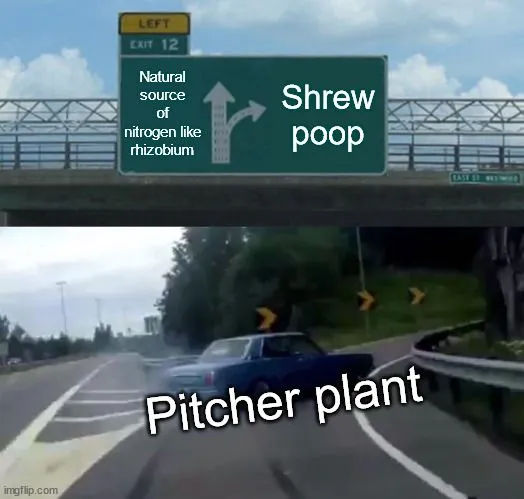
Nitrogen is the most abundant gas in the atmosphere, so it’s puzzling why plants should find it scarce. This is because nitrogen is already there in the air, but not in the soil, where plants could absorb it. Rhizobium bacteria can take nitrogen from the air and churn it into the soil. Plants rely on this, and in return, Rhizobium are provided sugars and shelter by the plant.
Carnivorous plants take a different route. Sundews, Venus flytraps, and pitcher plants tend to grow in bogs and other soils so poor in nitrogen that catching and digesting animals becomes worthwhile. A pitcher plant traps insects in a slippery, fluid-filled cup (a modified leaf, not a flower) and breaks the prey down to harvest its nitrogen.
But trapping insects is not the only trick in the book. In the cool, misty mountains of Borneo, the giant pitcher plant Nepenthes lowii grows tall pitchers that capture barely any insects at all. Instead, these plants persuade the mountain tree shrew (Tupaia montana), a squirrel-like little mammal, to do something far stranger: visit, feed, and poop on demand. As we will see, that arrangement supplies the bulk of the plant’s nitrogen.
How Did Researchers Figure Out The Shrew-pitcher Plant Relationship?
It is difficult to imagine how exactly scientists were able to decipher the nature of this relationship.
Imagine you see a Nepenthes plant bearing pitchers of two types. (A pitcher is a modified leaf, not a flower.) One kind dangles in the air, known as the aerial or upper pitcher, while another rests on the ground like a squat cup. Young Nepenthes plants produce mostly ground-level pitchers, but as they grow and climb, they switch to forming aerial ones.

The first thing you might wonder is why there are two different pitchers. Upon looking closer, the terrestrial pitchers have a slippery inner surface. This makes it hard for ants and other arthropods to find purchase, so they slide down past the lid into the fluid below. Aerial pitchers do not seem to be as slippery, indicating that they might serve a different purpose.
When observing these pitchers for a while, you would see insects regularly visiting, and dying, in the ground-dwelling pitchers. On the aerial pitchers, you would observe something quite unusual. Tree shrews make regular rounds to the same plants over and over, developing something of a circuit. They visit the plants on their route between noon and sunset.
But why would the shrews visit? Producing nectar costs the plant energy, so unless the shrews are thieves, the plant should be getting something from the shrew. You know that aerial and terrestrial pitchers look different, and that insects caught by terrestrial pitchers provide nitrogen.
Watch a single visit closely and the bargain becomes clear. The shrew climbs onto an aerial pitcher and licks a sugary white exudate from glands on the underside of the lid. The mouth of the pitcher and the angle of the lid are shaped so that the only comfortable way to reach the exudate is to straddle the opening, with the animal’s hindquarters poised directly over it. Tree shrews habitually mark a good food source with droppings, so while it feeds, the shrew defecates straight into the pitcher.
As we know, correlation (the shrew visiting) does not mean causation (the shrew somehow provides the pitcher plant with nitrogen).
To investigate whether the pitcher plant indeed gets its nitrogen from the shrew, researchers turned to Nitrogen-15.
Nitrogen-15 is a stable isotope of nitrogen. It contains the same number of protons and electrons as the most common isotope, nitrogen-14, but a different number of neutrons. Nitrogen-15 and nitrogen-14 are the only stable forms of nitrogen that exist. Approximately 99.6% of all nitrogen is nitrogen-14, but a rare 0.4% of it is nitrogen-15. Everything that contains nitrogen contains it in roughly these same proportions.
In order to find out just how much nitrogen the pitcher plant was getting from shrew poop, they compared the difference between the amount of nitrogen in the leaves between the aerial and terrestrial pitchers of similar species. They also needed to find out how much Nitrogen-15 was in shrew poop, as compared to the terrestrial pitcher of the similar species.
In short, they traced how much Nitrogen-15 was in shrew poop to see how much ended up in the aerial pitchers.
They found out that an astounding 57 to 100% of the nitrogen in the leaves of N. lowii plants with aerial pitchers comes from tree shrew droppings. The symbiosis between the shrew and the pitcher plant is no minor perk. Without it, these high-altitude pitcher plants would struggle to find the nitrogen they need to survive.
Conclusion
Plants have evolved to overcome scarcity in truly astounding ways. Who would have guessed that pitcher plants would use nectar to bait a specific species of shrew, and then use its poop as a nitrogen source? And N. lowii is not alone: its giant montane cousins N. rajah and N. macrophylla court tree shrews in the same way, while the largest of them, N. rajah, even collects droppings from the summit rat (Rattus baluensis) after dark. While poop might not be worth its weight in gold to you, it is certainly a matter of life and death for the pitcher plants of Borneo.
Just as plants got creative, researchers got creative too. While it might be easy to observe a correlative relationship in nature, it often requires a leap of faith or a clever use of technology to investigate how exactly a phenomenon takes place!
References (click to expand)
- Clarke, C. M., Bauer, U., Lee, C. C., Tuen, A. A., Rembold, K., & Moran, J. A. (2009, June 10). Tree shrew lavatories: a novel nitrogen sequestration strategy in a tropical pitcher plant. Biology Letters. The Royal Society.
- Chin, L., Moran, J. A., & Clarke, C. (2010). Trap geometry in three giant montane pitcher plant species from Borneo is a function of tree shrew body size. New Phytologist, 186(2), 461-470.
- Greenwood, M., Clarke, C., Lee, C. C., Gunsalam, A., & Clarke, R. H. (2011). A Unique Resource Mutualism between the Giant Bornean Pitcher Plant, Nepenthes rajah, and Members of a Small Mammal Community. PLoS ONE, 6(6), e21114.
- He, X., Xu, M., Qiu, G. Y., & Zhou, J. (2009, August 18). Use of 15N stable isotope to quantify nitrogen transfer between mycorrhizal plants. Journal of Plant Ecology. Oxford University Press (OUP).