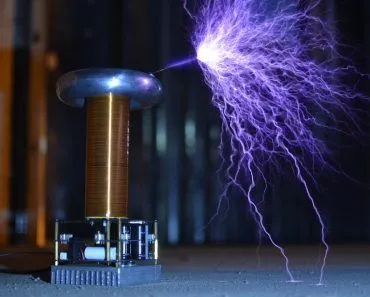
The sound we hear from power lines results from a phenomenon known as corona discharge. This occurs when the air surrounding an electrically charged conductor becomes ionized and causes an electrical discharge.
Have you ever heard a buzzing sound from the high power lines overhead or near transformers? These sounds are flat and monotonous but hard to ignore. Do you know why they are produced?
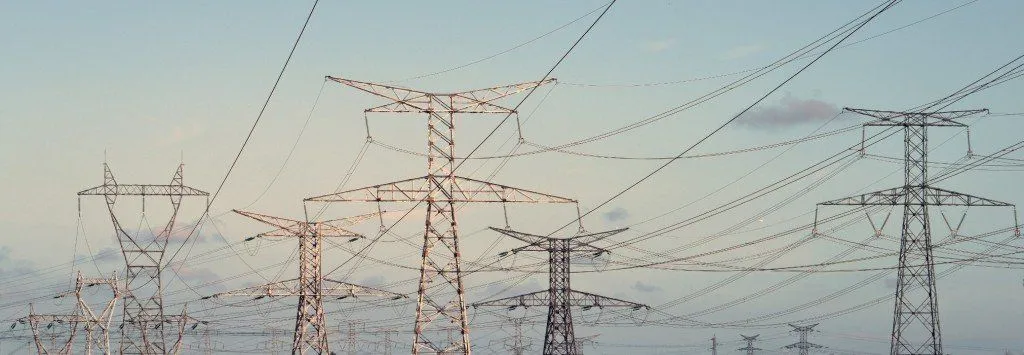
Let me start by telling you that that buzzing sound actually has a name!
Mains Hum Or Electric Hum
Electric hum, mains hum, or power line hum are all terms used to describe the sounds produced by transformers or power lines due to the alternating current passing at the mains electricity frequency. The grid itself runs at 50 Hz across the UK, Europe and Australia, and at 60 Hz across North America. Counterintuitively, though, the deepest tone you actually hear is not 50 or 60 Hz, but exactly double that: 100 Hz on a 50 Hz grid, and 120 Hz on a 60 Hz grid.
Why double? The vibrations that make the noise are driven by magnetic forces, and a magnetic force does not care which way the current is flowing. Over one full cycle of alternating current, the magnetic field swings to a peak, drops to zero, reverses, and peaks again, so the pull that shakes the metal happens twice per cycle. That doubles the fundamental hum frequency to 100 or 120 Hz, with a stack of higher harmonics layered on top. The exact pitch therefore depends on your country, since different parts of the world use different current frequencies.
Now that we know what ‘electric hums’ are, let’s look at the various reasons behind them.
The Buzzing/humming Sound Of A Transformer
Transformers hum for two main reasons: stray magnetic fields and magnetostriction. Magnetic fields cause the internal accessories of the transformer to vibrate at a frequency of either 50 or 60 Hz.
The other source of the electric hum produced by a transformer is magnetostriction. Magnetostriction occurs when a ferromagnetic material interacts with an alternating magnetic field, consequently undergoing minute expansion and contraction.
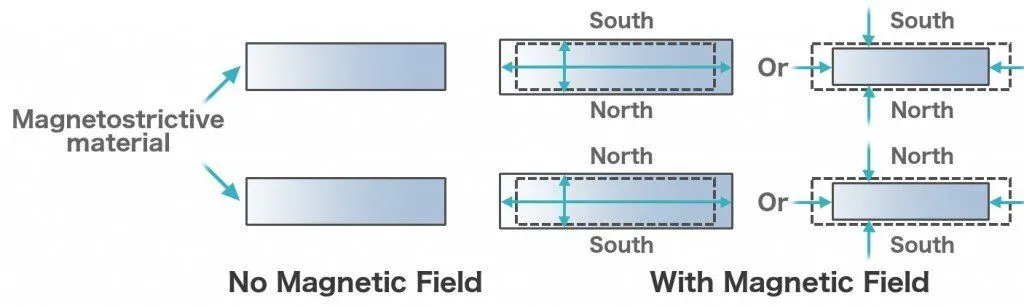
When the iron core within the transformer coils expands or contracts (i.e., changes shape minutely) due to the magnetic effect of alternating current flowing through it, it produces a small amount of vibration. This is what makes the transformer produce that constant buzzing sound.
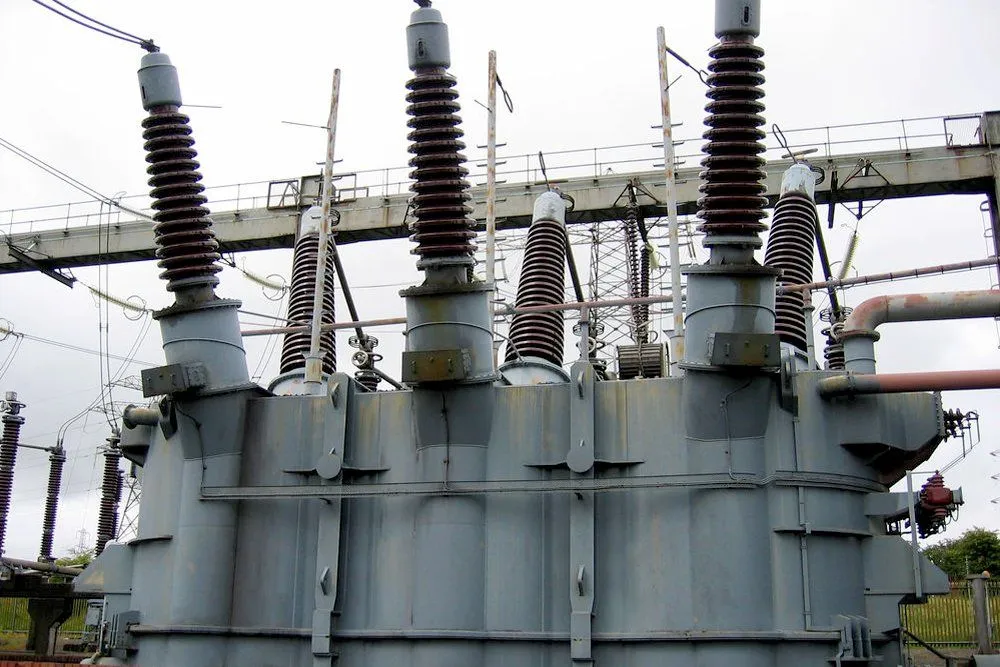
Certain design changes can reduce the buzzing sounds caused by transformers, but they cannot be completely eliminated.
It is important to note that the intensity of the humming sound is directly proportional to the applied voltage. This means that the higher the voltage, the louder the humming sound. As a result, some transformers may not produce an audible humming sound.
While this section focused on transformers, the explanation for the humming sound produced by overhead power lines is also quite interesting.
Buzzing/humming Sound Of High Power Lines
The sound you hear from overhead power lines results from a phenomenon known as corona discharge. This electrical discharge occurs when a fluid, such as air, surrounds an electrically charged conductor and becomes ionized.
This is like a spark of electricity that happens when a material, like air, is around an object carrying an electrical charge, like a power line, and the air gets charged up, too. It’s similar to the static you feel when you rub a balloon on your hair – the balloon carries a charge that it passes to your hair. Just like how your hair reacts (by standing up), the air around the power line also reacts (by producing sound) because it’s been energized or ‘ionized’.
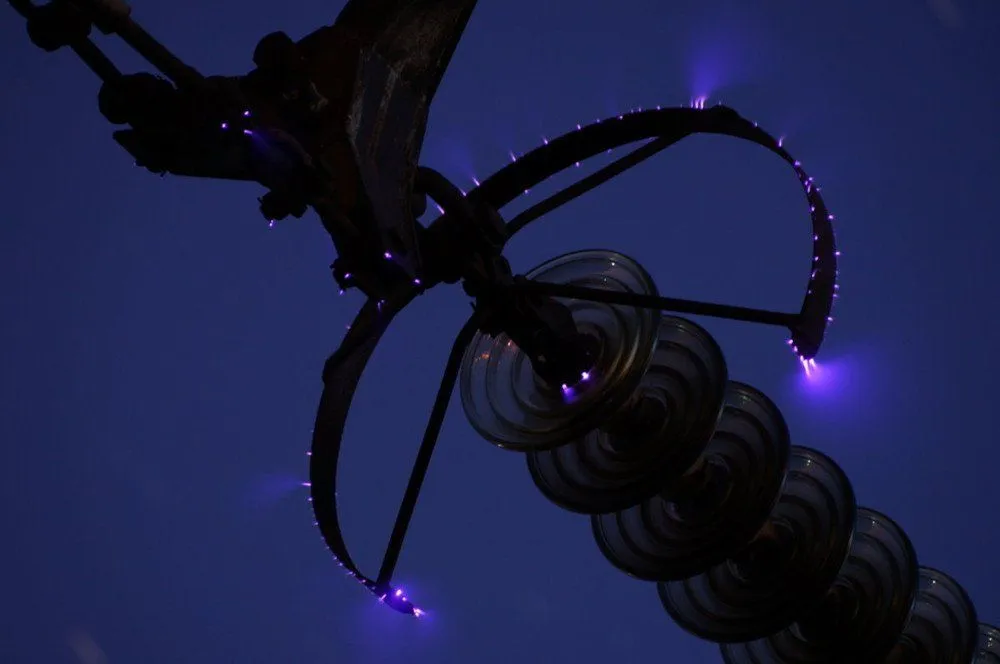
Corona discharge usually occurs in high-voltage systems unless steps have been taken to limit the range of the electric field.
Besides producing a slow, buzzing sound, it also creates a bluish glow surrounding power lines. This phenomenon is not very different from a lightning bolt. It’s a miniature version of a lightning strike, only that the latter produces a blinding flash of light (as opposed to a soft bluish glow) and a thundering boom (as opposed to a soft buzz).
Why Are Power Lines Louder In Rain, Fog And Humid Weather?
If you have ever noticed that the buzz of overhead lines gets noticeably louder on a damp, foggy morning or during a steady drizzle, you are not imagining it. Corona discharge is, in the words of utility engineers, basically a foul-weather phenomenon. On a dry, clear day a well-designed line may corona only faintly, but add moisture and the hum can swell into an audible crackle and hiss.

The reason is simple physics. Water increases the conductivity of the air, so it becomes easier for charge to leak off the conductor and ionize the surrounding air. As IEEE power engineer Robert Dent explained in Scientific American, "Water increases the conductivity of the air and so increases the intensity of the discharge." Corona discharges can be set off by water droplets, fog, snow and even thin films of moisture clinging to the line.
There is a second effect at work. Raindrops and dewdrops sitting on the cable form tiny pointed tips, and a sharp point concentrates the electric field far more than a smooth surface does. Each droplet becomes a little launch pad for corona, which is why a wet conductor can be dramatically noisier than the same line bone-dry. Research on corona discharge confirms that higher humidity and temperature push up corona losses, while the discharge subsides again once the surface dries out.
Is It Normal For Power Lines To Buzz, Or Should You Be Worried?
For the most part, a soft, steady hum from overhead lines and transformers is completely normal. As one utility puts it bluntly, there is no reason to be alarmed, because that low-level corona buzz is associated with essentially all transmission lines and simply gets louder in damp weather. A faint, unchanging drone is just electricity going about its business.
What is worth paying attention to is a change in the sound. A new, loud crackling, popping or sizzling noise, especially one paired with visible sparking or arcing, is a different beast from the gentle corona hum. That can signal a damaged insulator, a loose connection or a line that is failing, rather than healthy operation. If a line near you suddenly starts snapping and sparking, it is sensible to report it to your electricity utility.
The one situation that is always an emergency is a line that has come down or is sagging low. The Electrical Safety Foundation International advises that you should "assume that all downed power lines are live," that the ground "up to 35 feet away may be energized," and that you should call 911 for help if anyone is in contact with a line. In other words: a normal buzz is fine to walk under, but never approach a fallen, sparking or arcing wire. Treat it as live, keep your distance, and let the professionals handle it.
Last Updated By: Ashish Tiwari
References (click to expand)
- Goldman, M., Goldman, A., & Sigmond, R. S. (1985, January 1). The corona discharge, its properties and specific uses. Pure and Applied Chemistry. Walter de Gruyter GmbH.
- Corona discharge ignition.
- Goldman, M., Goldman, A., & Sigmond, R. S. (1985, January 1). The corona discharge, its properties and specific uses. Pure and Applied Chemistry. Walter de Gruyter GmbH.
- Chang, J.-S., Lawless, P. A., & Yamamoto, T. (1991). Corona discharge processes. IEEE Transactions on Plasma Science. Institute of Electrical and Electronics Engineers (IEEE).
- Zaitsev, I. O., & Kuchanskyy, V. V. (2021). Corona Discharge Problem in Extra High Voltage Transmission Line. Studies in Systems, Decision and Control. Springer International Publishing.
- What causes the noise emitted from high-voltage power lines? Scientific American (Robert Dent, IEEE Power Engineering Society).
- Quantifying and mitigating electrical and environmental impacts of corona discharge. Scientific Reports (2025). PMC, NCBI.
- Downed Power Lines. Electrical Safety Foundation International (ESFI).
- Why high-voltage power lines hum in some weather conditions. Omaha Public Power District (OPPD).