A knot in wood is the cross-section of a branch that the trunk grew around. As the tree thickened year by year, each branch base was engulfed by new wood. Knots from living branches fuse with the surrounding grain (intergrown or tight knots); knots from dead branches stay separate and can fall out of a sawn board, leaving a knothole behind (encased or loose knots).
Recently, I was reading the famous novel To Kill A Mockingbird by the late author Harper Lee; in that book is a memorable reference to a knothole in a tree. In the book, the brother-sister duo of Jem and Scout discover a few items (including a small box containing coins, a ball of twine, two figures carved from soap, an entire pack of gum, a spelling medal, and a pocket watch) hidden in the knothole of a tree.
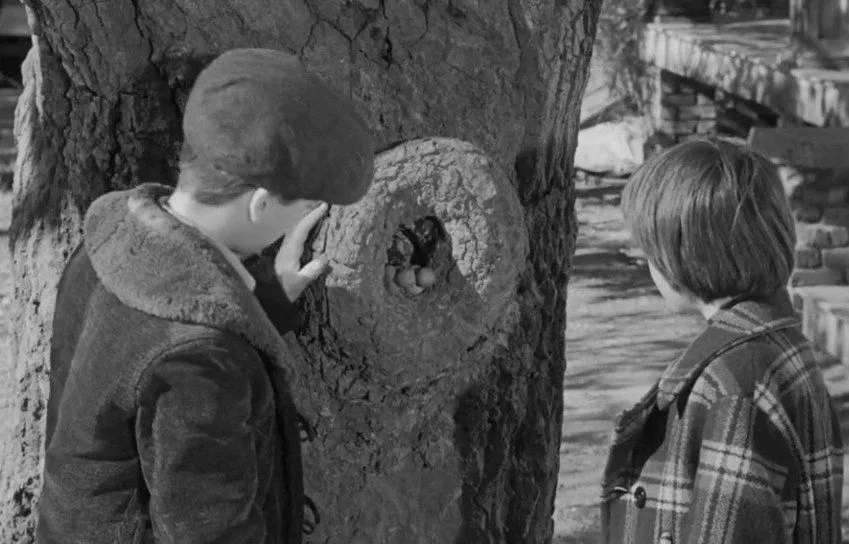
I’ve always been fascinated by knotholes that form on tree trunks; they are nifty and fascinating details that, for some reason, don’t seem to make much sense! Have you ever given it any thought: how do knots form on tree trunks?
Tree trunks are basically solid, right? So how do such knots, which may appear like lumps or holes, appear on the trunk?
What Are Knots?
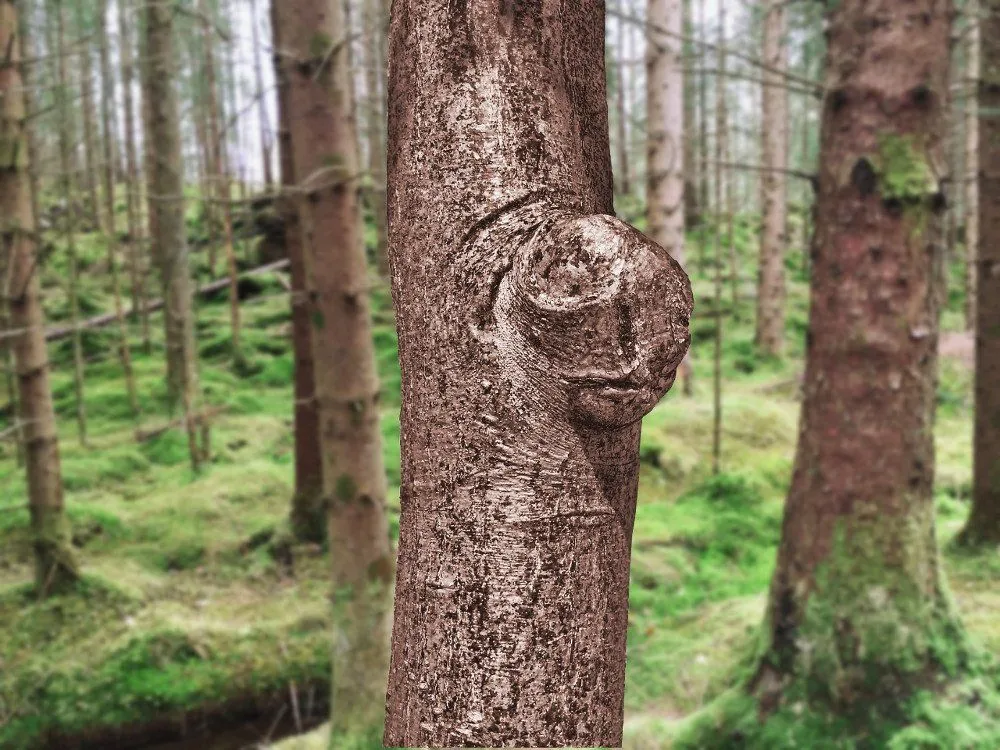
Knots are the bases of branches embedded inside the trunk wood. In simple words, they are the places where a branch once grew out of the tree, and as the trunk continued to widen, it grew around (or over) that branch base, locking it inside. From the outside they often show up as roughly circular lumps or holes on the bark; on a sawn plank, they appear as those familiar darker oval patches you see in pine furniture.
How Are Knots Formed On Tree Trunks?
One of the primary reasons behind the formation of knots is the natural growth of the tree. As a tree continues to grow, its lower branches tend to die off and their bases may become overgrown and enclosed by subsequent layers of trunk wood. This leads to the formation of an imperfection in the tree trunk that we refer to as a knot. So, you could say that the knots in wood appear in places where branches once were.
Let me briefly explain how a typical knot forms on the trunk of a tree: you see, as a tree grows, its trunk naturally gets bigger too (i.e., its circumference increases). It so happens that the continuously growing trunk overtakes the branches that sprout out from its own surface. As a result, knots form around these branches, and trunk material continues to build up as the tree expands further. The wood in the knot is usually very tough (even harder than the surrounding wood), and therefore, forms a hard bulge around the branch emerging from its center.
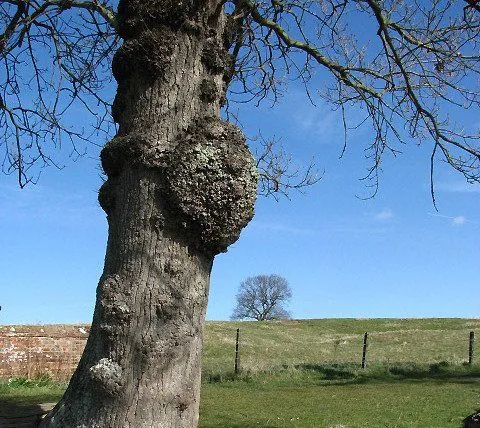
It is important to understand that the dead branch may not be attached to the trunk wood, except at its base. Also, a knot on the surface of a branch (or log) of a tree always represents a knot in the wood beneath it. And when such an encased branch eventually rots away (or falls out of a sawn board) you are left with the gap that woodworkers (and readers of To Kill a Mockingbird) call a knothole.
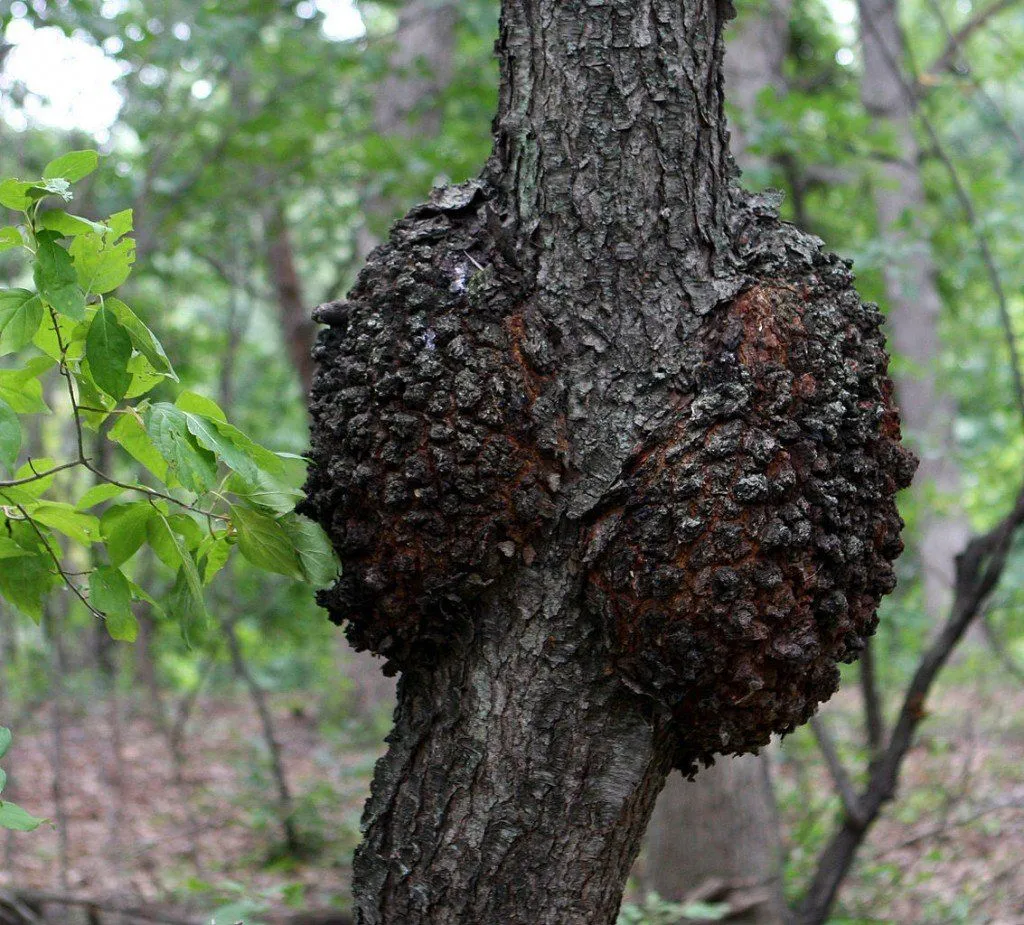
Not every lump on a tree forms by this quiet overgrowth process, though. Injuries, broken tops and certain diseases can each leave their own marks on a trunk, and the resulting structures are often lumped in with "knots" in casual conversation, even though wood scientists separate them out. In the cherry and plum family, for example, the fungus Apiosporina morbosa causes a disease called black knot, which produces those hard, black, warty galls you sometimes see crowding a branch. The galls look knotty enough to share the name, but they are actually fungal tissue rather than true wood knots.
Types Of Knots In Wood
Forestry and lumber grading actually split knots into a couple of useful categories, and the distinction matters once a tree ends up at the sawmill.
An intergrown knot (also called a tight, live or sound knot) forms when the trunk engulfs a still-living branch. The wood fibers of the branch and trunk grow continuously into each other, so the knot stays firmly locked in the board even after sawing. These show up as those clean, oval, darker patches you see in furniture-grade pine.
An encased knot (also called a loose or dead knot) forms when the branch dies first, and the trunk grows around it without fusing. The dead branch is wrapped in trunk wood, but its fibers never bond. That is why these knots often pop out of a sawn board, leaving the round knothole behind.
You will also see a few size-and-shape names on lumber grading sheets: pin knots are tiny ones, less than about half an inch (roughly 13 mm) across; spike knots are elongated branches that happen to have been sawn lengthwise; and knot clusters are groups of small knots crammed close together.
And not every woody outgrowth on a tree is a true knot, either. Burls are rounded, gnarled bumps caused by stress, injury, viruses or insect damage; the cambium starts growing in a disorganized, swirly pattern, and the result does not contain a buried branch at all. Their unusual, twisting grain is exactly what makes burls so prized for turned bowls and decorative veneers.
Effects Of Knots
Knots are known to affect the technical properties of the wood. They are pretty hard to cut through themselves, but also reduce the local strength of the wood that surrounds them. However, they don’t necessarily affect the stiffness of structural timber, as elastic strength and stiffness are more dependent on the sound wood than upon localized defects.
Knots are not always bad though; they are often exploited for visual effect. In some cases, knots on trunks add to the aesthetic appeal of the planks that are sawn from those trees.
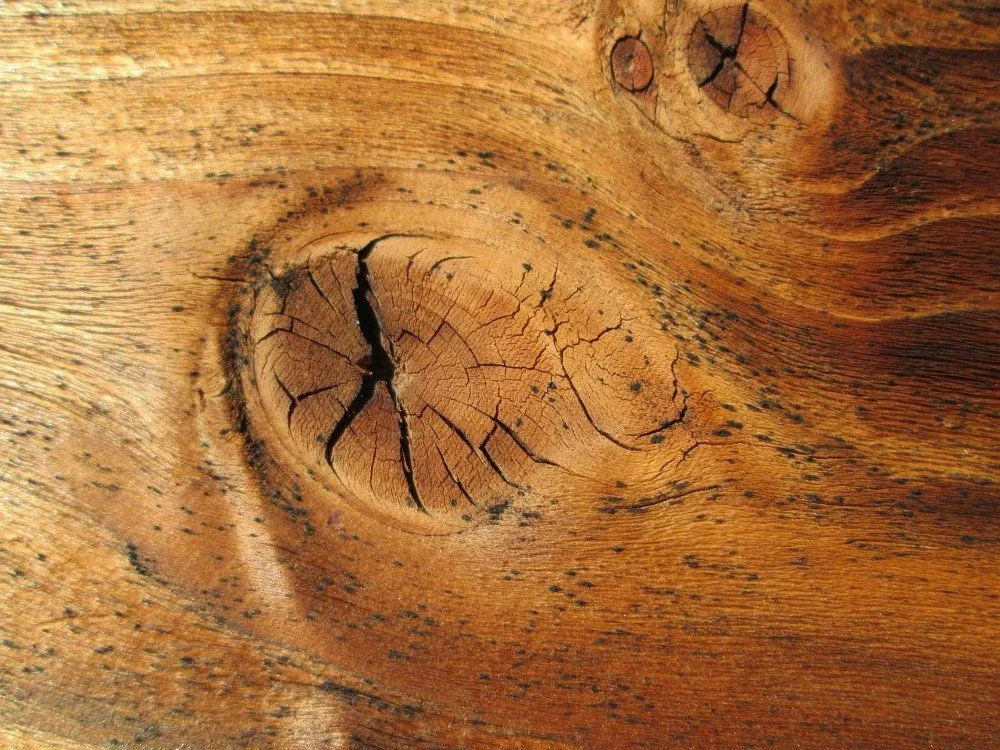
In a plank that is cut longitudinally, a knot appears as a roughly circular “solid” (usually darker) piece of wood around which the grain (‘grain’ refers to the pattern resulting from the longitudinal arrangement of wood fibers) of the rest of the wood “flows” (parts and rejoins).
Thus, knots might compromise the local strength of the wood, but they also add to the aesthetic appeal of wooden furniture.
Why Are Knots Harder Than The Surrounding Wood?
Anyone who has tried to drive a nail or run a plane through a board knows the feeling: the blade glides through the clear wood and then hits the knot like a pebble. We noted earlier that knots are usually harder than the wood around them, but why should a buried branch be so much tougher? Three things stack up.

First, geometry. A knot is the cross-section of a branch, so its fibers run roughly end-on to the face of the plank rather than lying flat along it. You are effectively cutting into end grain, which is far denser and harder to sever than the side grain of the surrounding board. Second, the wood at a branch base is often denser to begin with. To hold a heavy limb in position, conifers lay down stiff reaction wood (in softwoods this is called compression wood), and the US Forest Service notes that its specific gravity is frequently 30 to 40 percent greater than normal wood. Third, chemistry. Softwood knots are soaked in resin and natural compounds called lignans; a peer-reviewed analysis reports that spruce knotwood can hold 6 to 24 percent lignans by weight, several times the extractive content of the surrounding trunk wood. As that resin dries, it sets the knot into a hard, almost varnished plug. Put the three together, and it is no wonder a saw squeals when it reaches a knot.
What Is A Knothole?
You may have noticed that I opened this article with a knothole, not a knot: the hollow where Jem and Scout found their little treasures. So what exactly is a knothole, and how is it different from the knot itself? A knothole is simply the gap left behind once a knot is gone. In a plank it is, as the dictionary puts it, a void left by a knot in the wood; in a living tree it is the cavity left where a branch rotted and fell away. The trunk keeps adding a fresh growth ring each year, yet it never fills that opening back in.
Remember the two families of knots from earlier? Intergrown (tight) knots are fused into the surrounding grain and tend to stay put. Encased (dead) knots, on the other hand, were never bonded to the trunk wood, so once a board is sawn and handled, these loose knots can simply drop out, leaving the clean, round hole that woodworkers (and fence-peering children) call a knothole. Because nothing fills that space, a knothole is the structurally weakest spot in a piece of timber: the US Forest Service points out that while intergrown knots "resist some kinds of stress," encased knots or knotholes "resist little or no stress" at all. That is why a single knothole in the wrong place can downgrade an otherwise sound board.
What Is A Tree Knot Called?
It is surprising how often people go hunting for the right word for these woody lumps, whether to settle an argument or to fill in a crossword grid. The plain answer is the simplest one: a knot is just a knot, and the hole it leaves is a knothole. A rounded, swirly-grained bump on a trunk is a burl, as we saw above. But English keeps a few older, gnarlier words in reserve.
A knar (sometimes spelled knur) is defined in the dictionary as a knot or burl in a tree, a hard protuberance on its trunk or branch. A gnarl is "a knot in wood ... a protuberance with twisted grain, on a tree." These words all trace back to the same Middle English root, knarre, meaning a knot in wood, which is exactly why a tree covered in such bumps is described as gnarled. Crossword setters are especially fond of them, because they are short and vowel-light: a clue fishing for a four- or five-letter word meaning a woody knot is often after KNAR, KNUR, GNARL or BURL rather than the everyday "knot." Either way, every one of these words points back to the same thing we started with: the buried base of a branch that the trunk grew around.
References (click to expand)
- Knots - forest.mtu.edu:80
- Holes - forest.mtu.edu:80
- Black knot | UMN Extension. extension.umn.edu
- Black Knot of Prunus in the Home Landscape - Penn State Extension
- Know Your Knots: Defects, Characteristics & Grades - NELMA Grader Academy
- Go Figure: How Tree Burls Grow - Northern Woodlands
- Properties of Wood and Structural Wood Products - Timber Bridges (Ch. 3). USDA Forest Service
- Lignan-Rich Coniferous Knotwood Extractives - Antioxidants / PMC
- knothole - Wiktionary
- knar - Wiktionary
- gnarl - Wiktionary