Rockets launch nearly vertically, then curve over because their real goal isn’t to reach space — it’s to reach orbit. Orbit requires a sideways speed of about 28,000 km/h (17,500 mph). A maneuver called the gravity turn uses Earth’s pull to gently tip the rocket onto a sideways trajectory, saving fuel that would otherwise be spent fighting gravity.
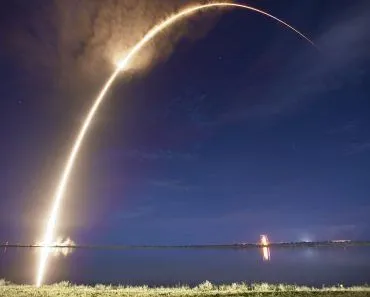
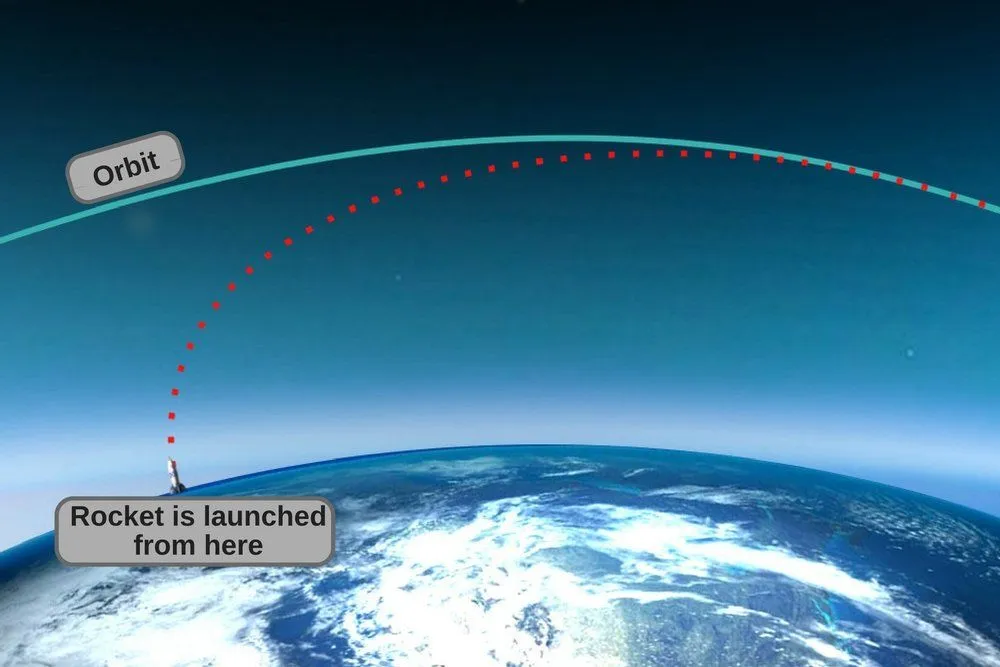
Take a look at this picture of the trajectory of a launched rocket:
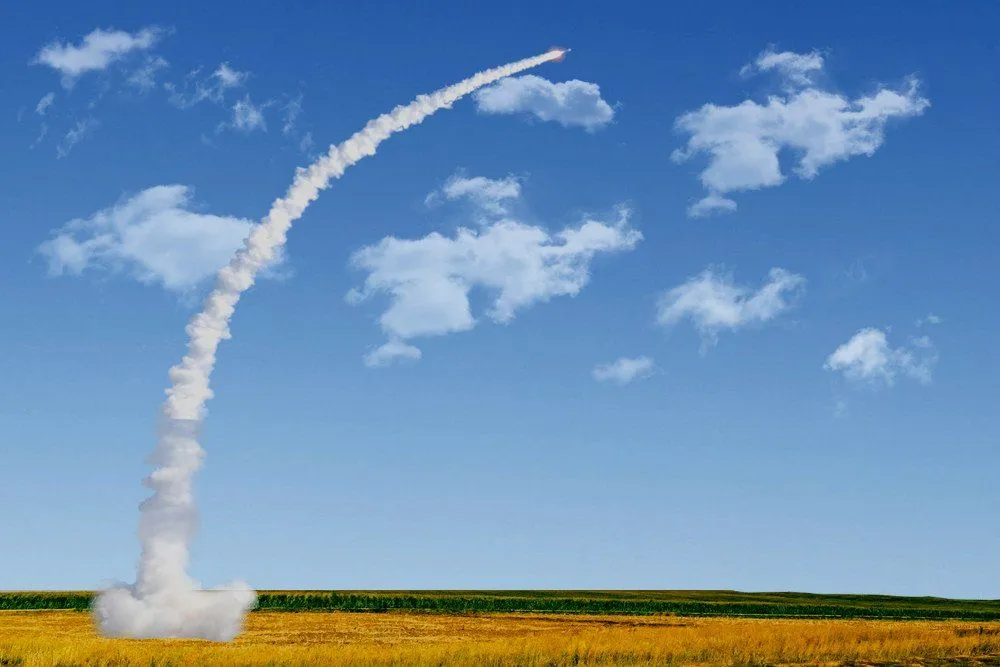
Do you notice the rather intriguing thing about the rocket’s path? Instead of moving in a straight line, the rocket follows a curved trajectory. This isn’t a mistake—you will see the exact same thing in every other picture and video of a rocket launch.
Even so, it doesn’t seem to make sense. The rockets are supposed to go into space. So wouldn’t it make more sense if they went straight up in a line, rather than following a parabolic path? They’d reach space much faster that way, it would seem. There must be a reason because rocket scientists tend to be pretty smart, so why do they not go straight up?
Why Do Rockets Launch Vertically?
In the context of space technology, a rocket is something that can send people and stuff into space. That thin, cylindrical, very tall vehicle launches from the launch pad, leaving a humongous cloud of smoke in its wake.
In theory, it could launch like an airplane taking off from a runway, but that would require several changes in the current rocket designs and be downright uneconomical. (Check out Why Don’t Space Shuttles Take Off Like Airplanes?)
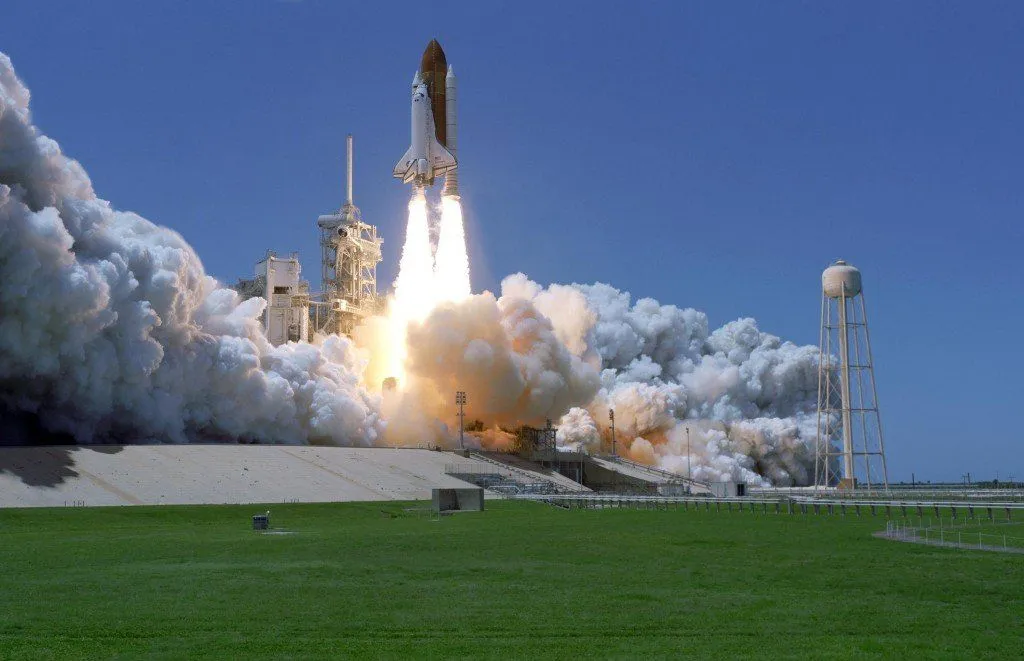
Rockets are launched vertically with tremendous upward thrust, thanks to their engines and the solid boosters attached (jettisoned soon after the launch). Following the launch, the rocket’s climb is initially slow, but by the end of the first minute into the ascent, the rocket is moving at a staggering 1,000 mph (1,609 kmph). (Source)
As a rocket soars through the atmosphere, it expends a substantial portion of its energy battling air resistance. To optimize its fuel usage, the rocket must swiftly ascend to a high altitude, piercing through the densest part of the atmosphere in the shortest distance possible. This strategic maneuvering is a testament to the meticulous planning and precision involved in rocket launches.
Why Does A Rocket’s Trajectory Change After The Launch?
Much confusion about a rocket’s trajectory stems from the common assumption that most rockets want to escape Earth’s gravity and reach ‘space’.
While this is not technically incorrect, it does not paint a clear picture.
First, space is not all that far away (you might want to check out: Where does space begin?).
You are officially considered ‘in space’ if you fly above 100 km (62 miles) above Earth — the so-called Kármán line. The US Air Force is more generous: anyone who flies above 80 km (~50 miles) earns ‘astronaut’ wings. Felix Baumgartner’s 2012 ‘space jump’ from 39 km (~24 miles) — and Alan Eustace’s 2014 record-breaking 41.4 km jump that beat it — are famously called space dives, even though neither actually started in space.
There’s one singular takeaway from all of this….

Hence, it’s not that rockets simply want to reach ‘space’; they can actually do that using much less fuel. What most rockets really want to do is enter the Earth’s ‘orbit’.
Why Is Making It Into The Orbit So Important?
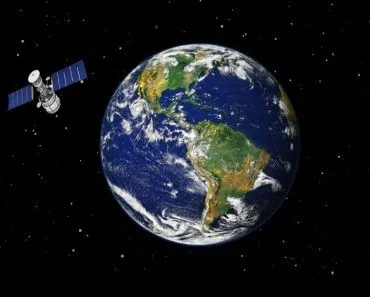
The primary goal of rockets is to attain the planet’s orbit and stay there. Once a rocket reaches the planet’s orbit, the gravitational pull of the planet keeps it from drifting off into outer space. However, the gravitational pull is not so strong that the rocket must burn massive fuel to prevent it from plummeting back to Earth.
To enter orbit, a rocket initially tilts onto its side and gradually increases the tilt until it achieves an elliptical orbit around Earth.
However, attaining the desired orbit is not easy. It requires a huge quantity of fuel to reach a horizontal velocity of roughly 28,000 km/h (17,500 mph) at low-Earth-orbit altitudes (Source). The technique used to optimize the spacecraft’s trajectory to attain the desired path is called a gravity turn or a zero-lift turn.
This technique provides two significant benefits. Firstly, it allows the rocket to maintain a low or zero angle of attack during the early stages of ascent, which means the rocket experiences less aerodynamic stress. Secondly, it allows the rocket to use Earth’s gravity instead of its own fuel to change direction. The rocket can save the fuel that it would have used to change direction and use it to accelerate horizontally to attain a high speed and enter the orbit easily.
In summary, a rocket must curve its trajectory after launch to enter Earth’s orbit. If it goes straight up without curving its path, it will eventually run out of fuel and plummet back to Earth like a stone.
Do Rockets Ever Go Straight Up? Why Not?
This is the question most people actually have in mind: rockets clearly start by pointing straight at the sky, so why don’t they just keep going that way? Picture firing a cannonball straight up. It climbs, slows down, stops, and then falls right back to where it started. A rocket that burned all its fuel pushing straight up would do exactly the same thing. The moment the engines cut off, there’s nothing left to hold it up, so gravity wins and it drops back toward the ground.

Staying in space isn’t about how high you go; it’s about how fast you move sideways. To stay in orbit, a spacecraft has to travel sideways at roughly 28,000 km/h (17,500 mph), fast enough that as gravity curves its path downward, the ground curves away beneath it just as quickly. The vehicle is effectively falling forever and keeps missing the planet. As the Smithsonian’s National Air and Space Museum puts it, “if a rocket just flew straight up, then it would fall right back down to Earth when it ran out of fuel.”
So a rocket does begin almost straight up, but only to punch through the thick lower atmosphere as quickly as possible. After that it has to spend the bulk of its fuel building horizontal speed, not altitude. Going straight up the whole way would waste that fuel fighting gravity and leave the rocket with no way to stay up. For more on how a payload settles into a stable loop, see our piece on how satellites are put into orbit.
Why Do Rocket Launches Look So Slow?
Have you ever watched a launch livestream and thought the rocket looked oddly sluggish, almost like it was crawling off the pad? It’s a common reaction, and the rocket isn’t slow at all. Within about a minute of liftoff a large rocket is already supersonic and pushing through “max Q,” the point of greatest aerodynamic stress, on its way to thousands of kilometers per hour. The slowness is an illusion created by distance and sheer scale.

What your eyes actually track is not the rocket’s real speed but its angular speed across your field of view. For an object moving across your line of sight, that angular speed is roughly its sideways velocity divided by its distance from you (ω = v/r), so the farther away something is, the slower it appears to move even at the same true speed. Spectators and cameras sit several kilometers from the pad for safety, and a vehicle tens of kilometers away sweeps through only a sliver of angle each second.
Scale fools us too. A rocket can stand 70 meters tall, taller than most office buildings, yet from a distance it shrinks to a bright dot. Our brains judge speed by comparing motion to nearby reference points, and out over open sky or ocean there are none, so the mind quietly underestimates how fast that dot is really climbing. Up close, the same vehicle would blur past in an instant.
Last Updated By: Ashish Tiwari
References (click to expand)
- Rocket Principles.
- Launch a rocket from a spinning planet.
- He, S., & Lee, C.-H. (2018, January). Gravity-Turn-Assisted Optimal Guidance Law. Journal of Guidance, Control, and Dynamics. American Institute of Aeronautics and Astronautics (AIAA).
- Lawden, D. F. (1991, July). Rocket trajectory optimization - 1950-1963. Journal of Guidance, Control, and Dynamics. American Institute of Aeronautics and Astronautics (AIAA).
- Why do rockets curve when they fly into space instead of going straight? Ask an Explainer. Smithsonian National Air and Space Museum.
- Angle of Rotation and Angular Velocity. Physics. OpenStax (Rice University).