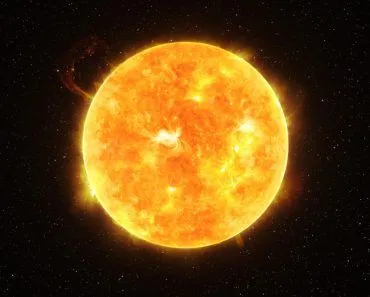
The Sun is actually a white star. At noon, its light travels through the thinnest slice of atmosphere and reaches you as a near-equal mix of all colors, which your eye reads as blinding white. At sunrise and sunset, sunlight slants in at a low angle and crosses much more air, so Rayleigh scattering strips away the shorter blue and violet wavelengths and leaves the longer red and orange light to dominate, making the rising or setting Sun look red.
Interestingly, the Sun (usually depicted as a friendly yellow ball in elementary school books) is actually a white star. Seen from space, with no atmosphere in the way, it would look near-white. From the surface of Earth, it appears to shift colors over the course of a day: when it rises above the horizon, it generally has a red tint; as it moves higher in the sky, it loses the redness and becomes brighter, appearing blindingly white around noon.
Looking directly at the Sun during the day is, of course, not advisable, as it is extremely bright. If observed safely through proper solar filters, it appears white. As the Sun sinks back towards the horizon at the end of the day, it once again takes on a reddish hue.
This article will explain why the sun appears reddish during sunrise and sunset but white at noon.
Sunlight And Earth’s Atmosphere
The Earth’s atmosphere comprises various gases, water vapor, and dust particles. Its protective layer provides numerous benefits, such as sustaining all life forms on Earth by supplying essential gases for biochemical processes, shielding the planet’s inhabitants from harmful solar radiation, and repelling almost all foreign inanimate objects from space.

Moreover, the atmosphere causes some fascinating phenomena, such as the flow of winds, the blue hue of the sky, and the sun’s varied colors at different times of the day.
Let’s begin with sunrise, as all life forms do.
Why Does The Sun Appear Red During Sunrise?
Sunlight is a combination of different types of electromagnetic radiation. You might have heard this term before. You can read this article right now because of visible light, a type of electromagnetic radiation.
There are many other types of electromagnetic radiation, such as radio waves in wireless communication, infrared in night vision glasses and TV remotes, X-rays in healthcare, and gamma rays associated with nuclear power.
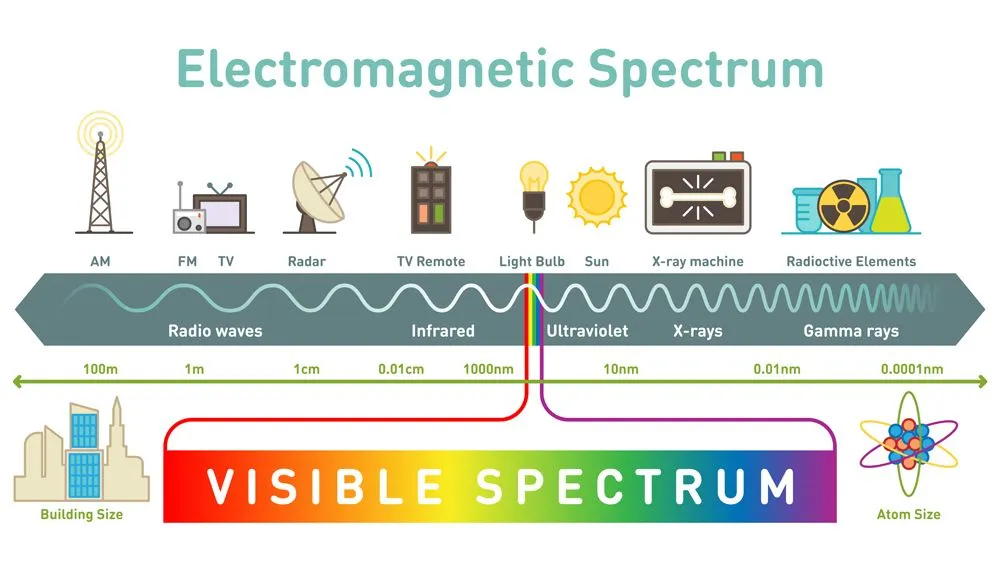
While the sun emits all types of electromagnetic radiation, most of the sunlight comprises visible light, ultraviolet rays, and infrared rays (heat). You might remember from your high school science class that sunlight is white because it consists of all seven colors of the rainbow, each with different wavelengths.
When sunlight reaches the atmosphere, the particles scatter light with shorter wavelengths (blue and violet) while letting longer-wavelength colors like red, yellow, and orange pass through. This is why the sun appears red when viewed near the horizon. Redder wavelengths from celestial bodies like the sun or moon penetrate the atmosphere better than other colors.
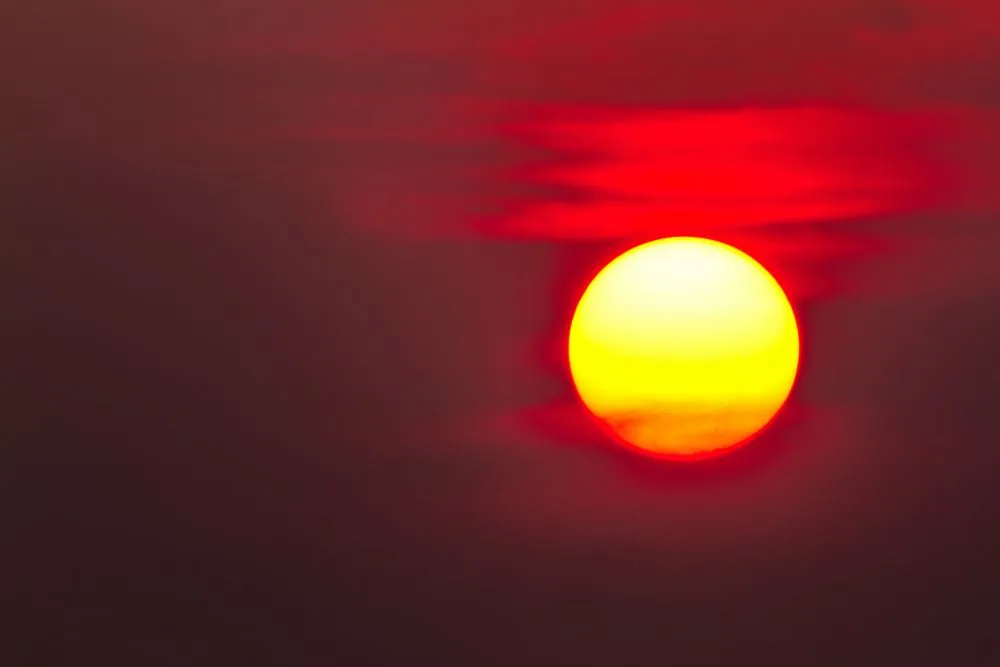
And why does the sun look particularly red when it sets or rises?
Because at sunset or sunrise, sunlight must travel through the maximum amount of atmosphere to reach the observer’s eyes. Due to this, more blue light gets scattered from the sunlight, making the sun look redder when it rises or sets.
Rayleigh Scattering
A natural phenomenon known as Rayleigh scattering (named after a British physicist called Lord Rayleigh) dictates that shorter wavelengths (blue) of light are scattered more easily than longer ones (red). This is why the sky appears blue and the sun (or sometimes even the moon) appears red or orange.
Rayleigh scattering is kind of like why you see dust flying around when you shine a torch – it scatters the light. Imagine light as a team of runners of different heights running a race. The shorter runners (blue light) get jumbled up and bounced around more than the taller runners (red light).
Why Does The Sun Appear White At Noon?
When the sun is directly overhead, sunlight must travel through the least amount of Earth’s atmosphere to reach the observer’s eyes. Because of this, all colors of sunlight reach the observer’s eyes with almost equal intensity, and this combination of colors gives the sun a blinding white hue.
However, this hue should never be observed with the naked eye.

The sun appears red because red light is more effective at penetrating the atmosphere than other colors. Celestial bodies visible from Earth have a reddish or orange hue depending on their position in the sky and the time of day.
Why Does The Sun Look Yellow Or Orange In Between?
If the noon Sun is white and the setting Sun is red, what about all the colors in between? Most of us would draw the Sun as a cheerful yellow ball, and on many afternoons that is exactly how it looks. The yellow and orange are simply the in-between stages of the same story.

Air molecules scatter the short blue and violet wavelengths far more strongly than the long red ones, by roughly a factor of ten. Even when the Sun is fairly high, a little blue is skimmed off its direct light, so the disc looks slightly yellow rather than pure white. As the Sun drops lower through the morning and evening, its light wades through more and more air, more blue is peeled away, and the disc shifts from white to yellow to orange and finally to deep red right at the horizon. So yellow and orange are not separate effects; they are the same scattering process caught partway through. The exact shade on any given day also depends on how much dust, smoke, or humidity is hanging in the air, which is why some sunsets glow a fierce orange while others fade to a pale gold.
Why Does The Sky Look White Near The Sun At Noon?
Here is a question that trips up a lot of people: it is not only the Sun that can look washed out at midday, but the sky around it too. On a clear winter day the noon sky is a deep blue, yet on a hazy or humid summer afternoon the sky near the overhead Sun often turns a milky, glaring white. Why the difference?
The deep blue of a clear sky comes from Rayleigh scattering off tiny air molecules, which favors blue light. But the air also carries larger particles, including dust, smoke, pollution, and tiny water droplets, called aerosols. These particles are comparable in size to the wavelength of visible light or bigger, so they scatter through a different process called Mie scattering. Crucially, Mie scattering treats all colors almost equally instead of favoring blue. When light bounces off these larger particles it stays white, and that white light mixes into the sky and dilutes the blue.
According to the textbook Practical Meteorology, aerosols with diameters greater than about 0.1 micrometers are 10 to 1,000 times more efficient at scattering light than air molecules are, which is exactly why polluted or humid air looks hazy. So when the air is loaded with moisture or particles, especially looking toward the bright overhead Sun where you are staring down the most direct glare, the extra white light from Mie scattering swamps the blue and the sky pales to a glaring near-white. The same physics gives clouds their white color, since cloud droplets scatter every wavelength of visible light in all directions.
What Does A Red Sky Tell You About The Weather?
Long before satellites and forecast apps, sailors and farmers read the colors of the sky. You have probably heard the old rhyme: red sky at night, sailors' delight; red sky in the morning, sailors take warning. It turns out there is real science behind it.

In the middle latitudes where the United States, the United Kingdom, and much of Australia and Canada sit, weather systems generally drift from west to east. A vivid red sky at sunset means the setting Sun in the west is sending its scattered red light through clear, dry, dust-rich air. As Scientific American explains, dust and aerosol concentrations are highest in the lowest layers of the atmosphere when sinking high-pressure air dominates, which is why those evening reds turn especially radiant. High pressure usually means fair weather is on the way, hence the sailor's delight. A red sky at sunrise in the east, by contrast, can mean that good weather has already moved off to the east and a wetter system may be approaching from the west.
The same particles that paint these skies can be supplied dramatically by wildfires, volcanic eruptions, and pollution. Smoke particles are larger than air molecules and are very effective at removing blue light, so a smoky sky can turn the Sun and Moon a deep, eerie red even high above the horizon, as it did across San Francisco in 2020. So if the Sun looks unusually red one morning, it may be telling you that there is extra dust or smoke in the air, not just that it is low in the sky.
Last Updated By: Ashish Tiwari
References (click to expand)
- Composition of the Sun.
- The Solar Composition.
- Rayleigh scattering.
- Chemistry in the Sunlight.
- The Appearance of the Sky. UCAR Center for Science Education.
- Why Is the Sky Blue? NASA Space Place.
- Aerosols in the Atmosphere. NASA GISS.
- Scattering. Practical Meteorology, R. Stull.
- Red Sky at Night, Sailors' Delight: Scientific Validity. Scientific American.