Table of Contents (click to expand)
The night sky turns red or orange when it rains because of light pollution. Low rain clouds act like a ceiling that reflects a city's artificial light back down to the ground, and this glow makes the sky appear reddish. Out in the countryside, away from city lights, you won't see it.
Have you ever observed that on some days, especially after it rains, the night sky appears to be somewhat reddish? Yet, strangely enough, you wouldn’t observe the same thing during the day. Given that, why does the sky turn reddish, or even bluish in the evening after it rains?
To begin with, let me inform you that the reddish hue of the night sky is a relatively recent phenomenon on our planetary timeline; in other words, it wasn’t observed a few decades ago. This goes to show that the phenomenon is not entirely natural, at least in terms of the underlying cause.
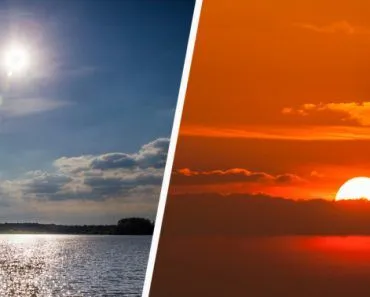
You might already know the reason behind the blue color of the sky during the day; simply put, it happens due to the scattering of light by particles present in the atmosphere. The light coming from the sun that illuminates our planet consists of seven different-colored components, and the particles in the atmosphere spread shorter blue wavelengths more than longer red wavelengths, hence the blue color of the sky during the day. But at night, when there is no sunlight to get scattered through the atmosphere, how does the sky appear illuminated?
As it turns out, it’s the artificial lighting of big cities that lights the sky up at night. To better understand how this works, we’ll have to explore something known as ‘skyglow’.
Skyglow
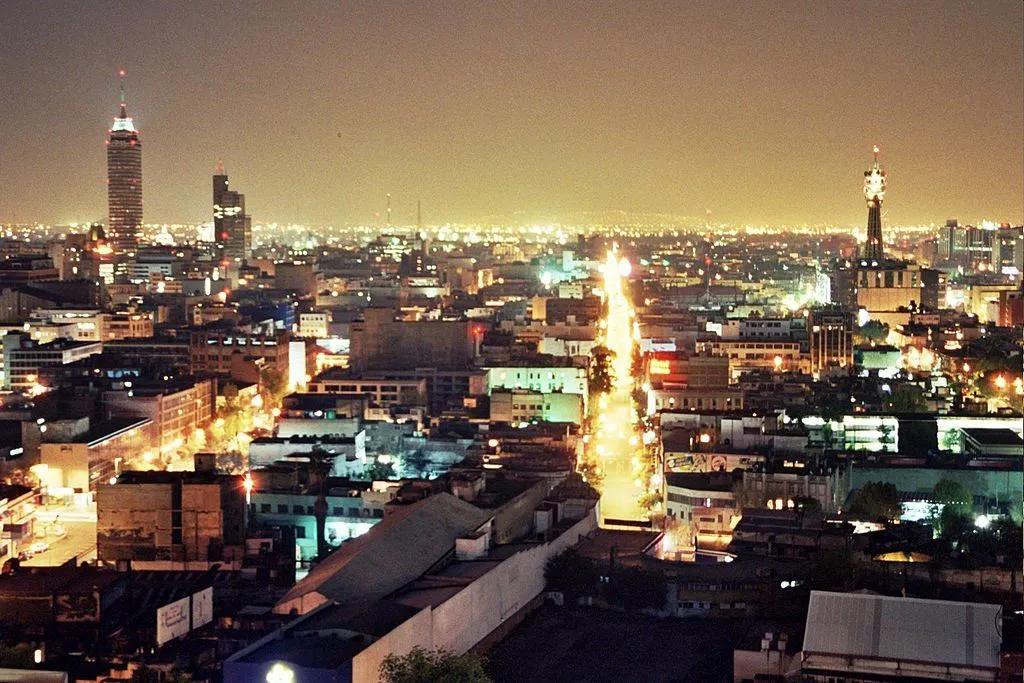
Even in the absence of sunlight, the night sky is not completely drenched in darkness; natural sources like the moon and stars give some illumination to the sky. The term skyglow, however, is usually used to refer to the luminance of the night sky due to artificial sources, such as excessive lighting from a metropolitan area. Skyglow is a prominent side effect of light pollution.
The luminosity of the night sky seems to be magnified after rains, i.e., when there is cloud cover in the sky. On clear nights, the shorter wavelengths of artificial light are scattered more easily, giving the night sky a slightly bluish hue.
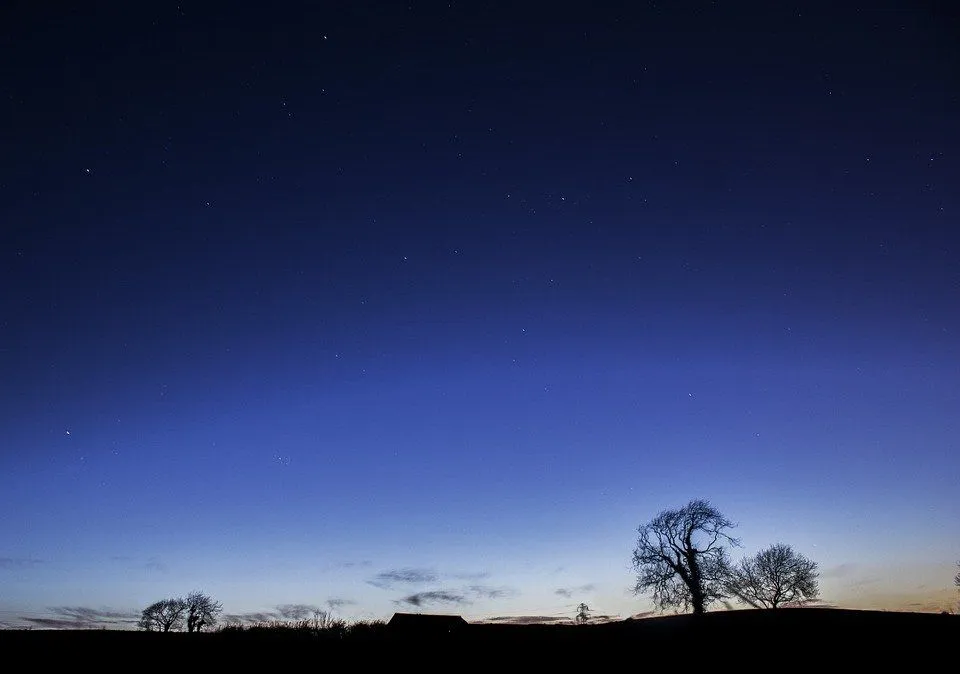
However, when there is cloud cover, the longer wavelengths (i.e. red) of artificial light, instead of transmitting through the atmosphere and ending up in space, will scatter back to Earth.
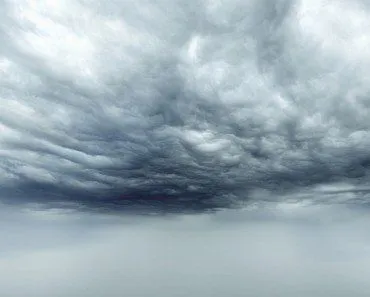
If you want to delve a bit deeper, clouds can be classified into three main categories: upper, middle and low-level clouds. The clouds that you see in the sky when it rains are usually low clouds. You can’t see the middle and upper-level clouds unless they block the sun or moon and thereby hinder their ability to reach Earth.
The reddish hue that you see at sunset (especially during rainy seasons) is due to the reflection of light from the low-cloud base, which happens to be relatively close to the ground. This is how rain plays an important role in changing the hue of the sky from blue to pale-white, yellowish-orange (especially over brightly lit roads) or even reddish.
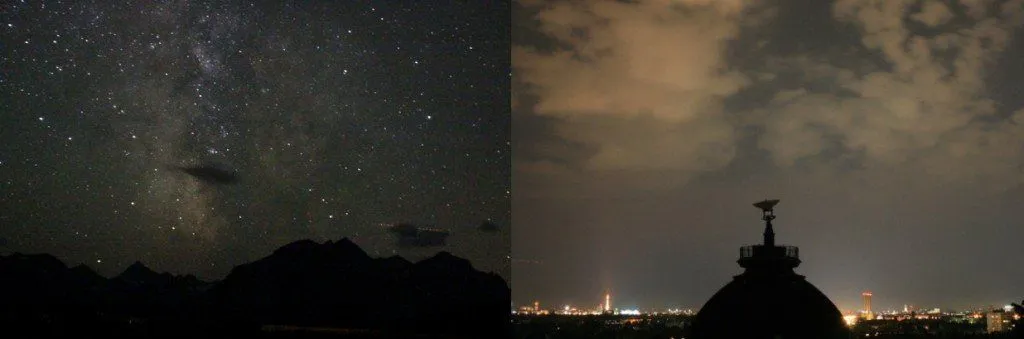
In a study conducted by a team of scientists led by Christopher Kyba from the Freie Universitaet and the Leibniz Institute of Freshwater Ecology and Inland Fisheries, they took measurements for hours every night for months in Berlin. It was observed that the blue portion of the sky was about 7 times (7.1x) more radiant on cloudy nights than on clear nights, while the red portion was roughly 18 times (17.6x) brighter! In other words, clouds amplify a city's red light far more than its blue light, which is exactly why an overcast, rainy night sky leans reddish-orange. The study was aptly titled "Red is the new black".
You normally wouldn’t see a reddish tinge while it’s still raining, as the visibility becomes poor at night and therefore you can’t see the reflected light. Once the rain stops, however, the unusually-colored sky appears once again.
Red Sky At Night, Sailor's Delight: The Natural Red Sky
Now, before you blame every red sky on city lights, here's the twist: not all of them are artificial. Long before skyglow existed, sailors and shepherds were already reading the colors of the dawn and dusk sky, and the deep reds they saw were entirely natural. This is a different beast from the rainy-night glow we just discussed.

The cause is the very same scattering of sunlight that paints the daytime sky blue. When the Sun sits low on the horizon at sunrise or sunset, its light has to plow through a far thicker slice of atmosphere to reach you. Along that long path, the short blue and violet wavelengths are scattered away in every direction, and what survives the journey to your eye is dominated by the longer red and orange wavelengths. The dustier or hazier the air, the richer the red.
That observation hardened into a proverb roughly two thousand years old (a version even appears in the Bible, where Matthew 16:2-3 quotes, "When it is evening, ye say, fair weather: for the heaven is red"): "Red sky at night, sailor's delight; red sky in the morning, sailor's warning." And there is genuine meteorology behind it. Across the mid-latitudes (roughly 30° to 60° north and south, a belt that covers most of the United States, the UK, Canada and southern Australia), weather systems generally drift from west to east. A glowing red sunset means the western sky is full of dry, dust-laden air under high pressure, and since that fair weather is heading your way, you can expect a pleasant day. A red sunrise, by contrast, means that the high pressure has already slid off to the east, often leaving the door open for a low-pressure system (and rain) to roll in from the west. The rule only holds inside that belt of prevailing westerlies, which happens to be exactly where most ScienceABC readers live.
What Is That Flash Of Light You See During A Rainstorm?
The reddish glow is not the only thing a rainy sky throws at you. Every so often the whole sky lights up for a split second in a brilliant flash. That flash is lightning, a colossal spark of static electricity, and it is one of the most reliable companions of a heavy storm.

Inside a tall storm cloud, powerful updrafts and downdrafts fling ice crystals and soft hail (called graupel) violently against one another. Each collision strips away electric charge: the lighter ice crystals tend to carry positive charge up toward the top of the cloud, while the heavier graupel collects negative charge lower down. Air is normally a good insulator, so for a while it keeps these opposite charges apart. But once the separation grows large enough, the air's insulating ability breaks down and the stored-up electricity discharges all at once, either within a cloud, between two clouds, or down to the ground. That discharge is the flash you see.
And it is staggeringly hot. A lightning channel heats the surrounding air to around 28,000 °C (50,000 °F) in a fraction of a second, several times hotter than the surface of the Sun. The air explodes outward as a shock wave, and that pressure wave is exactly what reaches your ears moments later as a clap of thunder. (Ever wondered why the bolt zig-zags across the sky instead of dropping straight down? We unpack that in our piece on why lightning is zig-zag shaped.)
Not A Good Thing…
As picturesque as it may seem, this lightening of the sky is not a good thing from an ecological standpoint. Both human beings and animals are used to their circadian rhythms – the internal biological cycles that dictate when we should be sleeping and when we should be awake. Messing with that rhythm can have a number of negative impacts on your health, as well as disturb the equilibrium of nature.
Changing the way we light our cities can directly help to curb the problem of light pollution, which happens to be the root cause of this problem. Street lights with old gas-discharge (sodium) lamps are increasingly being replaced by LEDs, which last longer, are cheaper to run, and switch on and off instantly. Here, though, is a twist worth knowing: swapping to LEDs is not an automatic win for the night sky. Many early LED conversions used cool, blue-rich white light, and because the atmosphere scatters those shorter blue wavelengths so strongly (the same reason daytime skies are blue), several cities actually saw skyglow stay the same or get worse. Studies of conversions in places like Tucson, Arizona found that the benefits show up only when the new lights are properly shielded, dimmed, and tuned to warmer, amber tones. So the fix is not LEDs alone, but smart LEDs pointed at the ground rather than the sky. In the meantime, what you can do while sitting at home is avoid flooding your room with unnecessary artificial lighting and thus limit your contribution to light pollution in your tiny corner of the world!
References (click to expand)
- Atmospheric optics - Wikipedia. Wikipedia
- Colours of Clouds - www.weather.gov.hk
- Non-Instrument Weather Forecasting. The University of Hawaiʻi System
- Fact or Fiction?: If the Sky Is Green, Run for Cover—A Tornado .... Scientific American
- Kyba, C. C. M. et al. Red is the new black: how the colour of urban skyglow varies with cloud cover. Monthly Notices of the Royal Astronomical Society (2012).
- Barentine, J. C. et al. Skyglow Changes Over Tucson, Arizona, Resulting From A Municipal LED Street Lighting Conversion. arXiv (2018).
- The Appearance of the Sky. UCAR Center for Science Education.
- Red Sky in the Morning. NOAA Global Monitoring Laboratory.
- Is there scientific validity to the saying 'Red sky at night, sailors' delight...'? Scientific American.
- Severe Weather 101: Lightning Basics. NOAA National Severe Storms Laboratory.