Table of Contents (click to expand)
A calorie is a unit of energy, not a measure of weight. One small calorie is the energy needed to raise the temperature of 1 gram of water by 1 °C. The “calorie” on food labels is actually the large Calorie, or kilocalorie (kcal), which equals 1,000 small calories, the energy to warm 1 kilogram of water by 1 °C.
“Hey man! You need to cut down on your calories!“
“My calorie count doesn’t allow me to have those chips.”
“Mr. Mathers, you’re going overboard with your calories.”
If you’re the kind of person who cares about his/her body, then there is a good chance that you’ve heard the word ‘calorie’ plenty of times in your life, particularly from nutritionists, dietitians, and other medical professionals.
‘Calorie’ For Beginners
If you happen to be one of those people who’ve heard the word ‘calorie’ innumerable times, but still have no idea what it actually means, then this article is for you.
A calorie is a basic unit of measurement. For example, when we need to express distance, we use meters; ‘Usain Bolt ran 100 meters in just 9.58 seconds‘. This sentence contains two units. One is meter (a unit of distance) and the other is ‘second’ (a unit of time). Similarly, calories are also units of measurement of a certain physical quantity.
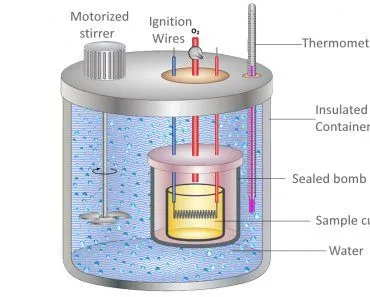
Many assume (since it is commonly associated with the weight of a person) that a calorie is the measure of weight. However, this is not true. A calorie is actually a unit (measure) of energy. In technical terms, 1 small calorie is equal to the energy required to raise the temperature of 1 gram of water by 1 degree Celsius (about 4.18 joules).
Calories come in two different sizes: small calories and large calories. The one that shows up on food packaging is the large Calorie, also called the kilocalorie (kcal), and it is equal to 1,000 small calories. That makes the large Calorie the energy needed to heat 1 kilogram of water by 1 degree Celsius. Confusingly, food labels usually write this big unit with a lowercase ‘c’, so when a wrapper says ‘250 calories’, it really means 250 large Calories (250 kcal), or 250,000 of those tiny ones.
You have probably seen ‘calorie ratings’ on packets of many things (chocolates, potato chips etc.). Imagine that the value of a calorie rating on an item is ‘100 Calories’. This means that you would gain roughly that much energy when you consume it (although the value printed on the label and how much your body actually extracts from it are never exactly the same).
Why Do We Say ‘Burning’ Or ‘Cutting’ Calories?
Since “calorie” is a measure of energy, when someone says that he is burning a lot of calories at the gym, it essentially means that he is expending a lot of energy at the gym!
I’m sure that you didn’t think ‘cutting calories’ actually had anything to do with this, right?
Calorie Count
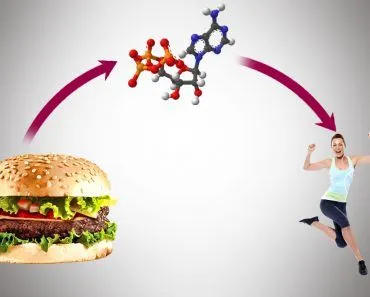
Everything that we consume has a particular calorie count; it is the measure of the energy stored in the chemical bonds of the thing that we are consuming.
What we eat is built mostly from three energy-yielding nutrients: carbohydrates, proteins and fats. Using the Atwater factors that nutritionists rely on, here is roughly how many Calories (kcal) your body gets from 1 gram of each:
1. Carbohydrate – 4 Calories (kcal)
2. Protein – 4 Calories (kcal)
3. Fat – 9 Calories (kcal)
4. Alcohol – 7 Calories (kcal)
Notice that fat is the most energy-dense of the bunch, packing more than twice the Calories of carbohydrate or protein for the same weight. That is why fatty foods add up so quickly on a calorie count, and why alcohol (at 7 Calories a gram) is sneakier than most people expect.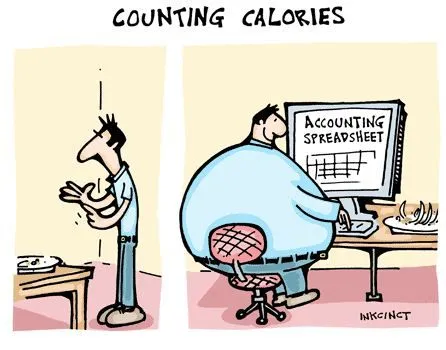
Are Calories Bad For Me?
This is essentially the same thing as asking, “Is energy bad for me?”
Every single action that is performed by the body requires energy. Standing, walking, running, sitting and even eating all require energy. If you’re conducting any of these activities, it means that you’re using energy, which essentially means that you are ‘burning’ calories, more specifically, the calories that entered your body when you consumed some food.
In short, NO… calories are not bad for you.
Balance Is The Key
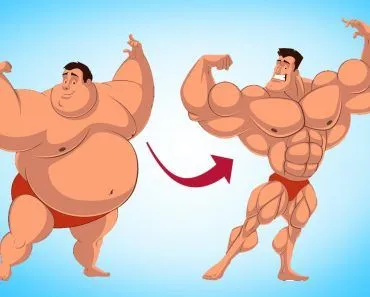
You need to find a balance between the number of calories that you’re consuming and the number of calories that you’re burning or using up. If you consume fewer calories than you spend, then you will gradually slim down, while on the other hand, if you’re gobbling up lots of calories but are being a couch potato, then you will eventually pile on weight.
Every activity that we perform over the course of a day results in the expenditure of some calories. Here is a small list of some of the most common activities that we frequently perform, as well as the number of calories that are burnt while doing them.
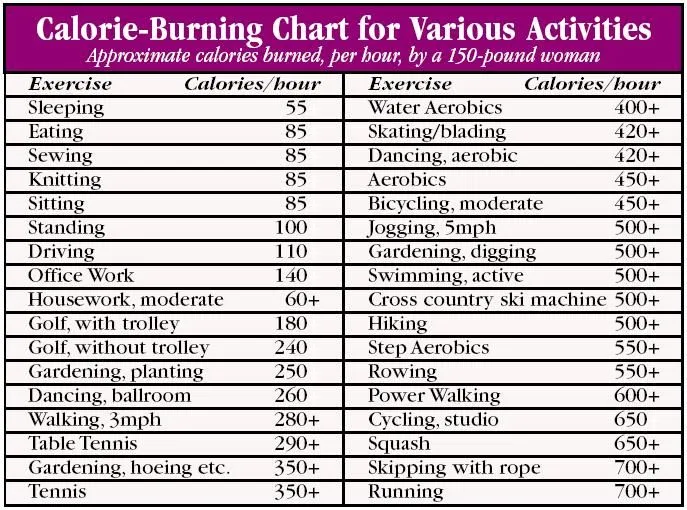 This simple mechanism that keeps track of the incoming and outgoing calories in the body is called our metabolism. The metabolism of a human being is what makes them look dangerously thin, excessively heavy, or downright dapper. The bulk of this happens while you do nothing at all: your basal metabolic rate (the energy your body spends just keeping the heart beating, the lungs working and the cells running) accounts for roughly 60 to 70 percent of the calories you burn in a day.
To keep your total number of calories in check, it’s a good idea to record the number of calories that you consume and the number of calories that you burn every day. There should be a balance between the two to maintain a fit body.
You may have heard the popular rule that 3,500 calories add up to one pound (about 0.45 kilograms) of body fat, so cutting 500 calories a day should melt off a pound a week. It is a handy starting point, but treat it as a rough guide rather than a law. The figure dates back to a 1958 estimate, and it assumes the math stays perfectly linear, which it does not. As you lose weight, your body adapts and quietly burns fewer calories at rest (a slowdown scientists call adaptive thermogenesis), so real-world weight loss tapers off and the pounds come off more slowly than the simple rule predicts. That is why researchers at the National Institutes of Health built a dynamic Body Weight Planner to replace the old 3,500-calorie shortcut.
Here is a short video that explains how the number of calories consumed affects different people in different ways. It also shows how the mentioned calorie count on packages is different from how much energy you actually gain by consuming what the package contains!
References (click to expand)
- Calorie | Definition & Measurement. Encyclopaedia Britannica
- Biochemistry, Heat and Calories. StatPearls. NCBI Bookshelf
- Foundation Foods Documentation (Atwater factors). USDA FoodData Central
- NIH Body Weight Planner. National Institute of Diabetes and Digestive and Kidney Diseases (NIDDK)
- Calorie. Wikipedia