No, burnt toast does not have the same amount of calories as regular toast.
There are few foods as universally beloved as bread; it has formed one of the foundational pillars of the human diet for thousands of years, and remains a vital staple all over the world. That being said, white bread isn’t the most interesting choice for a meal; in fact, “white bread” is often used to describe something that is very boring, plain or drab.
If white bread is a common part of your diet, then you are surely familiar with the process of toasting that same bread. A warm slice of toast slathered with melting butter is often far more delectable than a flimsy slice of white bread. The physical change in color and texture (between bread and toast) is immediately noticeable, which leads many people to wonder whether the nutritional content changes as well!
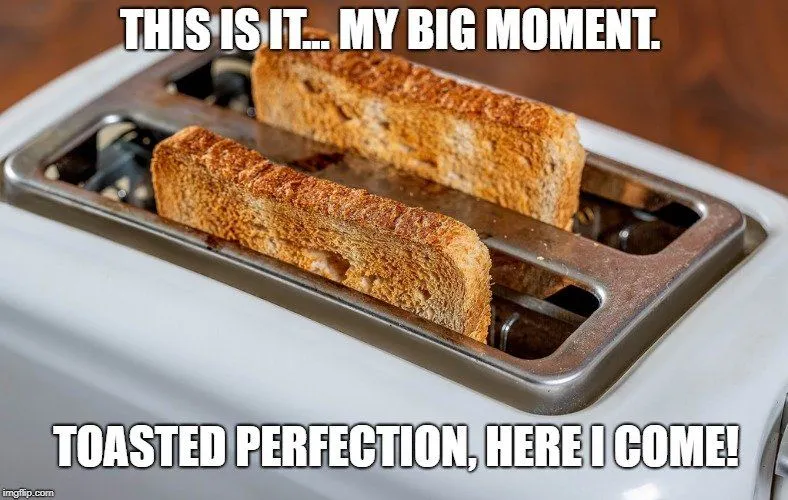
If toasting a piece of bread can help to reduce the caloric content of this carb-dense food, it may be ideal for people trying to lose weight! Before we get into the caloric shift that occurs in the process of toasting bread, let’s first look at what actually happens when you slip a slice into your toaster!
What Happens When Bread Is Toasted?
When you put a slice of bread in the toaster and the coils begin to heat up, a very special chemical reaction occurs. At temperatures of roughly 140–165 °C (285–330 °F), a Maillard reaction proceeds rapidly across the surface of the bread. You may not be familiar with the name of this process, but you have certainly enjoyed its effects in countless different foods. This is essentially a form of caramelization involving the outer molecules of the bread, namely the amino acids and sugars. The heat evaporates any excess water, which induces the start of these reactions on the outer molecules of the bread.
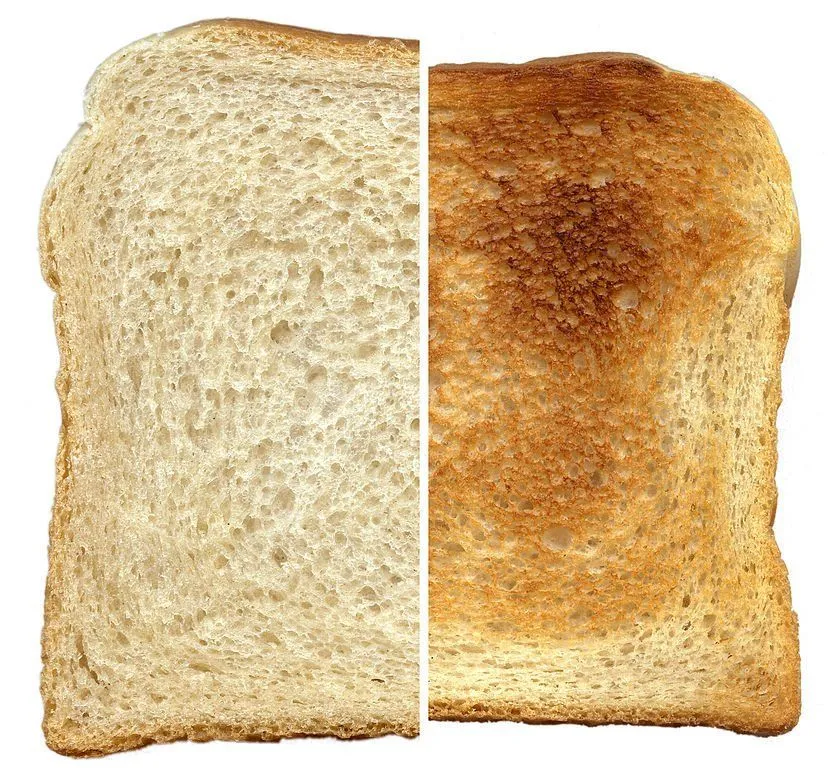
This reaction is a form of non-enzymatic browning, and will give the bread a slightly sweeter taste. This is due to the release of certain aromatic and flavor-producing compounds when the Maillard reaction occurs. These compounds are called furanones, and give toast its pleasant flavor, and also makes it a perfect complement for other sweet and savory toppings.

Although a piece of toast may look like it is brown all over, the toasted portions are almost always restricted to the outer layer, maybe 5-10% of the entire piece of bread, in terms of toasted volume. That’s why, if you toast a piece of bread a bit too long, you can easily scrape off the burnt portions, revealing the lighter colored toast/bread beneath it.
If you burn toast, it isn’t that the outer edges are becoming “more” burnt; instead, more of the molecules in the middle of the bread are undergoing the Maillard reaction, thus deepening the browning color. Unfortunately, when toast is burnt too badly, it can also release carcinogens, meaning that it can increase your risk of cancer. Additionally, the taste of a badly burnt piece of toast is anything but pleasant! Now that we understand the chemical processes that go into toasting a piece of bread, let’s take a look at the original question, the effect of toasting on the nutritional content of the bread, specifically the calorie count!
Is Toasting Bread A Physical Or Chemical Change?
This is the question that trips up half of every chemistry class, and the honest answer is that toasting bundles both kinds of change into one pop of the toaster. The first thing the heat does is drive water out of the slice, leaving it drier, crisper and lighter. That part, on its own, is a physical change; no new substance is created, you have simply removed moisture.

The browning, though, is pure chemistry. As we just saw, that golden color comes from the Maillard reaction, in which the reducing sugars and amino acids in the bread react and rearrange into brand-new molecules, including the brown pigments known as melanoidins and hundreds of aroma compounds that simply were not present in the soft white dough. Because genuinely new substances are formed, and because you can never cool a slice back down and un-toast it into fresh bread, the defining transformation is classed as a chemical change. That rearrangement is a one-way street. So when your teacher asks whether making toast is physical or chemical, the textbook answer is chemical, with the drying along for the ride as a physical bonus.
The Effect Of Toasting Of Bread On Its Nutritional Value
In recent years, some people have claimed that toasting bread can help reduce its calories, thus making it a good option for people trying to lose weight. Now, if you consider one slice of standard white bread, it typically contains about 70 calories, roughly 10% of which comes from fat. When you toast a piece of bread, as explained above, the water is removed, but this doesn’t mean that any of the calories are necessarily lost. The caloric change in a piece of bread is negligible, unless you badly burn the toast, in which case, it will likely be inedible.
That being said, toasting bread has been shown to lower the glycemic index of the food in question. In other words, by toasting bread, it will have less of an impact on your blood sugar levels. This is potentially helpful for people watching their blood sugar, though the effect is modest and depends heavily on the bread itself; people with diabetes should follow their clinician’s advice rather than rely on toasting alone.
Some of the other notable nutritional changes in toast versus bread is a small drop (~20%) in the amount of B vitamins, from 5% of your daily requirement to approximately 4% of your daily dose. Earlier, we mentioned that burning toast can release dangerous carcinogens; small amounts of acrylamide are released when bread is toasted, but the levels of this unwanted chemical are nothing to worry about until you are truly scorching your breakfast slice.
How Many Calories Are In A Slice Of Toast?
If you have ever squinted at a loaf wondering what a single slice actually costs you, here are the numbers. The U.S. Department of Agriculture lists toasted white bread at about 290 calories per 100 grams, which works out to roughly 65 to 80 calories for a typical slice, depending on whether it is a thin sandwich slice or a thick bakery cut. Whole wheat toast lands in much the same range.

The key thing to notice is that this is almost identical to the figure for the untoasted slice it started as. Toasting only drives off water, and water carries zero calories, so the calorie count of the slice itself barely moves; the figure per gram actually creeps up a touch, simply because the slice now weighs a little less while holding the same energy. What really swings the total is what you put on top: a generous spread of butter or a spoon of jam can easily add as many calories again as the toast underneath it.
Does Burning Food Actually Remove Calories?
It is one of the internet’s favorite kitchen myths: burn your food and you burn away the calories. There is a sliver of truth in it, but not nearly enough to be useful. A food’s calories are simply the chemical energy stored in its carbohydrates, fats and protein, the familiar 4, 9 and 4 calories per gram, and that energy is measured by completely burning a dried sample inside a sealed device called a bomb calorimeter. Your body extracts a little less than that figure, because some energy is always lost in waste.

When you char food past brown and into black, some of those carbohydrates break down toward plain carbon and drift away as smoke, and carbon is not something your gut can digest for energy. So a truly blackened patch really does carry slightly fewer usable calories than the unburnt version. The catch is that the saving is trivial: only the thin outer crust ever blackens, while the bulk of the slice stays untouched, so you would have to scorch the whole thing to an inedible cinder to shed a meaningful number of calories. Worse, that heavy charring is exactly what drives up acrylamide and similar compounds flagged as probable carcinogens, all while degrading heat-sensitive nutrients such as the B vitamins. As a weight-loss trick, in other words, burning your breakfast is all downside. If you genuinely want fewer calories, just cut a thinner slice.
Other Benefits Of Toast
While toasting your bread isn’t the secret to slicing calories out of your diet, there are some other potential health benefits of eating toast. When it comes to digestion, toast works as a much better binder for your stool than white bread, meaning that it can be an ideal choice if you are struggling with diarrhea or other stomach issues. If you are feeling nauseous or hung over, eating toast is known to have a neutralizing and settling effect on the gut, reducing your chances of vomiting. Finally, as a dense and easily consumed bundle of carbohydrates, with the added bonus of having a lower glycemic index than regular bread, toast can provide a great energy boost in the morning.

References (click to expand)
- Mottram, D. S. (n.d.). The Maillard Reaction: Source of Flavour in Thermally Processed Foods. Flavours and Fragrances. Springer Berlin Heidelberg.
- Hedegaard, R. V., Granby, K., Frandsen, H., Thygesen, J., & Skibsted, L. H. (2007, September 26). Acrylamide in bread. Effect of prooxidants and antioxidants. European Food Research and Technology. Springer Science and Business Media LLC.
- Finot P. (1990). The Maillard Reaction in Food Processing, Human Nutrition and Physiology. Springer Science & Business Media
- Maillard Reaction in Flour Product Processing: Mechanism, Impact on Quality, and Mitigation Strategies. Foods. National Library of Medicine (PMC).
- Dietary Energy. National Library of Medicine (PMC).
- Bread, white, commercially prepared, toasted. FoodData Central, U.S. Department of Agriculture.