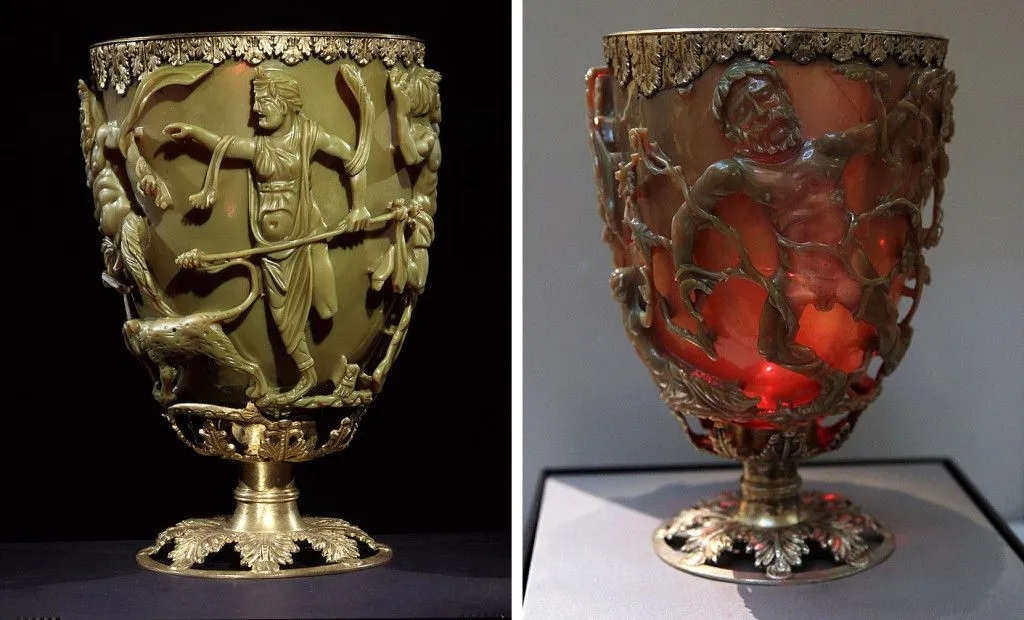
Yes. The Lycurgus Cup, a 4th-century Roman glass, looks green in reflected light but red in transmitted light. This dichroism comes from tiny silver-gold alloy nanoparticles (about 50 to 100 nm) scattered through the glass, which absorb and scatter different wavelengths via surface plasmon resonance.
See the animation below. Isn’t it baffling to watch? The ball turns green when it bounces against the box, but turns red if it goes through it. How is that possible? And why? Is something like this possible in real life?
What if I told you that an object similar to this does exist? However, there will be no need to throw any balls, since it is the incident light that will be changing color. The object we are about to explore is famously called ‘The Lycurgus Cup’.
The Lycurgus Cup
The Lycurgus Cup is an ancient Roman drinking cup made of glass that dates back to the 4th century AD. The most fascinating thing about this cup is that it exhibits dichroism. That is, the cup looks green when exposed to reflected light and red in the presence of transmitted light.
It is a Diatretum or a cage cup, consisting of an inner beaker and an outer decoration cage that stands out from the body. The cup is 15.9 cm (6.3 in) in height and 13.2 cm (5.2 in) in width.
Why Does The Lycurgus Cup Change Color?
The dichroic effect of the cup is due to the presence of tiny nanoparticles of a silver-gold alloy scattered throughout the glass.
Yes! You read that right. This cup is a great example of how nanotechnology has been a part of our lives from the very beginning and how it was used to complete great craftsmanship even in the earliest days of civilization.
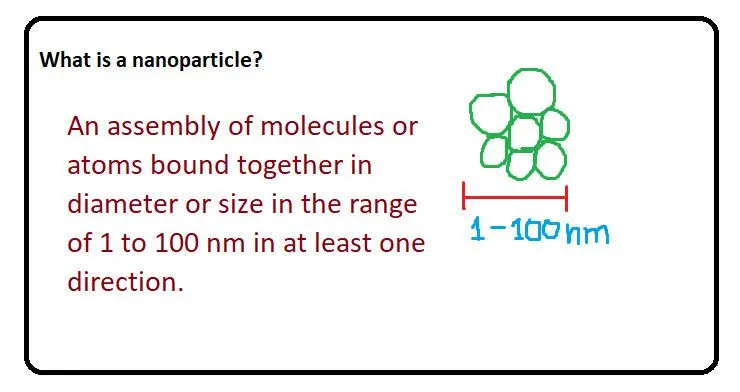
After studying fragments of the cup under a transmission electron microscope, researchers found that these particles are roughly 50 to 100 nm across and made of a silver-gold alloy (about 70% silver to 30% gold, with a little copper).

Why Are Gold And Silver Not Gold And Silver In Color?
We are well aware that gold is gold in color and silver is silver in color, but why do these cups exhibit red and green colors instead? Those are two completely different colors from the shades they normally exhibit.
This is where the beauty of Nanoparticles comes in.
As the size and shape of a material’s particles decrease, there are significant changes in their optical properties. The optical and electronic properties of nanoparticles strongly depend on their size, shape, and aggregation state. The color they exhibit is due to a phenomenon called Surface Plasmon Resonance. Before jumping directly into SPR, let’s learn about a few related terms and concepts through a simple analogy.
Classroom Analogy
Let’s imagine a classroom scenario. We know how the tables are arranged and how students are made to sit in their respective places, but not all students obey this rule. Some love to roam around the class, and seem to always be at a higher energy level.
Some compliant students might try to bring the roaming students back to their original place, but their efforts are in vain. A strict teacher might contain them for a while, but only a teacher with the same vibe and energy as they are will be able to truly impart knowledge in a way they can understand and absorb.

Plasma Oscillation And Plasmons
According to the Drude model, metals were considered to be made of fixed positive ions, from which several free electrons were detached. By definition, this forms a plasma.
Let’s assume we have one such single positive nuclei and a detached electron.
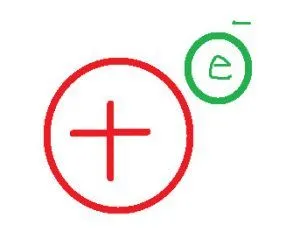
If the electron moves from its equilibrium position, the positive nucleus exerts an electrostatic attraction on the electron, causing it to move back to its original position. This repeated action causes the electron to oscillate. We know that any material contains a huge number of electrons and positive nuclei. Hence, a scenario can be viewed as a sea of free electrons on a bed of positive nuclei.
The collective oscillation of this sea of free electrons can be referred to as plasma oscillation. A quantum of this oscillation is called a plasmon. This oscillation has a frequency that can be referred to as the plasma frequency.
At these frequencies, the enhanced absorption of EM radiation takes place.
Surface Plasmon Resonance
When the frequency of the incident light matches the plasma frequency, resonance occurs. This can be referred to as Surface Plasmon Resonance.

During this phenomenon, some wavelengths get absorbed and some get scattered. The wavelengths absorbed by the plasmons can be seen as a dip in the absorption curve. The wavelength where this absorption occurs strongly depends on the particles’ size, shape, and aggregation state.
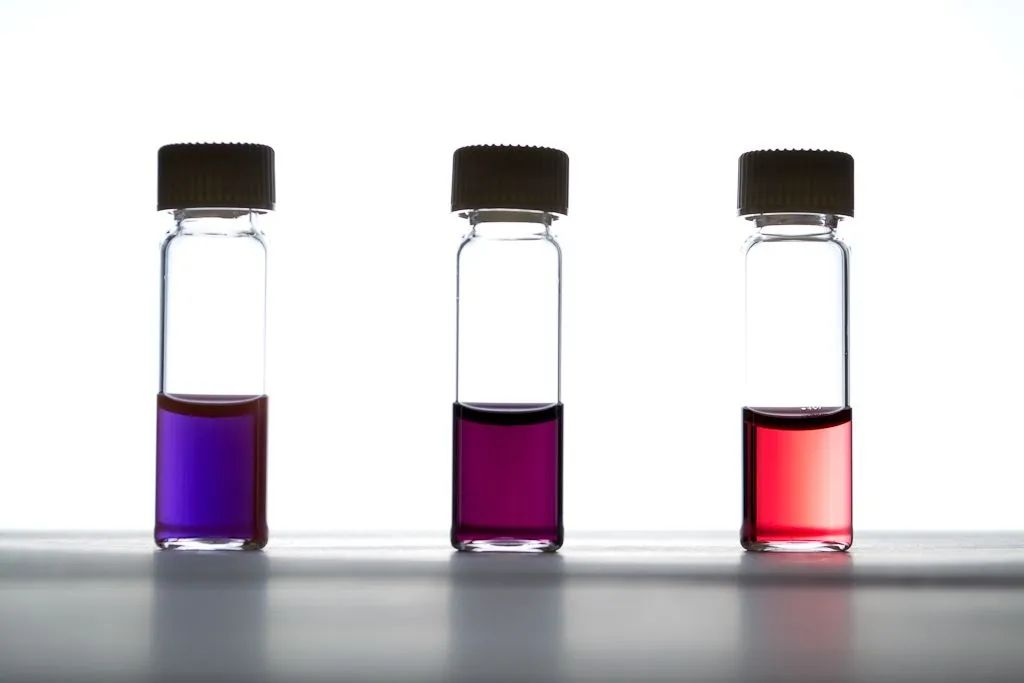
For gold nanoparticles that are around 30 nm in size, absorption occurs in the blue-green portion of the visible spectrum, so red light is scattered and reflected. Silver nanoparticles, on the other hand, absorb strongly near 400 nm in the violet-blue range. Because the Lycurgus Cup’s particles blend both metals into a single silver-gold alloy, the glass scatters green light toward you (reflected light) while letting red light pass through (transmitted light), and that is the dichroic effect we witness. Dichroism is also referred to as ‘The Lycurgus Effect.’
The Story Depicted In The Cup
Another captivating feature of the Lycurgus Cup is its outer decoration. It is intricately carved and depicts the story of king Lycurgus being punished for his crime against Dionysus.
Lycurgus, the king of Thrace, had banned the worship of Dionysus and turned on the god’s followers. When Dionysus, the god of wine and ecstasy, passed through his land, an enraged Lycurgus attacked the god’s companions. Among them was a nymph called Ambrosia.
Ambrosia pleads to Mother Earth for help and is transformed into a vine. The vine winds itself around Lycurgus and holds him fast, leaving him at the mercy of Dionysus and his followers. As punishment for his cruelty, Dionysus drives Lycurgus mad.
The cup shows Lycurgus being entangled by a vine with Ambrosia pleading by their side.
Conclusion
The Lycurgus Cup has not only aesthetically drawn people towards it for centuries, but it has also inspired new technologies. One example is the nano Lycurgus Cup Array (nano-LCA), reported by researchers in 2013: a plasmonic sensor built from billions of microscopic Lycurgus-style cups that changes color as it detects different liquids and biomolecules, often by the naked eye alone.
Though the early history of the cup is unknown, it was acquired by the Rothschild family, who later sold it to the British Museum. The cup is now housed in the British Museum in London.
References (click to expand)
- Freestone, I., Meeks, N., Sax, M., & Higgitt, C. (2007, December). The Lycurgus Cup — A Roman nanotechnology. Gold Bulletin. Springer Science and Business Media LLC.
- Plasmonic Color Engineering - nanoComposix. nanocomposix.com
- Gold Nanoparticle Properties - Cytodiagnostics Inc.. cytodiagnostics.com
- M Miziur-Moździocha. The symbolism of the Lycurgus Cup1. rcin.org.pl
- The Lycurgus Cup (drinking-cup). The British Museum.
- World's Most Sensitive Plasmon Resonance Sensor Inspired by Ancient Roman Cup. The Grainger College of Engineering, University of Illinois Urbana-Champaign.