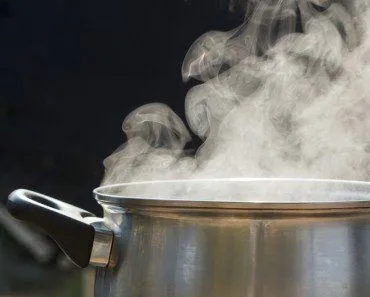
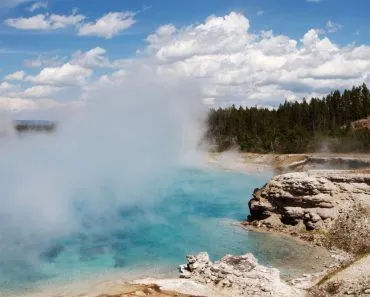
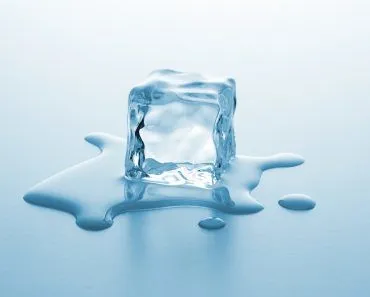
Yes, all elements can directly transition from solid to gas.
It is common knowledge that there are 3 states of matter: solid, liquid and gas. Usually, elements transition from solid to liquid to gas, or in the reverse order, depending on the change in surroundings.
However, it is also possible to have a direct solid to gas or gas to solid change.
When thinking of such a transition, the most common element that comes to mind is Iodine.
Throughout my primary education, any chapter that related to the states of matter spoke of Iodine and naphthalene being among the few elements that are capable of a direct solid to gas transition.
However, this is actually a misconception.
What Is Sublimation?
Sublimation is the direct change of an element from the solid phase to the gaseous phase, without going through the liquid phase, at a specific temperature and pressure. The reverse process, i.e., changing from gas to solid directly, is called deposition.
As mentioned above, Iodine is one of the common examples of substances that can sublimate. Others include naphthalene and dry ice or carbon dioxide. You may have noticed that mothballs, which are made of naphthalene, shrink and disappear over time. This is because they also sublimate from their solid state directly into a gaseous state. Therefore, they are converted into fumes and ‘disappear’.
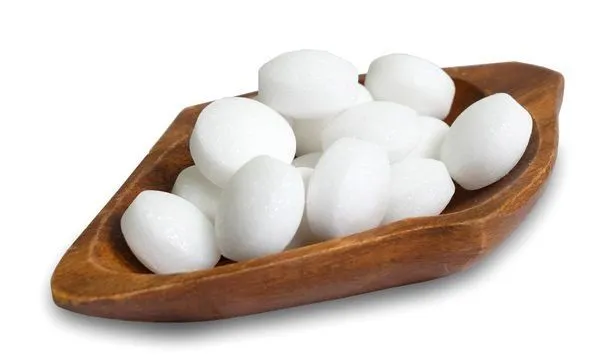
Similarly, if you’ve ever seen dry ice, it is impossible to not notice the thick white fumes that it gives off. This, again, is a visual example of sublimation. Dry ice is nothing but solidified carbon dioxide. At room temperature, it will directly convert to gas and the fumes you can see are gaseous carbon dioxide.
However, almost all elements are capable of sublimation under the right temperature and pressure conditions.
What Is A Phase Diagram And Why Is It Important?
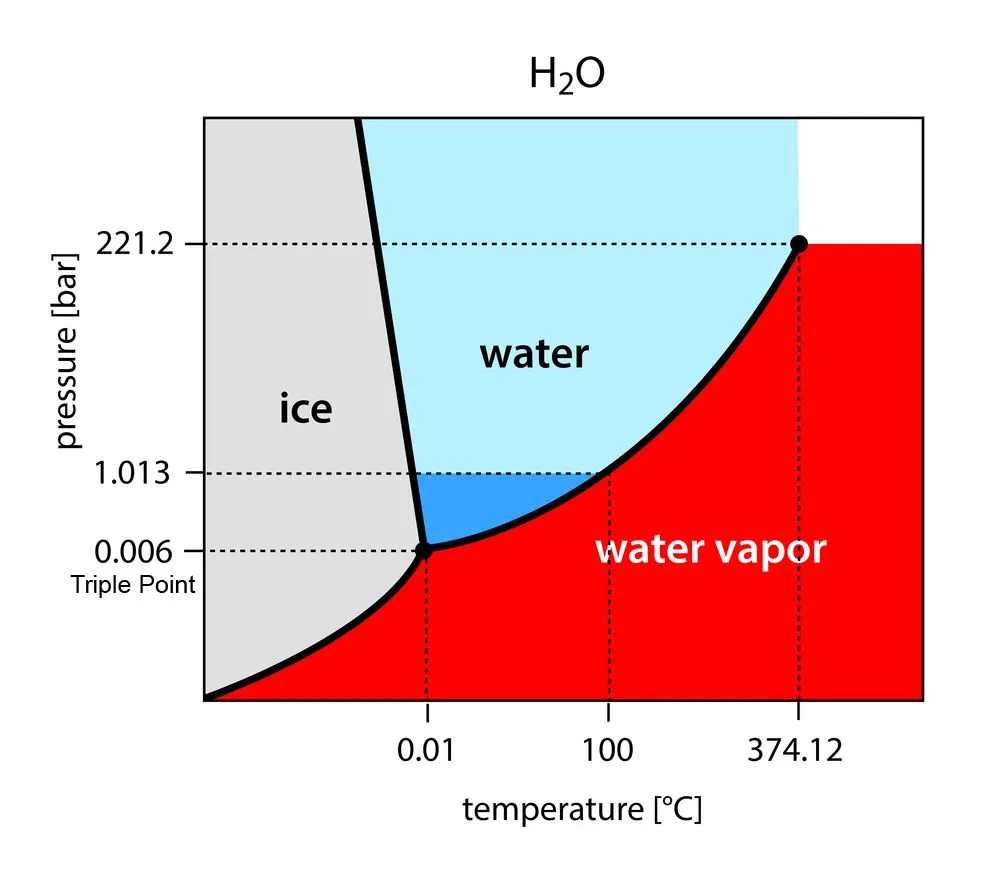
A phase diagram of a substance is a graph with temperature and pressure on the x and y axis, respectively. It shows the various temperatures and pressures at which a particular phase of the substance (solid, liquid or gas) can exist and remain stable.
There are three solid lines in the diagram. These show the temperatures and pressures at which the various phases are in equilibrium with each other, i.e., when they can exist together. These lines also denote when phase transition will occur, or, in other words, when the substance will change from one phase to another. The areas marked by the lines show the three phases. For instance, consider the phase diagram for water, as shown below.
Needless to say, the phase diagram for different elements will be different.
On a phase diagram, the 3 solid lines will intersect at one point, known as the triple point. As mentioned above, the lines also show the equilibrium between phases.
Therefore, the triple point denotes the point when all three phases – solid, liquid and gas – can exist in equilibrium with each other.
Triple Point And Sublimation
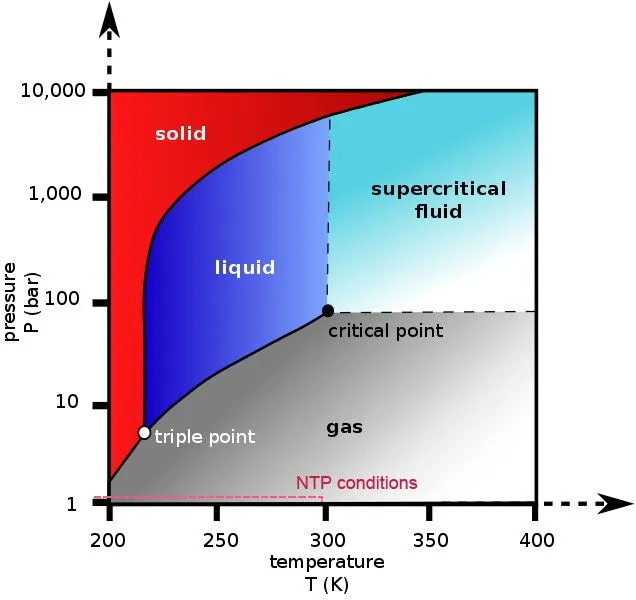
As you can see from the phase diagram, the curve at the bottom shows the transition between the solid and gaseous states. The liquid phase cannot exist below the triple point. Therefore, at any point below the triple point, most substances, when heated, will sublimate from solid to gas.
Conversely, at any point above the triple point, we will even see elements like iodine and carbon dioxide go through a liquid phase.
For most elements, however, the triple point sits well outside normal temperature and pressure conditions (NTP), which are a pressure of 1 atm and a temperature of about 20°C (68°F). This is why we cannot see them undergo sublimation. However, even substances like water can undergo sublimation, when exposed to conditions below their triple point. For water, that point sits at 0.01°C and 0.006 atm (about 611 Pa).
Let’s consider one of our previous examples again. The triple point of carbon dioxide (dry ice) is ~5 atm and -56.6°C. At normal pressure, i.e. 1 atm, as the dry ice is heated, it will directly go to the gas stage, or sublimate. This example shows that even though the temperature is not below the triple point temperature, sublimation will occur. This is because when we look at the phase diagram for carbon dioxide, NTP conditions lie below the triple point, even though the temperature, individually, is less than that of the triple point temperature. Therefore, it is important to note that sublimation will occur at any point below the triple point.
It is also important to note that phase diagrams apply at ideal conditions, meaning that they apply to a single, pure substance in a closed system at equilibrium. These conditions are never met practically, so deviations are to be expected.
In theory, although most substances can undergo sublimation, it is not possible to practically achieve those conditions for every one of them. In everyday life, the textbook examples of substances you can watch sublime are dry ice (solid carbon dioxide) and naphthalene. It is worth being precise here: dry ice and naphthalene (C10H8) are compounds, not elements, and iodine is the only true element of the trio.
Iodine also deserves a footnote, because the classic "iodine sublimes when you heat it" demonstration is not quite right. Iodine does sublime gently at room temperature, which is why a jar of crystals smells and slowly fades. But its triple point sits at about 113.5 °C and 12.1 kPa (roughly 0.12 atm), so at normal atmospheric pressure of 1 atm, which is well above that triple-point pressure, heated iodine actually melts near 114 °C before it boils. The purple vapor you see in a hot flask is rising from molten iodine, not directly from the solid.
What Is Solid To Gas Called, And Can A Gas Become A Solid?
If you have ever searched for the name of this change, here is the short answer: the direct change from solid to gas is called sublimation, and there is no liquid step in between. The change running the other way, straight from gas to solid, is just as real and has its own name: deposition (sometimes called desublimation). So yes, a gas can absolutely become a solid without first turning into a liquid.

The clearest everyday example of deposition is frost. On a cold, clear night, water vapor in the air touches a surface that has dropped below freezing, such as a blade of grass or a car windshield, and turns directly into ice crystals. The vapor never becomes liquid dew first; it goes gas to solid in one step. The delicate, fern-like patterns of hoar frost are a snapshot of that process. Snow forms much the same way high in the clouds, when water vapor deposits onto a tiny ice nucleus and grows into a crystal. Even the soot that coats a chimney is partly deposition, as hot vapor-phase carbon compounds cool and settle straight onto the cold flue as a solid.
Like sublimation, deposition is an energy story in reverse. Sublimation is endothermic (it soaks up heat to pull a solid apart into a freely moving gas), so deposition is exothermic: the gas molecules give up energy as they lock into a rigid crystal. That released heat is one reason a sudden frost can slightly warm the air right at the surface.
How Does A Solid Turn Into A Gas Without Melting?
To picture how a solid skips the liquid stage, it helps to think about what holds a solid together. In a solid, the particles are locked in place by intermolecular forces and can only vibrate. Heat gives them energy, and that energy is shared unevenly, so at any moment a few surface particles are jiggling far harder than the average. If one of those particles is vibrating violently enough to break free of all the forces tying it to its neighbors at once, it escapes straight into the gas phase. It never spends time as a loosely linked liquid, because it has overcome its bonds completely rather than just partially.

This is why solids with weak intermolecular forces, such as dry ice (held together only by weak dispersion forces) and the symmetric, lightly bound molecules of naphthalene and camphor, sublime so readily. It also explains the energy bookkeeping. Sublimation needs the full energy cost of both melting and boiling combined, written as ΔHsub = ΔHfus + ΔHvap, because the particle has to leap the entire gap from rigid solid to free gas in a single move. For dry ice, that energy of sublimation is about 26 kJ/mol. The same idea is captured by latent heat: the hidden energy a substance absorbs to change state without its temperature changing.
You do not even need to melt anything to make this happen on purpose. Freeze-drying, the technique behind instant coffee, lightweight camping meals, and the freeze-dried snacks eaten by astronauts, works by freezing food solid and then pulling a hard vacuum (down to a few millibars) so the ice sublimes away as vapor, leaving the structure and flavor intact. The same trick preserves vaccines and other delicate medicines for shipping and storage.
Can Every Element Be A Solid, Liquid, And Gas?
This is really the heart of the original question, and the answer is a careful yes. Given the right temperature and pressure, essentially every element can be coaxed into all three classic states. You can boil a metal like iron into a gas if you make it hot enough, and you can freeze a gas like oxygen or nitrogen into a solid if you make it cold enough. The state an element happens to show at room temperature is just a snapshot of where ordinary conditions land on its phase diagram, not a fixed property.
There is one famous holdout worth knowing about: helium. Helium is the only element that will not become a solid simply by being cooled at normal atmospheric pressure. No matter how close you push it to absolute zero, it stays liquid at 1 atm. To freeze it at all you have to also squeeze it, applying roughly 25 bar (about 2.5 MPa, or 360 psi) of pressure. The reason is wonderfully strange: helium atoms are so light and so weakly attracted to one another that quantum mechanical zero-point energy keeps them jiggling even at absolute zero, which is enough to stop them from settling into a fixed crystal until you press them together.
So the title question has a satisfying answer. Almost any element can move directly from solid to gas by sublimation if you put it below its triple point, and almost any element can take all three states under the right conditions. The catch is the word "right": for most of the periodic table, the temperatures and pressures involved are nowhere near the conditions of a normal kitchen or classroom, which is exactly why dry ice and frost feel so remarkable when we do get to watch them happen.
References (click to expand)
- Sublimation | COSMOS. The Centre for Astrophysics and Supercomputing
- Sublimation | Physics Van | UIUC. The University of Illinois Urbana-Champaign
- Sublimation and Phases. | Physics Van | UIUC. The University of Illinois Urbana-Champaign
- Triple Point of Water | UCSC Physics Demonstration Room. The University of California, Santa Cruz
- Phase Diagrams. Purdue University
- Triple Point of CO2. The University of California, Santa Barbara
- Sublimation and Fusion. Chemistry LibreTexts
- Deposition (phase transition). Wikipedia
- Sublimation of Iodine: Rise And Fall Of A Misconception. University of Waterloo
- Carbon Dioxide. NIST Chemistry WebBook (SRD 69)
- Helium. Encyclopaedia Britannica
- Liquid Helium. Wikipedia
- Primary Drying Phase Of A Lyophilisation Process. NCBI / PMC