Table of Contents (click to expand)
A stone skips because, as its flat face strikes the water at speed, it shoves water aside, and the water’s inertia pushes back with a lift force that bounces the stone upward (much like a planing boat). Spin keeps it stable. Throwing it fast and at roughly a 20° angle to the surface gives the most skips.
If you’re the type of person who likes to have fun without spending too much money, then you already know that spending time in nature is the best option. The natural world offers endless amounts of its own resources for humans to consume, pollute (the worst reality of our global society), survive upon, and even play with. One such form of entertainment it offers comes in the form of a very ‘physical’ game: skipping stones.
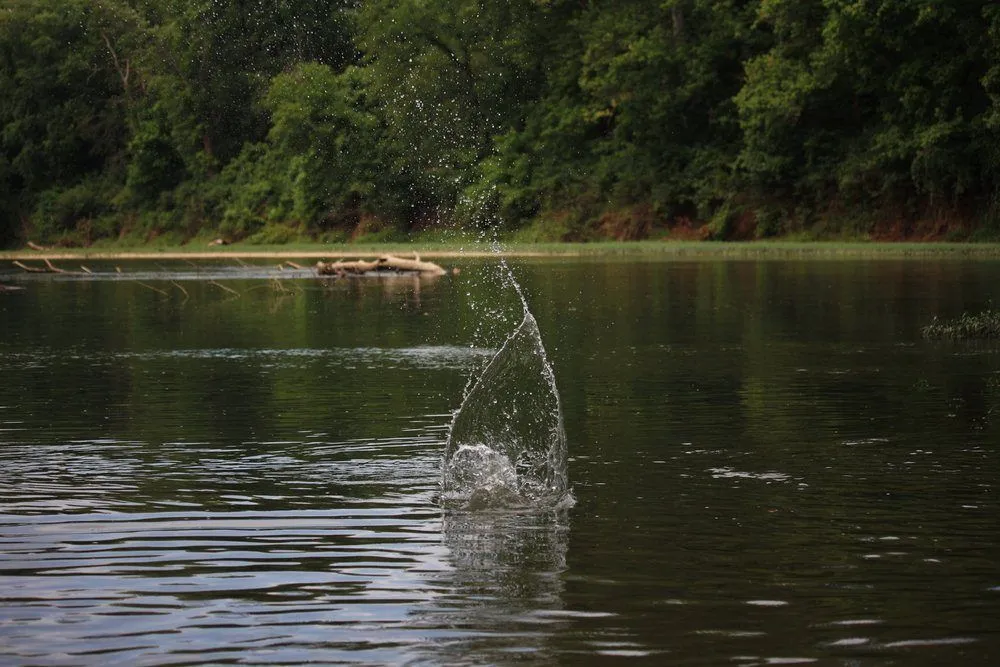
Those who know about skipping stones or have done it in the past know very well that it is a strange combination of hard work and a whole lot of fun. You may look at people tossing rocks and think they’re crazy, but it won’t be long before you’re also hunting for the perfect pebble to compete with the other stone skippers. Don’t be too jealous; they are throwing rocks, after all!
It’s amazing to see those stones skim across the water, seeming to jump 2, 5, or 12 times across the water’s surface. But how does it do that? What makes the stone skip over the surface of water without sinking after the first toss?
Skipping Stones: The Game
Before we go any further with the science of the game, let me first explain the game to those who don’t know much about it (where have you been?). Skipping stones is a simple game that involves two basic things; a stone (or a pebble or anything adequately flat with sufficient weight) and a body of water. By a body of water, I obviously don’t mean you should fill up your bathtub with water and start chucking rocks in it… I mean a sufficiently large body of water, like a pond or a lake.
As the name suggests, skipping stones involves doing your best to skip a stone off the surface of the water. What you do is find a flat-smooth stone and toss it at the surface at a low angle so that it bounces, rather than sinks, as it would if you threw the rock with a large arc. Ideally, the stone should skip more than once. First-timers usually struggle, but to be good at skipping stones, you need good stones and great technique. Be patient! The game is essentially who can get the most skips out of their stone. Anything over 4-5 is pretty good, but the best stone skippers in the world can get well into the double digits!
The Science Behind Skipping Stones
Now that you understand the game, let’s take a look what keeps the stone from falling through the surface of water and instead allows it to bounce off the surface repeatedly.
Needless to say, there are a number of natural forces at play here. The number of times a stone skips over the surface depends on a number of factors:
- The height from which the stone is thrown
- The angle at which the stone is thrown
- Nature of the stone’s impact with the surface
- Condition of the water’s surface
- The force with which the stone is thrown
Conservation Of Momentum
There is a principle in physics that dictates how two bodies react when they collide. It states that, “For a collision occurring between Object 1 and Object 2 in an isolated system, the total momentum of the two objects before the collision is equal to the total momentum of the two objects after the collision. That is, the momentum lost by Object 1 is equal to the momentum gained by Object 2.”
This simply means that there is no overall loss of momentum when there is an interaction between two bodies. In the case of skipping stones, when the flat face of the stone slaps into the water surface, it shoves a small slug of water down and out of the way. By Newton’s third law, the water shoves right back, and because water is dense and slow to move, that reaction is surprisingly stiff. The push it gives the stone is a lift force, the same kind that holds up a planing speedboat or a pair of water skis. So the stone isn’t riding on surface tension, which is a common misconception; surface tension barely matters here. What actually keeps the stone up is the water’s own inertia. If the stone is moving fast enough, that lift can briefly beat its weight and kick it back into the air for another hop. Throw it too slowly and there’s no skip at all; it just plops in. The minimum speed you need depends on how heavy the stone is.
More importantly, spin is what keeps the stone stable during its course of bouncing. This is why it helps if the stone is also rotating on its axis when thrown, as it stabilizes the stone against the torque of lift being applied to the back.
The Optimal Value
There is no single magic value for the speed with which you need to throw, but there is one for the angle. In 2004, French physicists Lydéric Bocquet and Christophe Clanet fired spinning aluminum disks at a pool of water with a catapult and filmed the splashes. They found a “magic angle” of about 20° between the stone and the water’s surface: tilt the stone to roughly 20° and it skips even at modest speeds, squeezing out the most bounces. Steepen the angle much past about 45° and the stone stops skipping and simply dives in. A calmer body of water also offers less resistance against the bounces.
Clearly, there’s no time to waste! Dash to the nearest lake with a handful of round, flat pebbles and check out your technique and the strength of your arms. Also, just to set a standard for yourself, the Guinness World Record for skipping stones (in terms of number of bounces) is held by Kurt “Mountain Man” Steiner, who set it on a Pennsylvania creek in 2013.
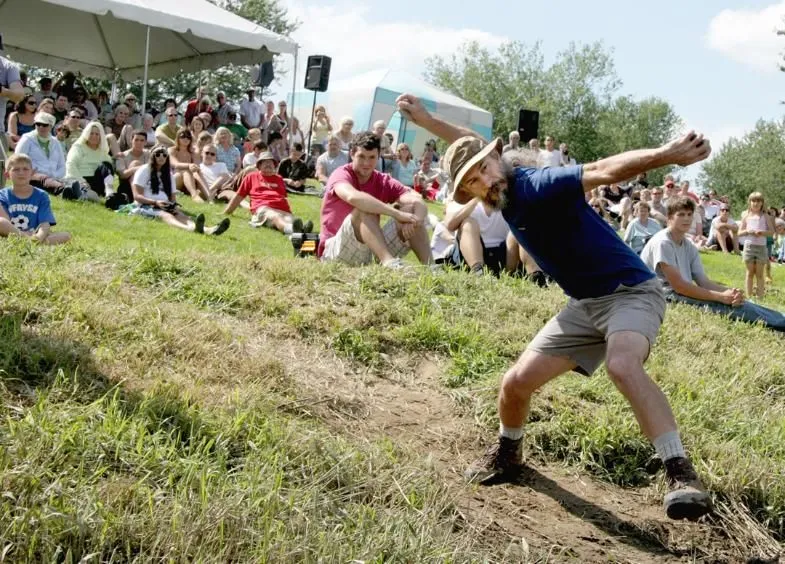
How many bounces, you ask?
88.
Better start practicing!