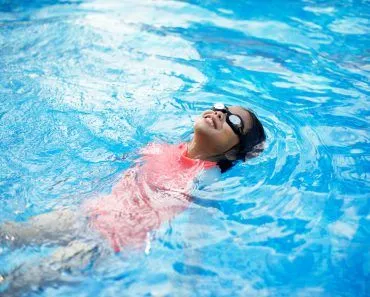
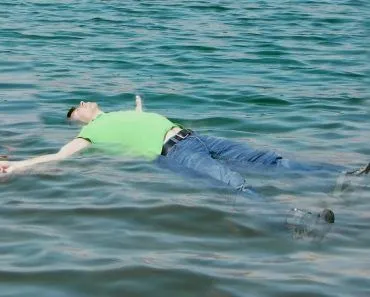
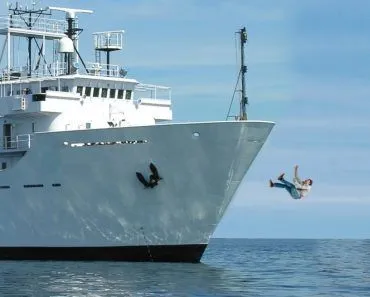
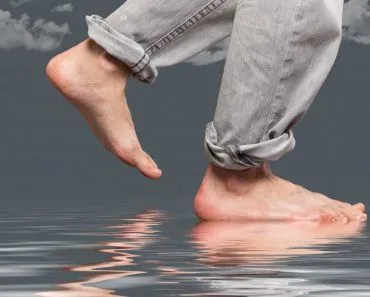
It’s painful to belly flop into a pool because a large surface area of your body is hitting the surface of the water.
Have you ever tried to belly flop into a pool? If the answer is yes, then you know that it can be quite painful.
The water can feel entirely unforgiving if you leap into it horizontally with your arms and legs stretched out. In fact, it feels almost solid, like concrete, but why does that happen? How does the way we orient our body make such a difference when landing in water?
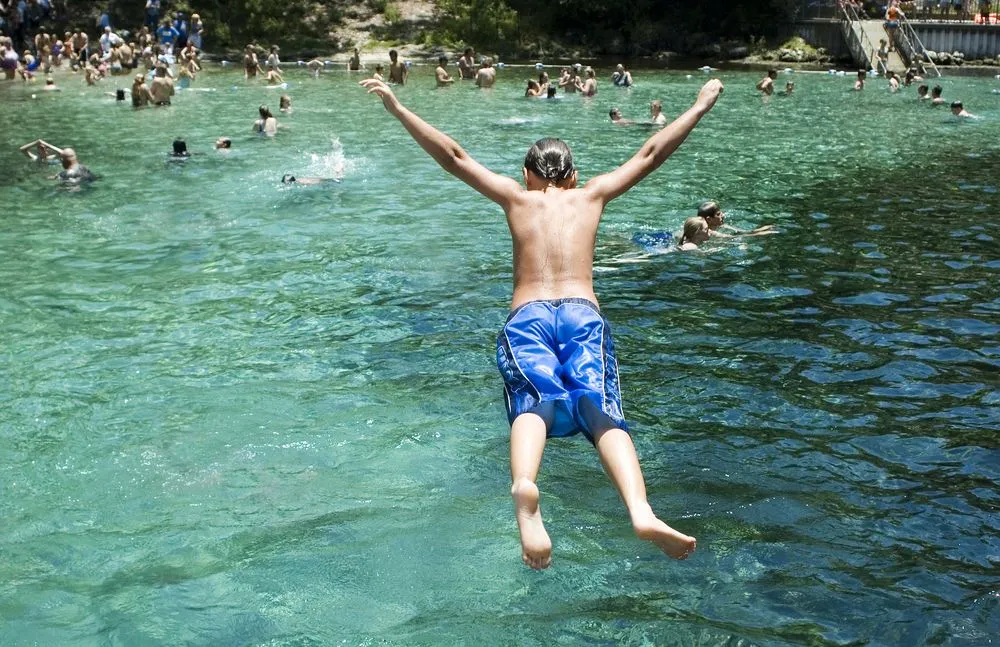
Dangerous Diving
Landing in water is not as harmless as it may sound, whether you are jumping into your community swimming pool, professionally diving, or falling out of an airplane. Olympic divers reportedly suffer a wide array of injuries from repeatedly hitting the water at less than optimal angles.
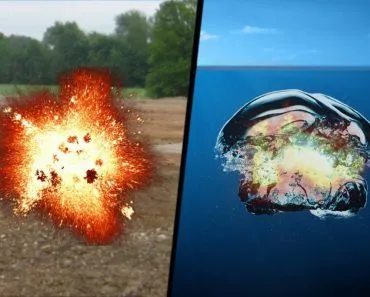
Darren Taylor, aka “Professor Splash,” a professional show diver, holds the Guinness World Record for the highest shallow-water dive. His current record, set in Xiamen, China in September 2014, is a belly flop from 11.56 m (37 ft 11 in) into a kiddie pool with just 30 cm (12 in) of water.
Setting the pool on fire is just for theatrics, the real danger is the ordinary act of diving. Even with a deeper pool, a belly flop from that high would be very dangerous for an amateur. Even Professor Splash has reportedly suffered concussions and internal injuries over the course of his belly-flopping career.
There are a lot of factors that could contribute to whether or not you will get injured by a fall into water, height being the primary one.
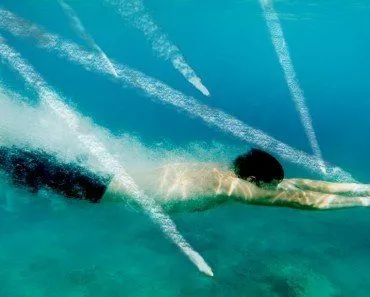
Your orientation also determines how harmful or harmless a fall into water could be. There’s a good reason why a swan dive is the most likely pose to adopt when diving into any deep pool. Your whole body pointed like an arrow is the most optimal way to enter a body of water.
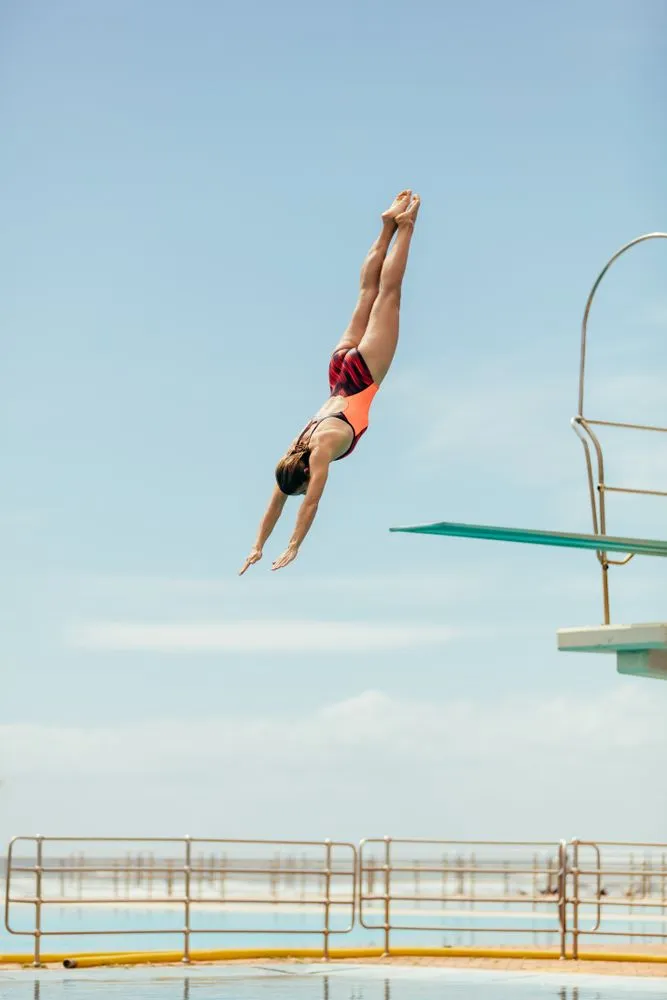
A belly flop is when you stretch out your arms and legs and land face first or belly first. Even when launching into a pool from a run-of-the-mill diving board, a bad belly flop can leave a bruise. In the worst cases, it has been known to cause internal injuries.
Why Do Belly Flops Hurt?
When you step into a pool, the water feels accommodating, and the entry feels effortless. When you fall into a pool, the water feels different, more solid. This feeling intensifies, depending on the height from which you fall and the orientation of your body.
Displacing Water
When you fall and hit solid ground, you can clearly feel the reactionary force on your body. It breaks bones quite easily. However, water is more dynamic and moves out of the way when you enter.
The water exerts a force on your body when you displace it. This force depends on the height of your fall, your weight, and the area of contact. When you walk into water, the water is slowly displaced to make room for you, so the force that the water exerts back on you is pretty small.
When you jump into water, however, the water has to move out of the way a lot quicker. If you jump from really high, your velocity will be greater and you will receive a more forceful pushback.
In a proper dive, your body decelerates at a slower rate, meaning that the force exerted by the water on your body is less. But for a belly flop, your entire body hits the water in a very small amount of time.
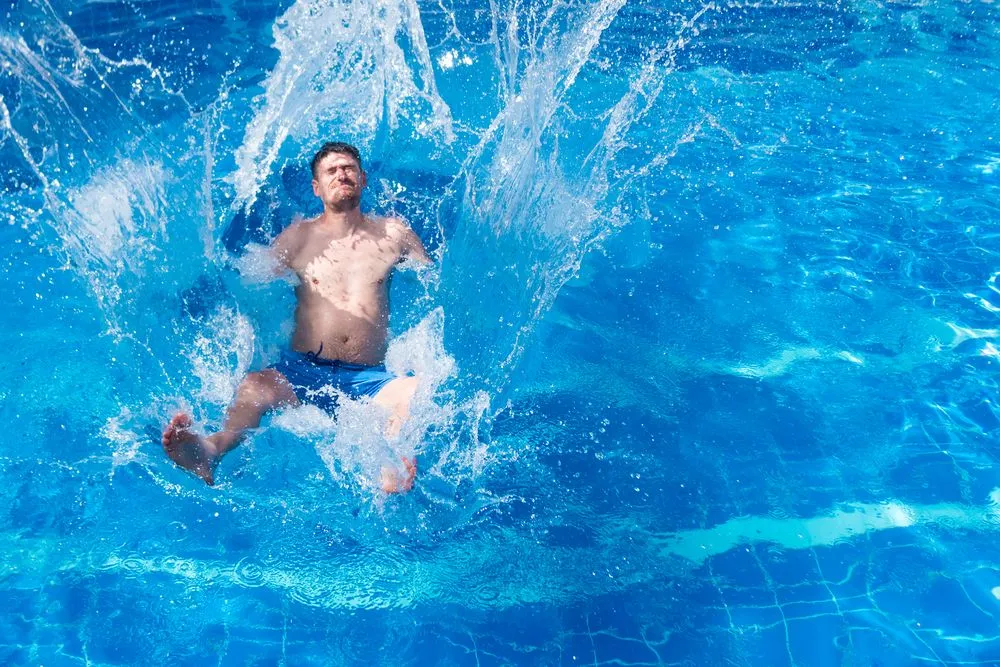
The larger the surface area of the body hitting the water, the more water is forced away in a shorter amount of time, which means a lot more reactionary force on your body.
This is just like a fall on solid ground, where you can minimize the chances of a broken bone by crouching or rolling to increase time and the displacement of impact. The experience of a belly flop is a little closer to hitting a solid surface. Thus, the water feels like concrete, and we end up getting bruised.
Surface Tension
When entering water, you need to break the surface of the water and submerge into it. At this point, we are faced with a pesky little problem called surface tension. Cohesive forces between water molecules are stronger at the surface. This is why it is harder to break the surface of water than to move when completely submerged in it.
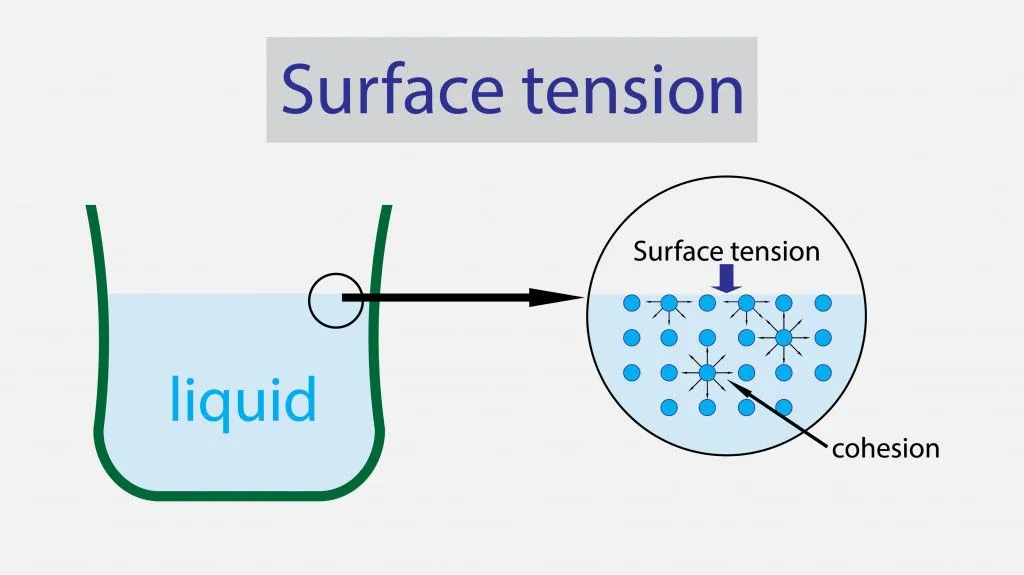
In diving competitions, aerators are often used to create bubbles at the surface of the pool. These bubbles break up the water column and make it more compressible, softening the impact for divers (the cushioning effect actually comes more from this added compressibility than from breaking surface tension).
The larger the surface area of the body hitting the water, the more resistance the water will offer. In a swan dive, your hands create an entry point for the rest of your body. In a belly flop, your whole torso slams into a large area of water all at once. Because water is essentially incompressible at these speeds, it cannot get out of the way in time, so for that fraction of a second it behaves like a near-rigid surface. A 2023 Brown University study on impact dynamics confirmed this: the rapid deceleration as a flat body strikes the water can briefly produce peak forces high enough to bruise tissue and even cause internal injuries.
At What Height Does Water Start To Feel Like Concrete?
There is no single magic height where water suddenly turns to stone. The "like concrete" feeling builds up gradually, because the force of the impact grows with your speed, and your speed grows with the height of your fall. Drop from twice as high and you do not hit twice as hard; the energy you have to shed roughly doubles, while your speed climbs only as the square root of the height. So a flat landing keeps getting nastier the higher you go, with no clean line where it flips from "ouch" to "concrete".

A few reference points help. A belly flop from just a meter or two (a few feet) already stings. Competitive high divers launch from a 27 m (90 ft) platform and break the surface at roughly 85 km/h (53 mph), an impact organizers compare to a car crash, and they only get away with it because they enter feet- or hands-first like an arrow. Push the height further and even a clean entry turns brutal: the Guinness World Record for the highest cliff jump belongs to Laso Schaller, who dropped 58.8 m (193 ft) feet-first in 2015 at more than 120 km/h (75 mph) and came away with a dislocated hip. Beyond that, water stops being survivable at all. A skydiver in a belly-to-earth fall tops out near 195 km/h (about 120 mph), and at those speeds the water simply cannot move aside in time, so a fall from extreme height into water is almost always fatal, parachute or not. The honest takeaway: how solid water feels depends on both your speed and your shape, not on one fixed "concrete" altitude.
Is Water Really Harder Than Concrete?
No. Water is never actually harder than concrete; the comparison is about the sensation of a sudden stop, not the material itself. When you hit the surface fast and flat, the water cannot flow out of the way quickly enough, so for a split second it pushes back almost like a rigid wall. That is why the slap of a belly flop can feel disturbingly like landing on pavement.
The crucial difference is what happens next. Concrete has essentially no give, so it halts you within millimeters and throws nearly all of your energy straight back into your body in an instant. Water, by contrast, keeps moving and parting around you, decelerating you over a much longer distance once you punch through the surface. That extra stopping distance is exactly why people survive cliff dives and bridge falls that would be instantly lethal onto solid ground. In other words, water is the far gentler of two unpleasant options. Calling it "harder than concrete" is vivid hyperbole, not physics. The accurate version is that, hit fast enough, water can briefly feel as unforgiving as concrete, even though it never comes close to actually being that hard.
Summing Up
The larger the surface area of the body hitting the water, the more resistance the water offers. With less time to decelerate into the water, you get a bigger impact. Thus, the flatter you make yourself when you jump in, the more solid the water feels and the more painful your dive will be.
So, in the unlikely event that you find yourself falling out of an airplane without a parachute, falling flat out onto the water would make you more likely to get injured, or even lose your life to the fall. For painless dives, make the point of entry as small as you can, so put your feet or hands first…
… that is, unless you’re in a belly flop contest, in which case, feel free to spread your wings and bear the bruises!
References (click to expand)
- Belly-flops can cause injuries - CNN. CNN
- Why do belly flops hurt so much? Ask 'Professor Splash'. NBC News
- Study Materials | Physics I: Classical Mechanics with an .... MIT OpenCourseWare
- The physics of the perfect dive - Exeter Science Centre. exetersciencecentre.org
- Want the secret to less painful belly flops? These researchers have the answer. Brown University
- Highest cliff jump. Guinness World Records
- Dare to dive from 27 meters or 90 feet? Impact is like a car crash at 85 kph. Associated Press / Spectrum News NY1
- Terminal velocity. Wikipedia