Interference of light is the phenomenon where two or more light waves overlap and combine according to the principle of superposition. When their peaks line up, they add into a brighter wave (constructive interference); when a peak meets a trough of equal size, they cancel out and the medium goes dark (destructive interference). It is the effect behind the iridescent colors of soap bubbles and oil films, and behind the bright-and-dark fringes Thomas Young saw in his famous 1801 double-slit experiment, which is what convinced physicists that light behaves as a wave.
One of the fundamental properties of light is its ability to interfere with itself. Most people observe optical interferences on a daily basis, but don’t quite know how this phenomenon actually occurs. Some examples that people can relate to is a film of oil on water or a soap bubble that reflects a variety of beautiful colors when natural or artificial light is shone upon it. This dynamic interplay of colors derives from the simultaneous reflection of light from both the inside and outside surfaces of the bubble. The two surfaces are very close together (only a few microns thick) and light reflected from the inner surface interferes both constructively and destructively.
Principle Of Superposition
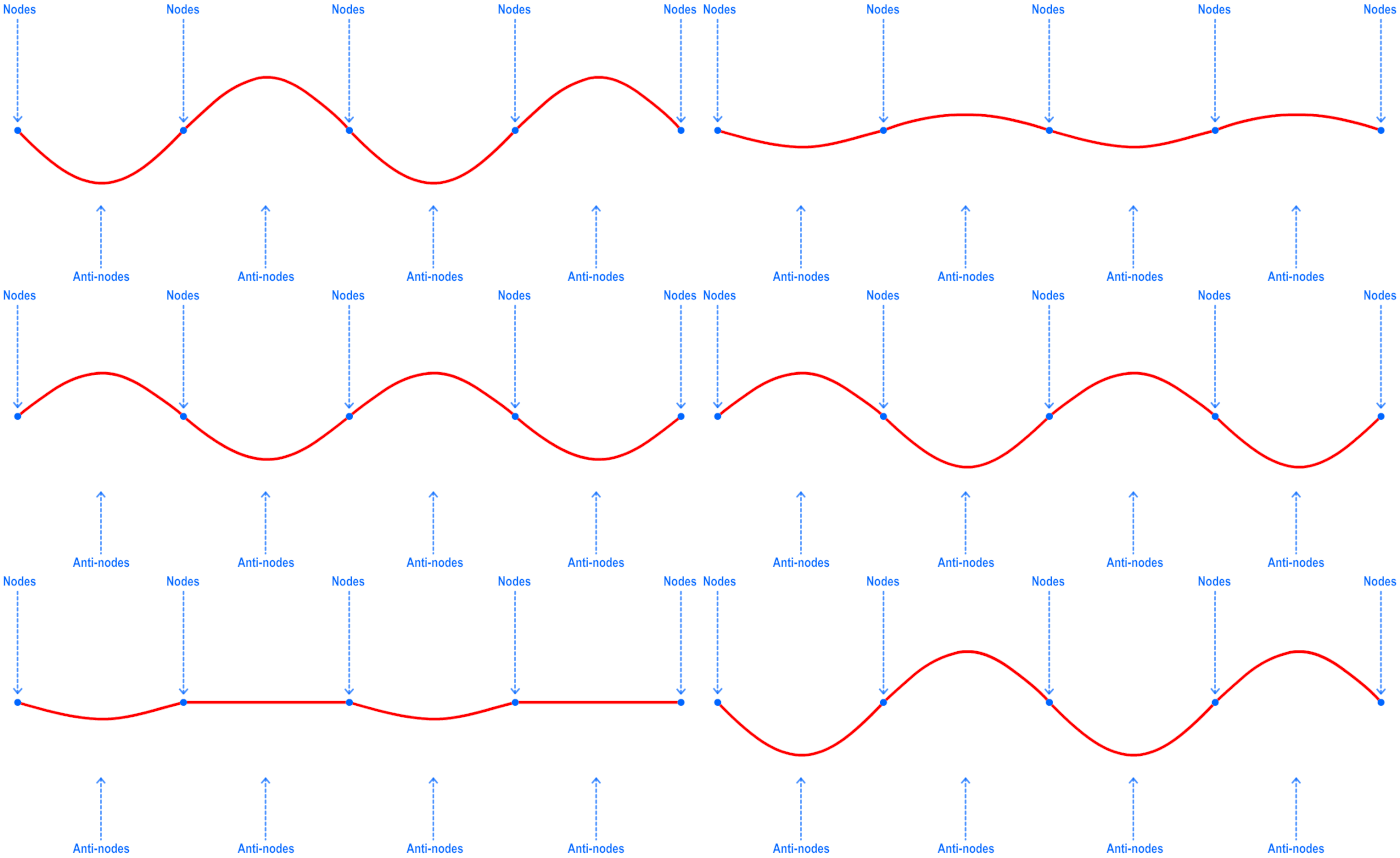
The superposition principle is one of those ideas that sounds much more complicated than it really is. Physics pans out like that sometimes. The superposition principle states that for linear systems, the net response caused by two or more inputs is the sum of the inputs that each would have caused on its own. Confused? Probably, so let’s simplify this a bit. In most cases, when people talk about the superposition principle, they’re talking about waves or sinusoidal vibrations in space and time. Examples of waves include light, sound, water ripples, and earthquake waves. All of these things work in the same basic way: If you take two waves and put them on top of each other (or superimpose them) they add together. This is what superposition is. Let’s get into some of the details of what that means in the real world.
When two waves are on top of each other, they combine to produce a total wave, which we call a resultant wave. We call it that because it’s the result you get when the waves are added up. Waves contain peaks and troughs that come in a pattern, one after another. When you superimpose the peaks of two waves, they add together to form an even bigger peak. When you superimpose the troughs of two waves, they add together to form an even bigger trough. This is called constructive interference. On the other hand, when you superimpose the peak of one wave with the trough of another, they add together and flatten out to nothing—a flat line. This is called destructive interference. It’s similar to how -6 + 6 = 0. The peak and trough cancel each other out.
Constructive & Destructive Interference
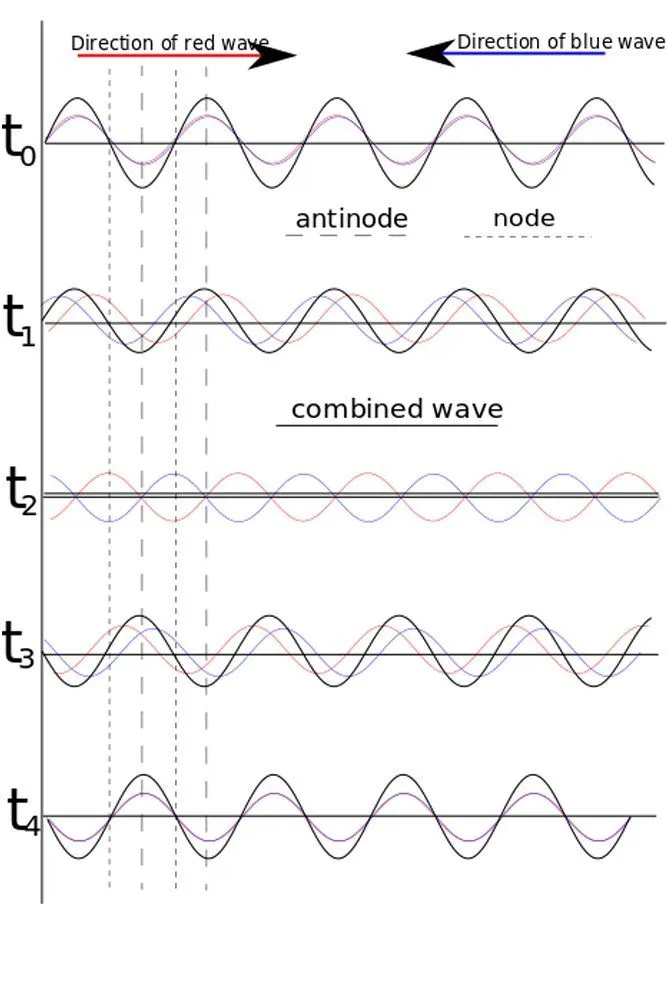
Most of the time, when we think about waves, we tend to imagine a single wave traveling through a medium. When we think about water waves, for example, we imagine a single wave traveling through the vastness of the ocean all by itself, but obviously, that’s unrealistic. Is there only one wave traveling through the entire ocean? Of course not! There are countless waves traveling in all directions. Some ocean waves are bigger and some are smaller. Some waves are caused by the wind, while others are caused by cruise ships, breaching whales and thousands of other things! Inevitably, some waves are going to cross over or meet with each other. When they do, the reaction between the waves is known as interference. This is the meeting of two or more waves traveling in the same medium. Waves meeting in the same medium actually disrupt each other’s displacement. They interfere with each other so that the resulting wave is a completely new and different wave from either of the original two.
Imagine that they’re traveling toward each other in the same medium. One is traveling left and the other is traveling right. They both have the same amplitude of 1 meter. When the two waves meet, there comes a moment when the crests of both waves end up in the same spot. Their crests overlap, so their amplitudes add together. Instead of the crest being 1-meter-tall, it’s now 2 meters tall! When the crests or troughs of two interfering waves meet, their amplitudes add together. This is constructive interference. So, what happens when the crest of one wave meets the trough of another wave? Well, the opposite happens, and it’s called destructive interference. When the crest and trough of two interfering waves meet, one amplitude subtracts from the other.
Let’s take the same two waves that we considered above. They’re still traveling toward each other and they are still 1 meter in amplitude each. However, this time, it just so happens that the crest of one wave lines up with the trough of the other wave. Do you know what will happen then to the overall amplitude? There won’t be any! The crest of the first wave will cancel out the trough of the second wave. The medium experiences zero displacement and the net result is a completely flat surface.
Where Do You See Interference Of Light In Everyday Life?

Here is the surprising part: you probably watch light interfere with itself several times a day without ever calling it that. The shimmering colors are not painted on; they are the result of waves adding up and cancelling out, exactly like the peaks and troughs we just talked about. Once you know what to look for, the examples are everywhere.
A soap bubble is the classic one. Light bounces off both the outer and inner surfaces of the bubble's incredibly thin skin, and those two reflections interfere. Because the skin is only a fraction of a micron thick and that thickness varies across the bubble, different colors cancel or reinforce at different spots, giving you that swirling, ever-changing rainbow.
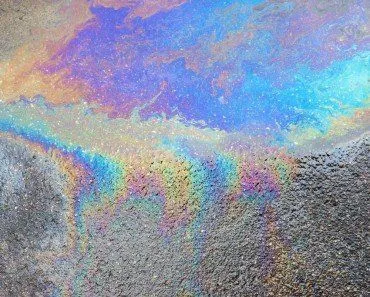
The same thing happens with a film of oil or petrol on a wet road. The thin oil layer floating on water reflects light from its top and bottom faces, and the interference paints those familiar rainbow patches you see on a wet road. Look at the back of a CD or DVD and you will see a similar splash of color, except there the effect comes from the tightly packed spiral of microscopic pits acting as a diffraction grating, sending different wavelengths off in different directions. The brilliant blue of a Morpho butterfly's wings works the same way: no blue pigment at all, just nanoscale ridges that make blue light interfere constructively. And the antireflection coating on your eyeglasses and camera lenses uses interference deliberately, cancelling out reflected glare so that more light passes through.
What Is Thin-Film Interference (And Why Do Soap Bubbles Show Colors)?

So why exactly does a colorless film of soap throw off colors? The trick is that the film has two surfaces, a top and a bottom, and they sit only a whisker apart. When a light wave hits the film, part of it reflects off the top surface right away, while the rest dips into the film, travels to the bottom surface, reflects there, and comes back out. That second wave has taken a small detour, so it comes out slightly behind the first one.
That extra distance is what decides everything. If the detour shifts the second wave so that its peaks line up with the peaks of the first wave, the two reinforce and that color shines brightly. If the shift makes peaks meet troughs, that color cancels out and vanishes from the reflection. The size of the detour depends on how thick the film is and on the wavelength of the light, and since red, green and blue light have different wavelengths, they brighten and cancel at different thicknesses. A soap bubble's skin is not perfectly even, so as the thickness changes from place to place (and as it slowly drains and thins under gravity), the favored color shifts too. That is exactly why the colors swirl and march around as you watch.
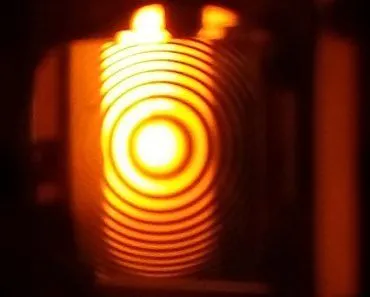
There is one more subtlety worth knowing: a light wave that reflects off a surface backed by a denser, higher-refractive-index material gets flipped by half a wavelength in the process, which physicists fold into the bookkeeping when they predict which colors survive. This single idea, called thin-film interference, also explains Newton's rings (the dark and bright circles formed in the thin wedge of air between a curved lens and a flat glass plate, still used to check how smoothly an optical surface is polished) and the antireflection coatings mentioned above, which are made roughly one quarter of a wavelength thick so that the reflected waves cancel.
Young's Double-Slit Experiment: The Proof That Light Is A Wave

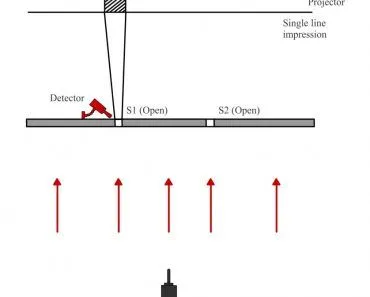
For a long time, scientists argued about whether light was made of tiny particles or of waves. In 1801, the English polymath Thomas Young settled the question with a beautifully simple setup. He let light pass through a narrow slit, then through two more closely spaced slits, and watched where it landed on a screen behind them. If light were a stream of particles, you would expect just two bright bands lined up with the two slits. Instead, Young saw a whole row of alternating bright and dark bands, called interference fringes.
Those fringes are interference in action. Light spreads out from each of the two slits, and the two sets of waves overlap on their way to the screen. Wherever a crest from one slit arrives together with a crest from the other (their path lengths differing by a whole number of wavelengths), they add up and you get a bright fringe. Wherever a crest from one slit lands on top of a trough from the other (a path difference of half a wavelength), they cancel and you get a dark fringe. Particles simply cannot do this; only waves can add and subtract like that. Young's pattern was the convincing evidence that light travels as a wave, and the very same experiment, repeated with electrons more than a century later, would go on to reveal the strangeness at the heart of quantum physics.