In chemistry, resonance describes how the pi electrons in some molecules are not fixed in a single bond but are delocalized, or spread out, across several atoms. This sharing of electrons gives the molecule extra stability. The real molecule is a single average (the resonance hybrid), not a structure flipping back and forth.
If I suggested discussing pi today, would you be interested? Just as all of us need a slice of “pie” from time to time, atoms also need “pi” to bond and form molecules. Remember, a molecule is the term for a group of atoms joining and staying together with strong interactions.
So, what is this “pi” in relation to atoms and molecules? Well, this “pi” is a type of a bond, one that is simply a tight ‘handshake’ between two or more atoms that keeps them together, forming a group of atoms called a molecule, in the language of chemistry. First of all, why do these atoms need to form bonds and groups called molecules? Well, think about it like a volcano.
When a volcano is not calm or stable, it bursts in a fiery explosion. The mountain was unstable, it erupted, and then became calm again. Similarly, an atom has an independent existence that is very unstable, so it reacts with other atoms to form a group and prevent an eruption of any kind.
What Are The Types Of Bonds Between Atoms?
Sometimes, these ‘handshakes’ or bonds are singular, which are called single bonds. At other times, the atoms can become very good friends and form double or even triple bonds. When there’s a double bond, one is a sigma bond and the other is a pi bond. Similarly, when there are three bonds, one of them is a sigma bond, and both of the other two are called pi bonds!
These pi bonds are very friendly, even with neighboring atoms, so they keep moving between the original two atoms to other atoms of the same kind within the same molecule…after all, they’re the ones maintaining the stability of the molecule.
These ‘friendly bonds’ increase the stability of the molecule in which they move around, and the event that increases such stability is called the RESONANCE.
A Simple Analogy To Understand Resonance
Imagine an egg tray, wherein not all the egg holders are filled; only some of them contain shiny, white eggs. These eggs are placed randomly apart from each other and each is tied together with a noodle strand.
Some eggs are tied with 2 noodle strands and some are tied with three. Now, if these noodle strands stayed in place, it would be relatively easy for an outsider to cut the noodle strands and take away the eggs.
However, if these noodle strands continually changed their placement between the eggs, it would be much more difficult for an outsider to catch them and cut them to break the eggs free. The same is the case with a molecule.
Here, the egg tray was a molecule, the eggs were the constituent atoms of the molecule, the noodle strands represented bonds, and the mechanism that the noodle strands applied to maintain the stability of the entire molecule by holding the eggs (or atoms) together is called resonance.

Which Elementary Particles Participate In Resonance?
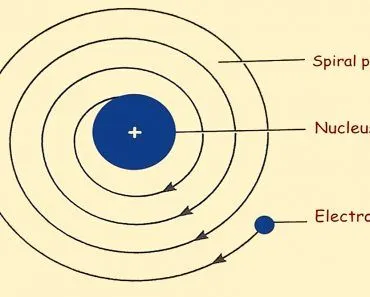
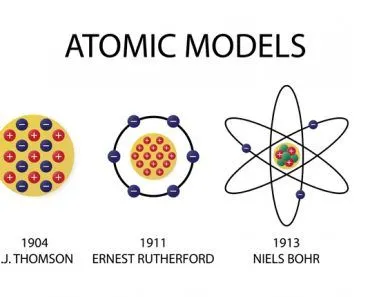
Electrons, protons, and neutrons make up an atom. Now, the protons and neutrons are quite lazy, simply staying at the center of the atom in a space called the nucleus. However, electrons are busy, regularly participating in the formation of bonds with other atoms.
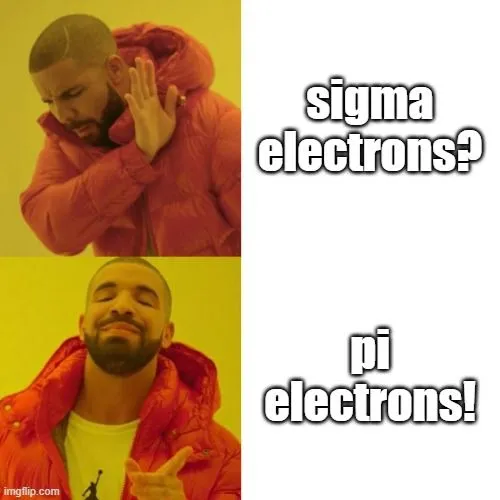
The electrons involved in sigma bond formation are called sigma electrons, while those involved in pi bond formation are called pi electrons. These pi electrons are very “responsible electrons”. They take part in maintaining the stability of the molecule by spreading themselves out, or delocalizing, over several atoms rather than staying locked between just two.
The valency of an atom is the number of electrons it can give, receive or share with other atoms to form a molecule. This valency remains fixed for an atom. So, the question arises, do atoms change their valency when the pi bonds shift from one place to another? No, not at all. The valency of an atom always remains satisfied, regardless of the movement of the pi bonds. The atom either develops a positive charge, depicting a deficiency of electrons, or it develops a negative charge, demonstrating an excess of electrons as the pi electrons shift.
Is Resonance Real Or An Imaginary Concept?
Here’s the part that trips people up. The separate resonance structures we draw on paper (the different pictures showing the pi electrons in one place, then another) are imaginary. A molecule does not actually flip back and forth between them like a flickering light. So in that sense, yes, those individual structures live only in chemistry books.
The resonance itself, though, is very real. The pi electrons genuinely spread out, or delocalize, over several atoms at once, and the true molecule is a single, steady average of all those drawings, called the resonance hybrid. Benzene is the classic example: all six of its carbon-carbon bonds are identical and sit neatly between a single bond and a double bond, which is exactly what you would expect if the electrons are shared all the way around the ring. This sharing makes the molecule measurably more stable, an effect chemists can put a number on and call the resonance energy.
So if you like tangible, real-world science, take heart. We may draw resonance with a set of make-believe sketches, but the extra stability it describes shows up in the lab as bond lengths you can measure and energy you can count.