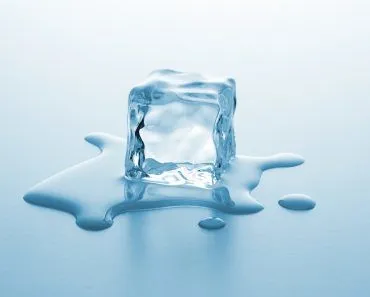
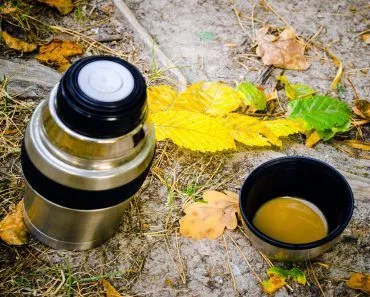
Magic mugs are coated with a thermochromic (heat-sensitive) paint that contains microcapsules of leuco dye. Below the activation temperature (typically around 40 to 47 °C, or 104 to 117 °F) the coating is opaque and hides the printed picture underneath. When a hot drink heats the mug past that threshold, the dye turns colourless, the coating goes transparent, and the picture is revealed. It reverses as the mug cools.
While sipping on a coffee at a friend’s the other day, I noticed something rather bizarre about the coffee mug. At first glance, it appeared to be a regular, white cup. However, when coffee was poured into it, a picture of a guy doing a facepalm appeared on one side! I was fascinated, and admittedly a bit surprised, but as I started to examine the picture, it vanished without a trace, as if it had never been there at all!
What I initially thought of as a brilliantly executed prank turned out to be an impressive example of thermochromism and heat-sensitive paint.
What Is Thermochromism?
The term may sound like a phenomenon pulled straight from a scientist’s dictionary, but in simple words, thermochromism is the property of certain materials to change their own color in response to a change in temperature. Thermochromism actually lies under the umbrella of a chemical phenomenon called chromism – a process that causes color changes (usually reversible in nature, meaning they can regain their original color) in certain materials.
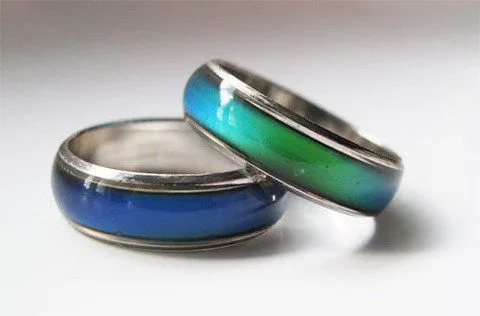
An impressive example of thermochromism can be seen in mood rings, which change their color according to the skin temperature of the wearer.
How Is Thermochromism Connected To Magic Mugs?
Everything!
In essence, thermochromism is the principle on which color-changing mugs and other such objects work. Since the term ‘thermochromism’ sounds a bit technical, the paint that they coat the mugs with is called ‘heat-sensitive paint’ – a paint that is sensitive to changes in temperature. Heat-sensitive paint is used in a variety of things, including mugs, baby bottles, kettles, car engines and much more.
How Does Heat-Sensitive Paint Work?
Also referred to as thermochromic paint, heat-sensitive paint contains pigments that change color according to changes in the surrounding temperature. There are two main types of these pigments: leuco dyes and thermochromatic liquid crystals.

Liquid crystals are used for high-precision tasks, namely where the smallest of changes in temperature must be monitored by the changing color of the material. Therefore, these are not used in regular use objects like coffee mugs or baby bottles, which just need an approximation of the temperature as ‘too cold’ or ‘too hot’. For this simpler purpose, leuco dyes enter the picture.
What Are Leuco Dyes?
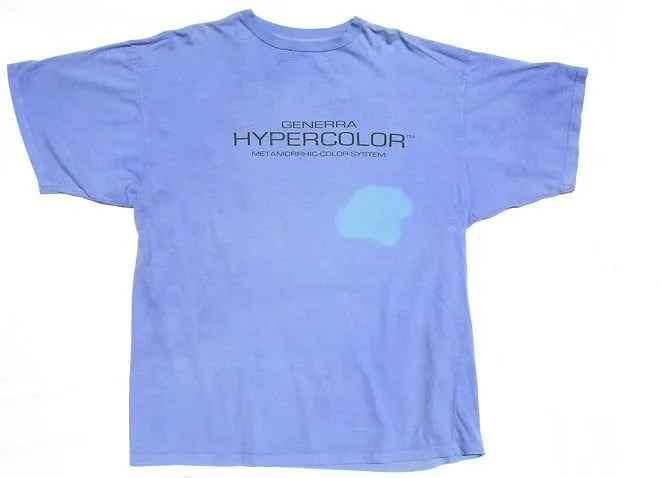
Thermochromic mug paints are made from mixtures of leuco dyes and a couple of other carefully chosen chemicals. The color changes that you see are basically the leuco dyes flipping between a colored form and a colorless (leuco) form. The whole cocktail is sealed inside microcapsules a few microns across, which are then mixed into the paint that coats the mug. A fascinating earlier example of the same trick was the Hypercolor garments by Generra Sportswear (a hugely popular 1991 fad of T-shirts that changed colour with body heat, until everyone figured out the dye couldn’t survive the washing machine).
Inside each microcapsule, three ingredients are doing the work together: the leuco dye itself (commonly crystal violet lactone), a weak acid known as the colour developer (often bisphenol A or a similar phenol), and a waxy long-chain alcohol like 1-tetradecanol that acts as the solvent. The whole game hinges on the melting point of that solvent.
When the mug is cold, the solvent is solid. The dye and the developer sit locked together as a crystal: the developer donates a proton to the dye, which opens up its ring structure into the conjugated, intensely coloured form. That is why a “cold” magic mug looks like a uniformly dark, opaque cup.
Now pour in a hot drink. Once the coating climbs past the activation temperature, typically around 40 to 47 °C (104 to 117 °F), the waxy solvent melts. The developer dissolves into the liquid solvent and lets go of the dye. The dye snaps back to its closed-ring leuco form, which is colourless. The coating goes transparent, the picture underneath is revealed, and voila!
(There are also cold-reveal mugs that work the same way, but with a lower-melting solvent. Those stay opaque at room temperature and turn clear when an iced drink or cold milk is poured in, often around 15 to 25 °C, or 59 to 77 °F.)
Drink up, the coating cools back down, the solvent re-solidifies, the dye and developer pair off again, and the picture vanishes. It’s a fully reversible chemistry, which is why a good magic mug can run through this cycle hundreds of times before the dye fatigues.
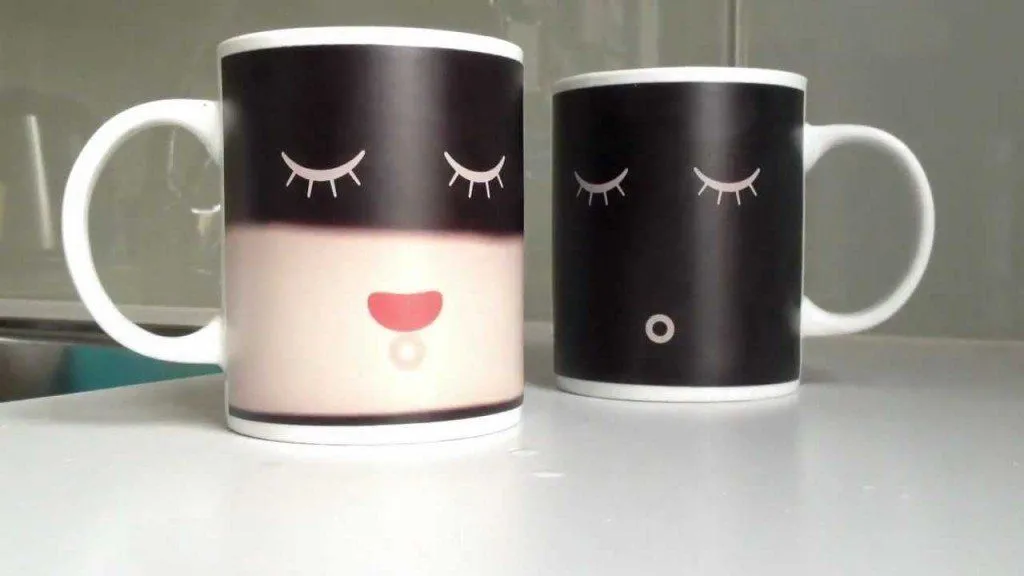
Now, if you ever visit a friend who tries to freak you out by putting a scary picture on the side of your coffee mug, you can outsmart them by simply ‘playing it cool’.
What Else Uses Thermochromic Paint Besides Mugs?
Once you know the trick, you start spotting heat-sensitive colour all over the house. The same two families of pigment, leuco dyes and thermochromic liquid crystals, show up in a surprising range of everyday objects. Liquid crystals handle the jobs that need a real temperature reading, while cheaper leuco dyes handle the “too hot / too cold / about right” jobs where an approximation is good enough.

The classic example is the flat strip thermometer you stick on an aquarium, a fridge, or a fevered forehead. Those rely on liquid crystals, whose colour can be tuned to flip at very specific temperatures, so a row of numbers lights up one at a time as the strip warms. Mood rings use the very same liquid-crystal layer, just read off your skin instead of a wall.
Leuco dyes, the cheaper cousins from your mug, do the rest. They turn the indicator on a baby bottle or a kettle a different colour once the contents are safe to drink or have come to the boil, and they print the temperature gauge that some maple-syrup bottles and beer cans use to tell you the drink is cold enough. Even a battery tester printed on the side of a pack works this way: pressing the contacts pushes a small current through a resistive strip, the strip warms up, and a thermochromic ink reveals how much charge is left. A fuller charge means more current, more heat, and a longer coloured bar. They are also used as security and anti-counterfeiting features, since a hidden colour that only appears at the right temperature is hard to fake.
Are Color-Changing Mugs Dishwasher And Microwave Safe?
This is the part the gift-shop label often glosses over. The ceramic body of a magic mug is sturdy enough, but the thermochromic coating that does the magic is the fragile part, and it does not love a dishwasher or a microwave.
The reason traces straight back to the chemistry. The colour-change cocktail sits inside microcapsules only a few microns across, glued to the mug by a thin polymer binder. A dishwasher attacks that layer from every direction at once: jets of water that run from about 50 to 70 °C (120 to 160 °F) across the wash and rinse cycles, aggressive alkaline detergents, and a long, repeated soaking. A 2023 study in the journal Polymers tested thermochromic prints against exactly these kinds of insults and found the colorant bled out of the prints under solvents, with ethanol and other low-polarity liquids doing the most damage. That is why most makers quietly recommend hand washing in lukewarm water with a soft sponge, even when the mug is sold as “dishwasher safe” (a claim that usually refers to the ceramic surviving, not the picture).
Microwaves are a different hazard. Heating an empty or near-empty mug can drive the coating well past its happy range, and leuco-dye systems suffer permanent damage once they are pushed above roughly 200 to 230 °C (392 to 446 °F), at which point the dye stops switching for good. The same 2023 study showed that ordinary daylight is a slower killer too: after about 18 hours of concentrated UV exposure, the colour-changing contrast had nearly vanished as the binder photodegraded and the microcapsule shells broke down. So the recipe for a long-lived magic mug is simple, and not very glamorous: wash it gently by hand, keep it out of the microwave, and store it in a cupboard away from bright sunlight.
References (click to expand)
- How do thermochromic materials work? - Explain that Stuff. explainthatstuff.com
- Thermochromism - Wikipedia. Wikipedia
- Reversible thermochromic leuco-dye composite systems. Polymers (Basel). PubMed Central
- Crystal violet lactone / developer / fatty-alcohol thermochromic systems. PubMed Central
- Crystal violet lactone. Wikipedia
- Hypercolor. Wikipedia
- Assessment of Thermochromic Packaging Prints' Resistance to UV Radiation and Various Chemical Agents. Polymers (Basel), 2023. PubMed Central