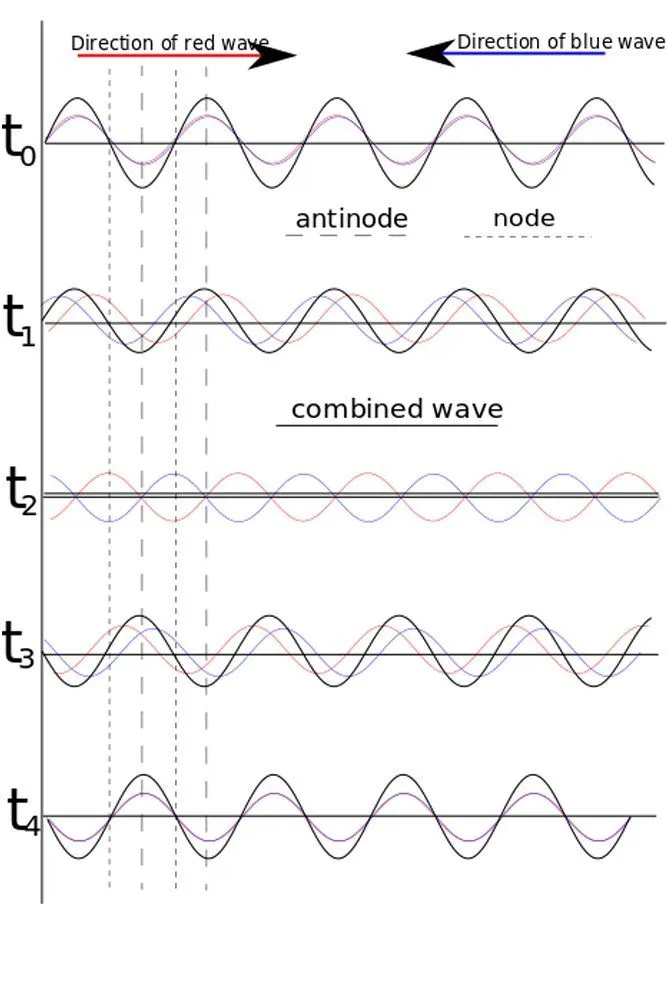
A standing wave is one that is formed by the combination of two waves moving in opposite directions, but having equal frequency and amplitude. A standing wave can only be formed when a wave’s motion is restricted within a given, finite space. In more specific terms, a standing wave is a wave that oscillates in time, but its peak amplitude profile does not move in space.
Also known as a stationary wave, a standing wave is formed due to interference. You see, when waves are superimposed, their energies are either canceled out or added together. In the case of waves that travel in the same direction, interference results in a traveling wave (the opposite of a standing wave).
How Is A Standing Wave Produced?
Suppose you pluck a string on a guitar. The moment you do that, you create vibrations within the body of the guitar, which are more specifically called mechanical waves. Such a vibrating instrument produces sound because the energy produced by these vibrations (in the form of sound waves) moves through the air and reaches our ears. The vibrations created within the instrument itself (the guitar, in this case) are called standing waves.
Standing waves can only be created when their motion is restricted to a given, finite region. Let’s consider the vibrating guitar string again.
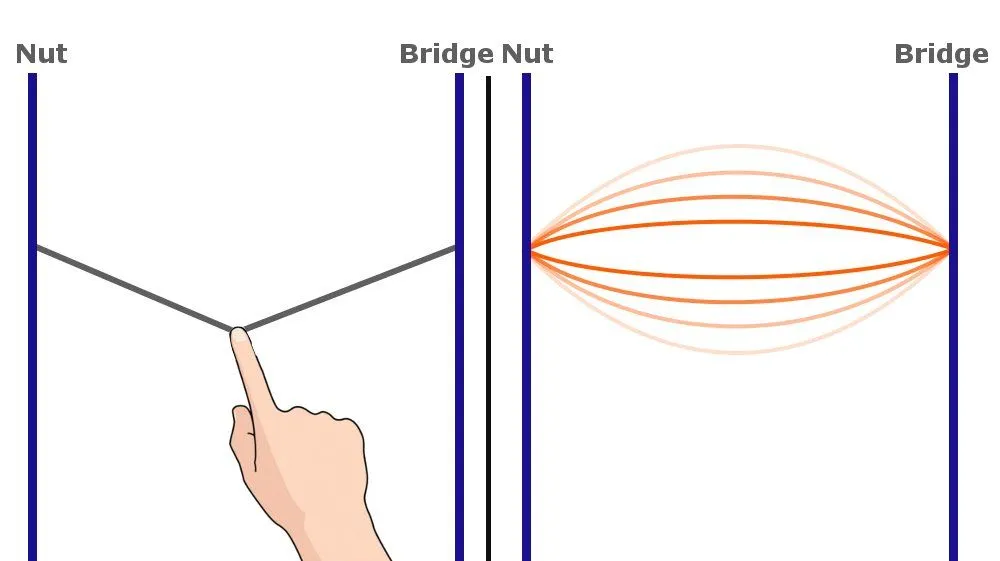
Caption: Notice how a string vibrates when it’s plucked.
You know that the guitar string (that you plucked) is restricted on both ends – by the bridge on one side and by your finger on the fretboard on the other. The moment you pluck a string, the wave reflects off each of the aforementioned boundaries of the string. The energy of the wave spreads out as it keeps moving back and forth between the two ends. Due to the process of interference, standing waves are produced.
Nodes And Antinodes Of A Standing Wave
A standing wave is called as such because, unlike ‘regular’ waves, it does not look like it’s traveling from one side to the other. Rather, it looks as if it were waving while standing in place.
Every standing wave pattern has certain points along the medium that appear to be standing still. These points are called nodes, or ‘points of no displacement’. There are also certain points along the medium that undergo maximum displacement during each vibrational cycle of the standing wave. These points are called antinodes.
Take a look at the following gif to get a better grasp of nodes and antinodes.
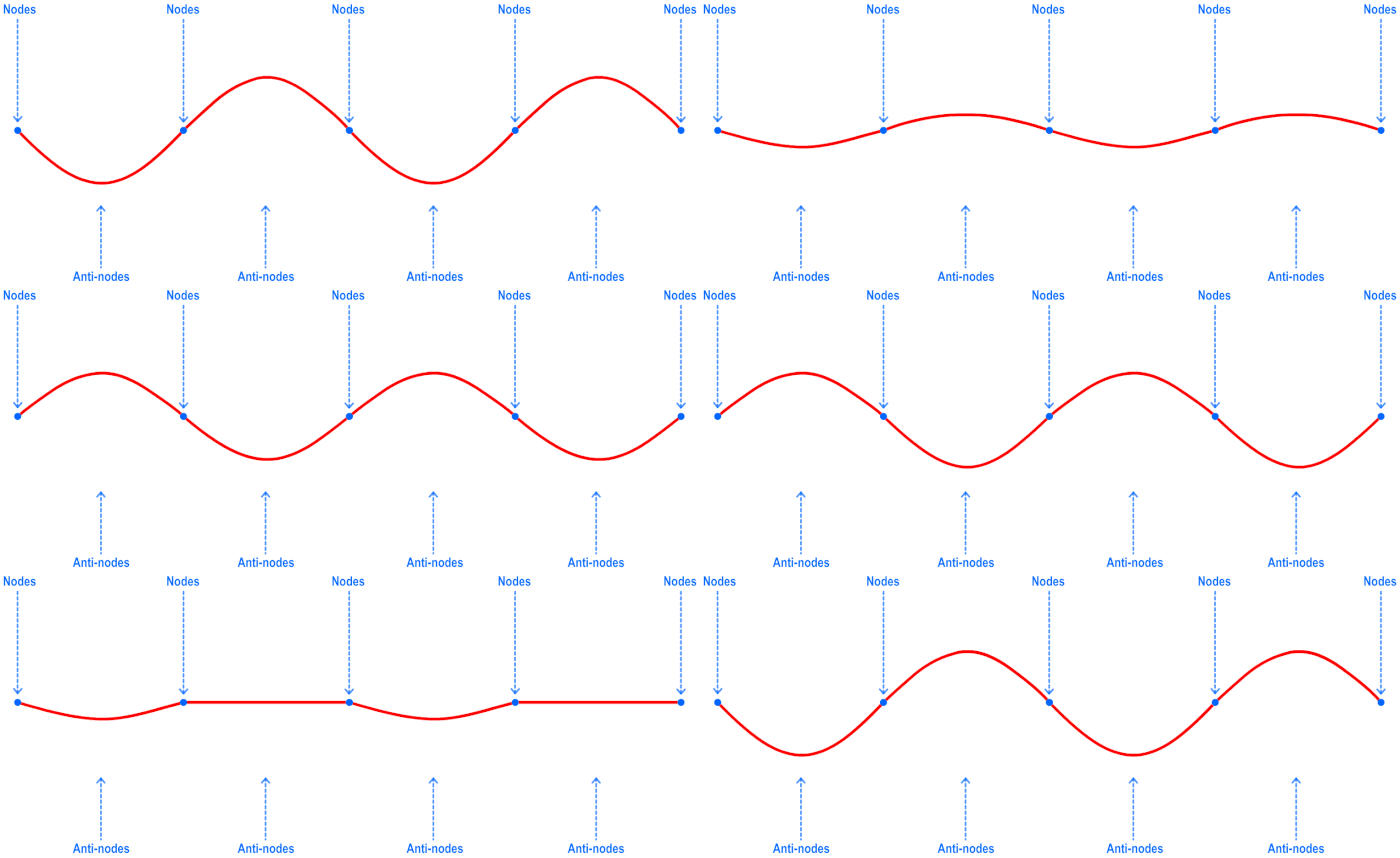
You can see in the gif above that there are some points in the wave that are not moving at all (nodes) and then there are points halfway between two adjacent nodes where the motion of the string has the greatest deviation (antinodes).
What Is The Standing Wave Ratio?
Standing wave ratio (SWR) is the ratio of the amplitude at the antinode (maximum) of the standing wave to the amplitude at the node (minimum).
When you look at a wave with a finite and non-zero SWR, you can assume that the wave is partially traveling and partially stationary. Pure standing waves have an infinite SWR. An interesting thing to note about pure standing waves is that they don’t transfer any energy from the source to the destination! However, the wave still remains subject to losses in the medium.
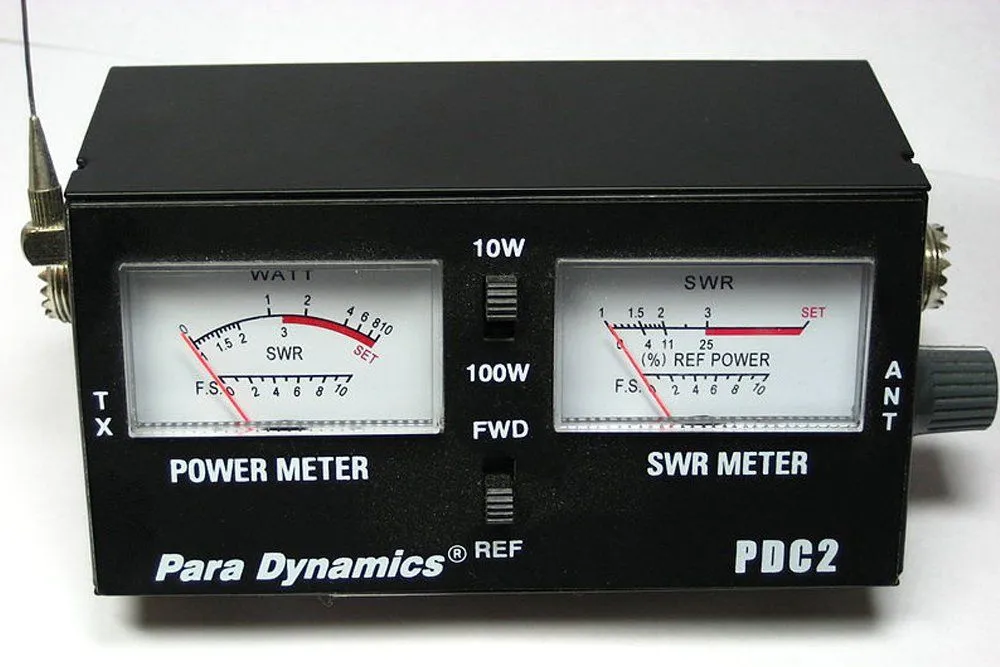
The term standing wave ratio is of the utmost importance in the field of telecommunications and radio engineering, as it helps in installing and tuning transmission antennas. That’s why checking the SWR (using a device known as the SWR meter) is a standard procedure at any radio station.
Standing Wave Examples
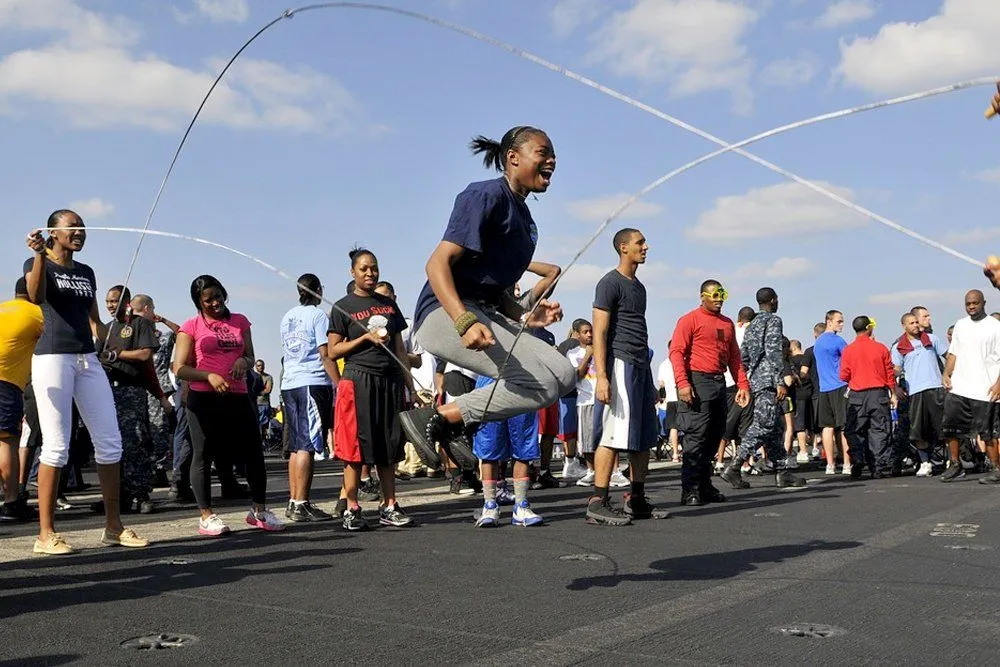
The aforementioned example of plucking the string of a guitar is a good example of standing waves beings produced. Other than that, two people shaking either end of a jump rope is also a good visual to understand the idea of standing waves. If they shake the rope in sync, it can form a pattern of waves oscillating up and down, with points along the rope where the rope’s arc is at a maximum (antinode) and points where the rope is almost still (node).
Standing waves can also be observed in sound waves. The presence of standing waves is most noticeable in musical instruments like flutes or guitars. Standing waves can also be observed in optical media, such as optical cavities, waveguides etc. Even the interference between X-rays can form an X-ray standing wave field!
What Are Some Real-Life Examples Of Standing Waves?
Standing waves aren’t just a chalkboard idea; once you know what to look for, you start spotting them everywhere. Each of the everyday examples below is the same trick at work. A wave gets trapped between two boundaries, reflects back on itself, and the two trips interfere to lock a pattern of nodes (still points) and antinodes (points of maximum motion) in place.

Musical instruments. This is the big one. On a guitar or violin, the string is clamped at both ends, so a standing wave forms with a node at each fixed end and an antinode in the middle, and that vibration sets the note’s pitch. Wind instruments do the same thing with a column of air instead of a string. A flute behaves like a pipe open at both ends, while a clarinet acts like a pipe closed at one end, and each shape allows only a particular family of standing-wave frequencies (the harmonics) to ring out.
The hot and cold spots in your microwave. A microwave oven bounces 2.45 GHz electromagnetic waves between its metal walls, and those reflections set up a standing wave inside the cavity. Food cooks fastest at the antinodes, where the energy is concentrated, and barely warms at the nodes, which is exactly why your oven uses a turntable to even things out. You can see it for yourself. Remove the turntable, microwave a bar of chocolate or a tray of marshmallows for a few seconds, and they melt in evenly spaced patches. The gap between melted spots is half a wavelength, roughly 6 cm (about 2.4 in). Double that to get the full wavelength (about 12 cm), multiply by the frequency, and you arrive at the speed of light: 2.45 × 109 Hz × 0.12 m ≈ 2.9 × 10⁸ m/s, satisfyingly close to the textbook value of 3 × 10⁸ m/s.
Seiches in lakes and harbors. Scale the idea up enormously and you get a seiche, a standing wave that sloshes across an entire enclosed body of water. When strong winds or a sudden change in air pressure push water toward one end of a lake and then release it, the water rocks back and forth like tea in a cup, with the biggest rise and fall at the shores (the antinodes) and almost no vertical motion at the center (the node). Lake Erie is notorious for them. According to NOAA, a seiche there in 1844 piled water about 6.7 m (22 ft) high at one end, breached a 4.3 m (14 ft) sea wall, and killed 78 people.
The common thread across all three is the boundary. A guitar string, the metal box of a microwave, and the shoreline of a lake are wildly different in size, yet each one confines a wave, forces it to reflect, and lets the back-and-forth trips interfere into the same node-and-antinode signature.
References (click to expand)
- Stationary Waves.
- Lowest frequency standing wave: fundamental - hep.physics.indiana.edu:80
- Standing Waves.
- Lab 1: Standing Waves.
- Rensselaer Polytechnic Institute (RPI) :: Architecture, Business ....
- Standing waves.
- Standing Waves and Resonance - University Physics Volume 1. OpenStax.
- What is a seiche? National Ocean Service, NOAA.
- Measure the Speed of Light Using Your Microwave. The Wonders of Physics, University of Wisconsin–Madison.