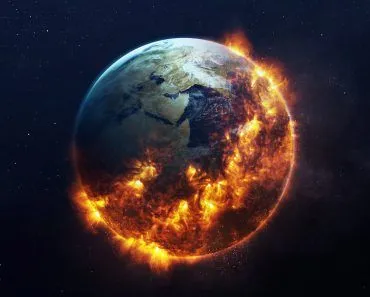
If the Earth were to switch off its gravity for 5 seconds, it would be catastrophic. With nothing holding them down, people, buildings, automobiles, trees and loose water would start to drift and tumble as the spinning planet kept moving beneath them. The air would also begin to expand outward, but 5 seconds is far too short for the atmosphere to actually escape into space, so the immediate danger is violent pressure changes rather than instant suffocation. Only a prolonged loss of gravity, lasting hours, would strip away the atmosphere and the oxygen that life depends on.
Gravity is not just the name of the movie with Sandra Bullock and George Clooney. As I’m sure you know, it’s an extremely important force that ensures the safety of life on Earth. Have you ever given any thought to what would happen if there was a switch somewhere on Earth for turning gravity off and on? Imagine that one fine day, Earth decided to just switch it off for a bit of fun? In other words, what would happen if gravity disappeared from Earth, even for as little as 5 seconds?
What Is Gravity?
Yes, we know it’s a movie, but apart from that, it’s one of the most fundamental forces in the universe that keeps our feet on the ground and the stars in the sky. A bit more important than a movie, right?
Gravity is the gravitational force that the Earth exerts on everything around it – everything that holds some mass, at least. This includes everything from the tallest skyscrapers to ultra-light insects. If you have mass, then gravity has you in its grasp. Gravity exerts a force (gravitational force) on everything on Earth and pulls it down. In other words, gravity is the force that keeps everything grounded.
When watching movies that take place in outer space, you might feel jealous of those astronauts floating and fooling around in the absence of gravity. In fact, you might even curse gravity for being there, holding you down all the time. However, you might not want that to happen if you fully understood what would happen if gravity ever decides to call it quits.
Gravity’s 5-second Absence
Without gravity, everything becomes weightless. Instantly, nothing would be held in place.
Now, I can guess what you’re thinking; you may be thinking that as soon as gravity disappears, you would start floating and flying over everything – cities, maybe even entire countries. It would be so awesome, right?
If you think that, you’re in for quite a surprise… and not a pleasant one.
In the absence of gravity, you wouldn’t float around aimlessly, instead, you’d be like tumbleweeds, fast-moving tumbleweeds. This would not only be you; everything would start moving, including buildings, automobiles, houses, trees…everything would start tumbling and rolling madly around the Earth. This is because the Earth would still be spinning, quite rapidly, as it does all the time. Remember, it’s gravity that holds everything in place.
However, this is hardly a big deal, when compared to the other types of destruction that an absence of gravity can cause. You can expect an apocalypse on a global scale, as everything would start to detach from its roots and begin rolling, tumbling and flailing randomly, somewhat like what they show in those epic destruction movies, except much worse.

Without gravity, Earth’s atmosphere would no longer be held to the surface. In just 5 seconds the bulk of the air would not have time to fully escape into space (air molecules at typical thermal speeds travel only a few kilometers in that time), but the pressure gradient that normally compresses the atmosphere downward would vanish, allowing the air to start expanding outward in every direction. The result would still be sudden, dangerous pressure changes near the surface.
If gravity stayed off for hours instead of seconds, the atmosphere really would dissipate and the oxygen we depend on would be lost with it.
Yes, the absence of gravity would only be 5 seconds and the great show of life would resume after that time, but there wouldn’t be many people left to enjoy the planet. It would mean a complete reboot on Earth!
Will Earth Lose Gravity For 7 Seconds On August 12, 2026?
The short answer is no, and it isn’t even close. Starting in early 2026, a story tore across Instagram, TikTok and Facebook claiming that Earth would lose gravity for exactly 7 seconds at 14:33 UTC on 12 August 2026, killing tens of millions of people in the fall. The posts blamed a supposedly leaked NASA document called "Project Anchor", complete with an invented $89 billion budget. It is a hoax from start to finish.

NASA addressed the rumor directly. As a spokesperson put it, "The Earth will not lose gravity on Aug. 12, 2026. Earth’s gravity, or total gravitational force, is determined by its mass." The only way for that pull to disappear would be for the whole Earth system, its core, mantle, crust, ocean, water and atmosphere, to suddenly shed its mass, which is not something any known physics allows. Fact-checkers at Snopes rated the claim false and could find no trace of any "Project Anchor" document; the story has been traced back to a single Instagram post from late 2025.
So why 12 August 2026? Because a real, perfectly predictable event falls on that date: a total solar eclipse whose path of totality crosses Greenland, Iceland and northern Spain. An eclipse simply means the Moon passes between the Sun and Earth and casts a shadow. It changes nothing about gravity. This isn’t even a new trick. The same "zero-gravity day" rumor circulated in 2014 and 2015, falsely tied to a Jupiter and Pluto alignment, and the idea can be traced to an April Fools’ joke the astronomer Patrick Moore made on BBC radio back in 1976. Each time, the only thing that changes is the date.
Does It Matter How Long Gravity Is Off, 1 Second Versus 7 Seconds Versus An Hour?
People search for every flavor of this question, from "1 second" to "10 seconds" to "1 hour," so it’s worth being clear: the length of the blackout completely changes the outcome. The slower-moving the consequence, the more time it needs to unfold.

One second: The fastest effect is the easiest to picture. The instant gravity vanished, everything not bolted down would stop being pressed against the ground and would start moving in whatever direction it was already heading. Because the Earth’s surface is rotating at up to roughly 1,670 km/h (about 1,040 mph) at the equator, unanchored objects would keep that sideways motion while the planet curved away beneath them. Even a 1-second pulse would mean a sudden, jarring lurch, but most things would barely lift off before gravity returned.
Seven seconds (or five): A few extra seconds give loose objects time to actually separate from the surface and pick up speed, which is why an unbuckled person or an untethered car could be flung hard enough to cause real injury when gravity snaps back on. The air, though, is slower to react. Nitrogen and oxygen molecules drift at only about 0.5 km per second, so in 7 seconds a parcel of air moves just a few kilometers. The atmosphere would start to swell upward and pressure would change abruptly, but the bulk of the air would still be here when gravity returned.
An hour or more: This is where it turns truly apocalyptic. Given enough time without the inward pull of gravity, the atmosphere would keep expanding and bleeding into space, the oceans would lift off, and Earth itself, no longer held together by self-gravity, would begin to come apart. The difference between a few seconds and a few hours is the difference between a violent global accident and the literal end of the planet as a coherent body.
References (click to expand)
- What would happen if the gravity on Earth was suddenly turned off .... Cornell University
- BBC - Earth - What would happen to you if gravity stopped working? - www.bbc.com
- Will Earth lose gravity for 7 seconds on Aug. 12, 2026? The truth about alleged NASA doc. Snopes.com
- Total Solar Eclipse on August 12, 2026. NASA Science.
- The Atmosphere: Earth's Security Blanket. NASA Science.
- Zero Gravity Day on Sunday: This Hoax Holds No Weight. Space.com.