Table of Contents (click to expand)
A bird strike is a collision between a bird (or other airborne animal) and an aircraft. Most cause little harm, but a bird sucked into an engine can choke off thrust, and one hitting the windshield can crack it. The danger is highest at low altitude during takeoff and landing, where most birds fly.
Human beings are constantly threatened by a number of potential hazards; and the more we invent, the more we become vulnerable to the failures of our inventions. Presently, the number of threats that concern us are so great in number that it is foolish to even try to make a complete list.
Let’s narrow this down a bit more and talk about the threats of flying through the air in a giant metal-and-fiber container or, in other words, an airplane.
The threat: bird strikes!
What’s A Bird Strike?
The event of an airborne animal (usually a bird or a bat) hitting an airplane in flight is referred to as a bird strike. It is known by a few other names as well, like a bird hit, bird ingestion or BASH (for Bird Aircraft Strike Hazard). Bird strikes also happen to other man-made objects on land, such as cars, power lines and wind turbines, which usually result in death for the birds.
The first ever case of a bird strike was reported by Orville Wright (one of the Wright brothers who are credited with inventing and flying the world’s first successful airplane), who noted it in his diary on September 7, 1905, barely two years after that first powered flight. But interestingly, the strike wasn’t totally accidental. Orville was flying circles near a cornfield in Ohio; he had apparently been chasing flocks of birds before he hit one. The dead bird lay on the wing of his airplane until he made a sharp turn to dump it off.
Although bird strikes pose a sizable threat to flight safety, the number of major accidents caused by them is quite low. The vast majority of bird strikes do little or no damage to the airplane (only around 7% of reported strikes cause any damage at all), but these collisions are almost always fatal to the birds involved. They are also surprisingly common: in 2024 alone, the US Federal Aviation Administration logged more than 22,000 wildlife strikes, roughly 61 every day.
The Most Vulnerable Phase Of Flight
Although it’s true that there is no way you can be completely sure of avoiding a bird strike (unless you are flying in a world where there are no aerial animals, which currently is unknown). Bird strikes usually occur when an airplane is flying at low altitudes. Therefore, the most favorable conditions for a bird strike are during take-offs or landings (or other related phases) of airplanes. The reason for this is obvious; most birds fly at low altitudes, so there is a greater risk of hitting an airborne machine. In fact, the FAA reports that about 70% of bird strikes happen below 150 meters (500 feet).
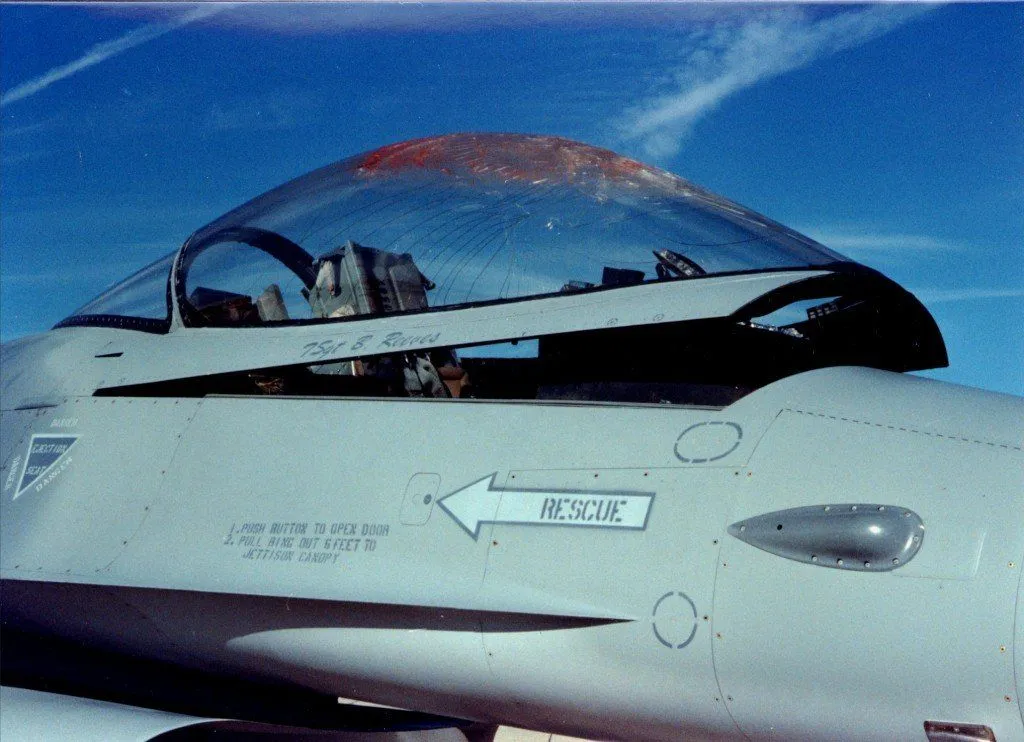
However, this doesn’t mean that there are no birds flying higher than “normal” altitudes; in fact, bird strikes have also been reported at higher altitudes of around 6000 meters (20,000 feet) to 9000 m (30,000 feet). The world record for a bird strike at the highest altitude ever is a staggering 11,300 meters (37,000 feet, or about 11.3 kilometers) above the ground, set in 1973 when a commercial airliner over the Ivory Coast struck a Rüppell’s vulture, a species whose blood is specially adapted to absorb oxygen in the thin air of the upper atmosphere.
What Happens During A Bird Strike?
Birds usually collide with any of the forward-facing edges of an airplane, which include the wings, nose cone, and the most common site – the jet engine.
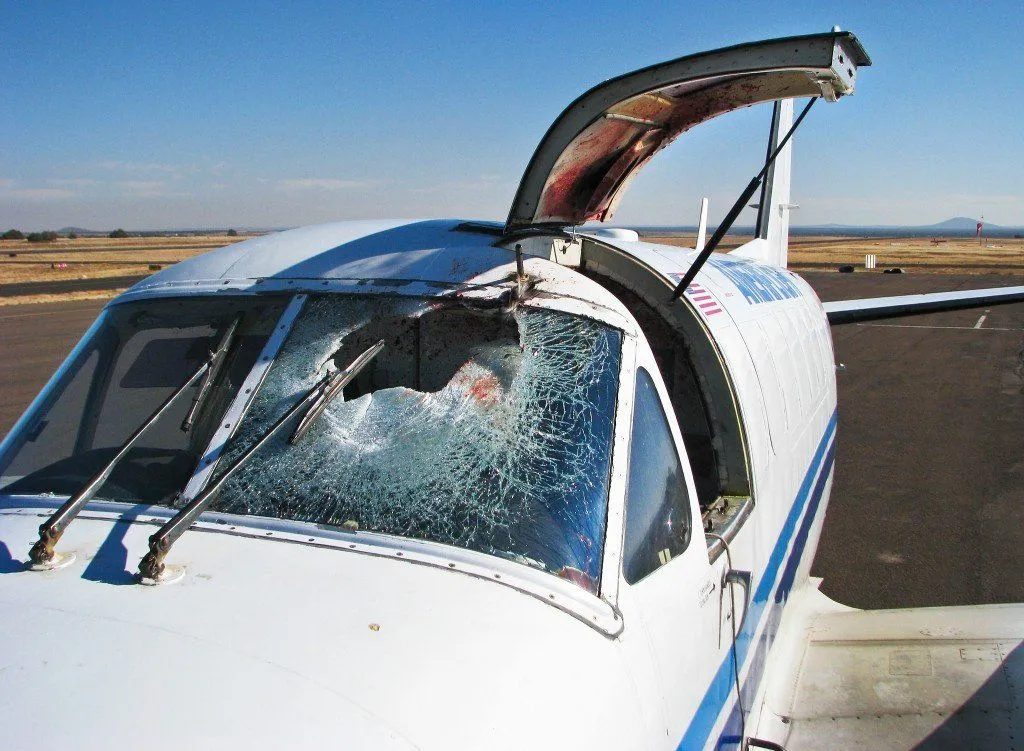
There have been cases of birds hitting the windshield or canopy of airbuses and fighter jets, which can (sometimes) result in the cracking of the surface of the canopy or windshield. These cracks can sometimes disrupt the air pressure inside the cabin and result in altitude loss or other flight-related problems. The severity of the damage done by the bird strike depends on a few factors, including speed difference, direction of impact, and the weight and size of the bird.
To put it in perspective, consider a 5-kilogram bird hitting an airplane at a relative velocity of 275 km/h. Can you figure out how much of an impact this translates into?
That impact is equivalent to the energy of a 100-kg bag being dropped from a height of 15 meters! Imagine what it would feel like to be hit by a sac weighing 100 kg from that height. Go on, take a few seconds and imagine it for yourself. Not too pleasant!
The most dangerous conditions arise when a bird hits the turbine and gets caught in the engine; this event is referred to as a jet engine ingestion (since the bird is ‘ingested’ by the engine).
After being ‘stuck’ in the engine, the bird can cause a disruption in the rotatory motion of the fan blades, resulting in a partial or complete failure of that engine. Now, what can a sudden failure of one of the engines do to an airplane, you may ask? Let’s not even talk about it. Flocks of birds are even more dangerous, as they can have a much nastier impact collectively.
The Miracle On The Hudson
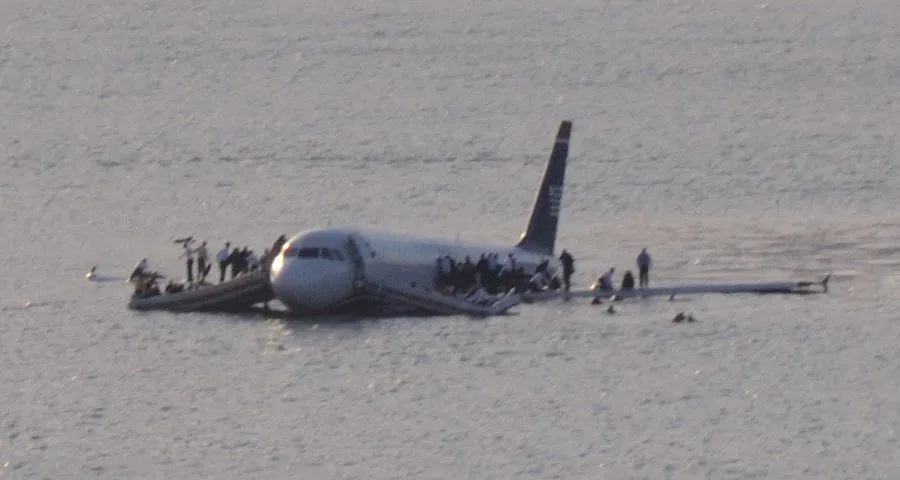
There have been many cases of bird strike incidents, but the one that got a lot of attention was the case of US Airways Flight 1549. Back on January 15, 2009, an Airbus A320 flew straight into a flock of Canada geese shortly after taking off from LaGuardia Airport in New York City. The big birds were ingested into both engines, knocking out almost all thrust at once. With no power and no runway in reach, Captain Chesley “Sully” Sullenberger glided the crippled jet down to a miraculous unpowered landing on the Hudson River. Quite incredibly, all 155 people on board survived. There is no surprise why this event is known as the “Miracle on the Hudson”.
Not every bird strike ends so well. On December 29, 2024, Jeju Air Flight 2216 struck a flock of ducks on approach to Muan, South Korea, and crashed during an emergency belly landing, killing 179 of the 181 people aboard. Investigators later found duck DNA in both engines. It stands as a grim reminder that, even one as huge as an airliner, an aircraft is never truly invulnerable to something as small as a bird.
References (click to expand)
- (2000) THE COSTS OF BIRD STRIKES AND ... - UNL Digital Commons. The University of Nebraska–Lincoln
- Frequently Asked Questions and Answers | Federal Aviation Administration. faa.gov
- Wildlife Strikes to Civil Aircraft in the United States 1990-2024. Federal Aviation Administration
- US Airways Flight 1549 incident. Encyclopaedia Britannica