Table of Contents (click to expand)
- Does Any Of This Really Happen If Someone Shoots A Gun In An Airplane?
- Important Thing To Know: Aircraft Cabins Are Pressurised
- Exiting After Puncturing A Small Hole In The Fuselage
- If The Bullet Hits A Window
- If The Bullet Hits The Fuel Tank
- If The Bullet Hits The Walls
- Can You Actually Fire A Gun On A Plane?
- Why One Bullet Hole Won’t Depressurize The Cabin
- How Long Would You Stay Conscious If The Cabin Lost Pressure?
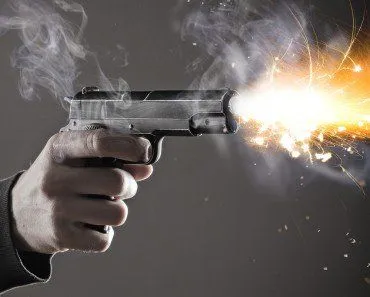
There are four potential outcomes if someone shoots a gun on an airplane: 1. The bullet punctures a hole in the fuselage and exits. 2. The bullet hits a window. 3. The bullet hits the fuel tank of the airplane. 4. The bullet hits the hidden wiring in the floor or the walls.
Popular culture is in love with a particular scene in action movies; the protagonist and the villain (or at least his right-hand man) get in a scuffle at 30,000 feet that ends in a firefight, wherein one of the parties shoots at the other. The shot from the gun punctures a hole in the fuselage of the aircraft, and more often than not, everything begins to go haywire, as air from the outside starts making a terrible mess in the cabin.
Does Any Of This Really Happen If Someone Shoots A Gun In An Airplane?

Although it largely depends on the type of gun (and the bullet) that you’re using, these are the four most likely outcomes when you shoot a bullet in an airplane:
1. The bullet punctures a hole in the fuselage and exits.
2. The bullet hits a window.
3. The bullet hits the fuel tank of the airplane.
4. The bullet hits the hidden wiring in the floor or the walls.
Important Thing To Know: Aircraft Cabins Are Pressurised
Pressurization of an aircraft refers to the process of maintaining a safe and comfortable environment inside an aircraft by increasing the internal atmospheric pressure. This is particularly important due to the significant decrease in oxygen levels and air pressure as an aircraft ascends to high altitudes.
The physics behind the pressurization of an aircraft involves the control of an airplane’s cabin altitude by pumping in compressed air, essentially duplicating earth’s atmospheric conditions at sea level (or slightly above). The compressed air is usually taken from the engines or an auxiliary power unit and is cooled before being circulated inside the cabin.
The pressurized air acts against the lower pressure outside the aircraft, creating a force that helps maintain the structure of the airplane’s fuselage. Pressurization systems must be robust and designed to handle these forces to ensure the safety of the aircraft and its passengers.
Now let’s look at the different scenarios.
Exiting After Puncturing A Small Hole In The Fuselage
If the bullet just made a small hole in the fuselage (body of the aircraft) and exited, then there won’t be much damage. This is because as mentioned, the cabin of the aircraft is pressurized, and the hole will only create a small leak, which wouldn’t affect the pressure level of the cabin. So, there’s not a big threat there.
If The Bullet Hits A Window
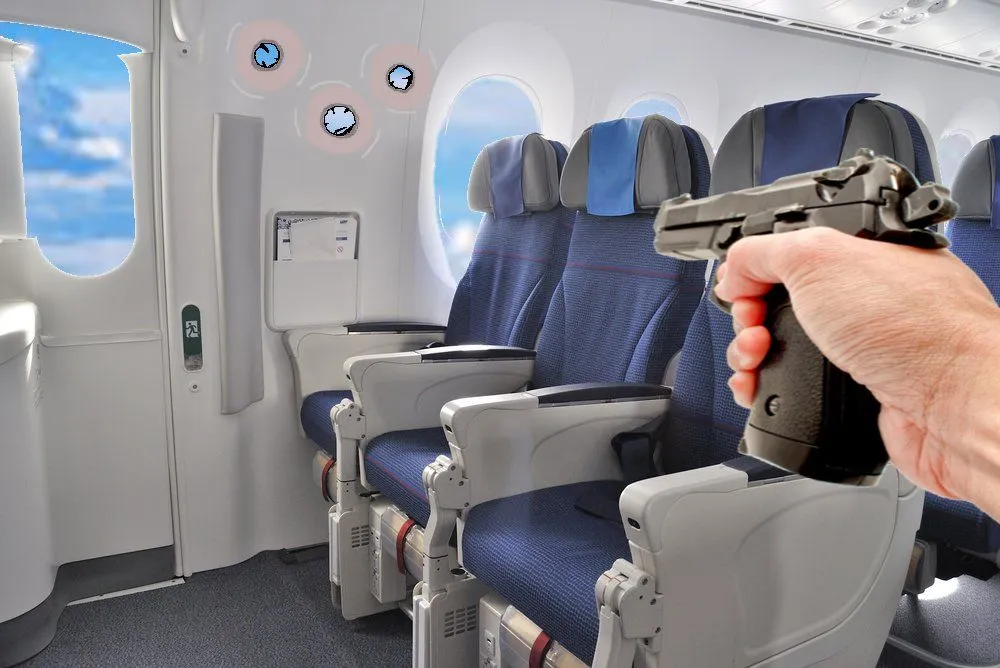
If the bullet hits a window and the impact is powerful enough to actually blow the window out, then you are in for trouble. Big trouble.
As mentioned earlier, the airplane is pressurized. Although a small hole wouldn’t affect the pressure level significantly, when there is a (comparatively) large hole in the fuselage due to a missing window, then the pressure equilibrium will be disturbed. Due to this, all of the air inside the cabin will rush towards the missing window, carrying debris along with it. If the person sitting next to the missing window is not strapped in with their seatbelt, then in all probability, they will be sucked out.

Since the concentration of oxygen at high altitudes is quite low, people sitting in the cabin would soon experience lightheadedness and incoherence (due to the lack of oxygen). Putting on oxygen masks while you can still think clearly is the first thing you should do.
If The Bullet Hits The Fuel Tank
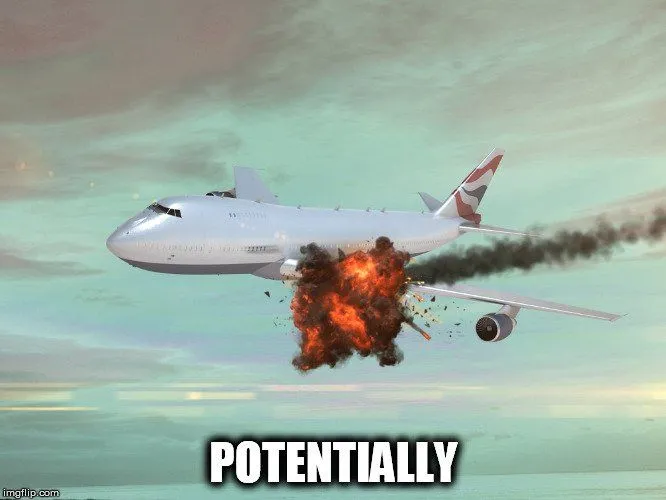
Although many commercial airplanes store the fuel in their wings, there are some airplanes that store thousands of gallons of fuel in their fuselage. If the bullet punctures the fuel tank, then it may create a leak that can potentially cause an explosion.
If The Bullet Hits The Walls
If the bullet hits the walls of the airplane or the floor, then there is a good chance that it will hit the internal wiring, or worse, an instrument panel. If this happens, then you may experience anything from some harmless problems (failure of the in-flight entertainment system, etc.) to much more severe technical problems. It all depends on where the bullet actually strikes.
Can You Actually Fire A Gun On A Plane?
Before we get to the physics, there’s a simpler question many people are really asking: is there a gun on the plane to fire in the first place? For ordinary passengers, the answer is no. The U.S. Transportation Security Administration (TSA) allows you to travel with a firearm, but only in checked baggage, never in the cabin. The gun has to be unloaded, packed in a locked hard-sided container, and declared to the airline at the ticket counter, with ammunition boxed separately. Firearms and ammunition, loaded or unloaded, are flatly prohibited in carry-on bags, and the same rules apply across most of the US, UK, Australia, and Canada.

So in practice, the only person legally carrying a loaded firearm in the cabin of a US flight is a federal air marshal, the plainclothes officers who began flying in the early 1960s and who blend in with regular passengers. That is also why the Hollywood mid-air shootout is mostly fiction; for a gun to go off in a passenger cabin, someone has to have smuggled it past security, which is exactly what the screening system is built to prevent. The interesting science begins with the rarer reality: what if a bullet did get loose at cruising altitude?
Why One Bullet Hole Won’t Depressurize The Cabin
The classic movie moment, where a single shot rips a cabin apart, gets the physics backwards. A pressurized cabin is not a balloon waiting to burst. Air is constantly pumped in by the pressurization system and constantly bled out through an adjustable outflow valve, the opening that sets how much pressure the cabin holds. That valve is far larger than any bullet hole. As pilot David Lombardo has explained, a bullet hole in a cabin wall would have no perceived effect on cabin pressure, because the hole is smaller than the outflow valve opening and leaks less air than is normally lost around the door and window seals.

Aviation distinguishes three kinds of pressure loss. Explosive decompression happens in under about 0.5 seconds, faster than your lungs can vent (they need roughly 0.2 seconds), which is why it can injure the lungs; it essentially never results from a small puncture and usually requires a large structural opening on a small, very high-flying aircraft. Rapid decompression unfolds over several seconds, and gradual decompression is so slow it may only show up on instruments. A bullet hole sits firmly in that last, harmless category. Even a much bigger opening drains slowly: NASA scientist Geoffrey Landis estimated it would take roughly 100 seconds for the pressure to equalize through a 30 cm (12 in) hole in a Boeing 747. The danger only appears with a window-sized failure, where the air rushing out toward the gap can exert close to half a ton of force on a person sitting right beside it, which is why a seatbelt matters so much near a blown-out window.
How Long Would You Stay Conscious If The Cabin Lost Pressure?
If a large opening did drop the cabin pressure, the real enemy is not the bullet but the thin air. At cruising altitude there simply is not enough oxygen to stay sharp for long. Pilots use a figure called the time of useful consciousness (TUC): the window between losing your oxygen supply and the moment you can no longer take sensible, life-saving action. Crucially, that is not the time to passing out; your judgment fades well before that.

The numbers shrink fast with altitude. Around 5,500 m (18,000 ft) you may have 20 to 30 minutes, but at 7,600 m (25,000 ft) it falls to 3 to 5 minutes, at 9,100 m (30,000 ft) to 1 to 2 minutes, and at a typical cruise of 10,700 m (35,000 ft) to just 30 to 60 seconds. Above 12,000 m (40,000 ft) you may have only 15 to 20 seconds, and a rapid decompression can roughly halve even those figures. That is exactly why airlines tell you to fit your own oxygen mask before helping anyone else; in the worst case you have seconds, not minutes, to think clearly. The masks themselves run on a chemical oxygen generator rather than a stored tank, enough to keep you conscious while the pilots dive to a breathable altitude. So a stray bullet at altitude is far less of a threat than the cold, thin air it might let in.
So, that’s it. As with many other things, popular culture shows an exaggerated version of this event. When the MythBusters team sealed and pressurized a retired airliner and fired a handgun through the fuselage skin and then through a window, nothing dramatic happened; only a window-sized opening blown out with explosives produced any real rush of air, and even then their crash-test dummy was not sucked out through the hole. A single bullet hole rarely causes a dangerous loss of pressure, because the cabin’s pressurization system can keep up with much larger leaks than that. Federal air marshals historically carried frangible rounds (the Glaser Safety Slug) built to break apart on impact rather than punch a clean hole through anything important, although the service moved to conventional duty ammunition when it re-equipped with the Glock 19 in 2020. In any event, firing a gun onboard an airplane is never a good idea, unless you’re on set for the next summer blockbuster.
References (click to expand)
- What if someone shot a gun on an airplane? | HowStuffWorks. HowStuffWorks
- Uncontrolled decompression - Wikipedia. Wikipedia
- Transporting Firearms and Ammunition. Transportation Security Administration (TSA)
- Atmospheric Oxygen, Hypoxia and Time of Useful Consciousness. University of British Columbia (ATSC 113)
- Rare pulmonary barotrauma after explosive decompression: a case report. PMC, NCBI
- What happens if an airliner suddenly loses cabin pressure? Smithsonian Magazine
- Federal Air Marshal Service - Wikipedia. Wikipedia