Table of Contents (click to expand)
- Can You Get Sucked Out Of An Airplane?
- What Happens If You Get Sucked Out Of The Airplane?
- How Does Cabin Pressurization Keep You Safe So High Up?
- How Do Paratroopers Jump Off Aircraft?
- Has A Passenger Ever Actually Been Sucked Out Of A Plane Window?
- Conclusion – Is Getting Sucked Out Of An Airplane Really A Threat?
Getting sucked out of an airplane requires a serious structural breach (a blown-out window, door plug or fuselage panel) that triggers rapid decompression at high altitude. Such events are extraordinarily rare, and a fastened seat belt is enough to keep a passenger in their seat even when a cabin depressurizes. Real incidents like British Airways Flight 5390 (1990) and Alaska Airlines Flight 1282 (2024) show how vanishingly uncommon a full ejection is.
If you’re an infrequent flier like me, your head probably races in all directions before you board a plane, thinking of the many things that could go wrong.
Think about it… you’re in a metal contraption piloted by creatures not designed to fly, sailing several thousand feet above their originally intended habitat.
What could not go wrong?
Running out of fuel mid-air? Engine stalling in flight? Or like they show in movies, getting sucked out of the airplane altogether!
Can You Get Sucked Out Of An Airplane?
While the short answer is yes, the probability of such an event occurring is extremely low.
Still, it helps if we understand the mechanics behind it.
Humans primarily live on land; our bodies have adapted to the atmospheric pressure near sea level, and our internal organs expand and contract in tune with it.
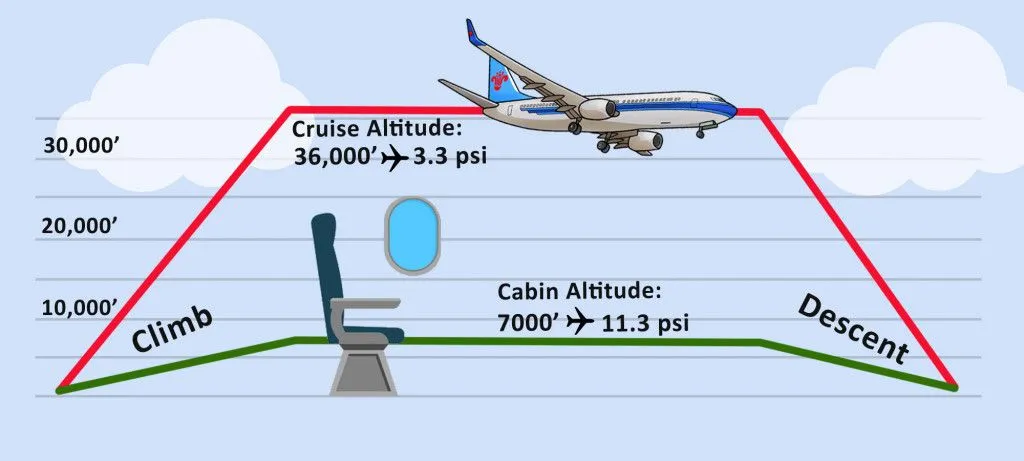
With an increase in altitude, the effective ‘quantity’ of atmosphere acting over you reduces, dragging air pressure down with it. Because this is unfavorable for the human body, aircraft cabins are pressurized to mimic a much lower altitude than the one you’re actually flying at. Most commercial cabins are kept at an equivalent altitude of roughly 6,000 to 8,000 ft, well below the 33,000–42,000 ft the plane is actually cruising at, and close enough to sea level to keep you comfortable.
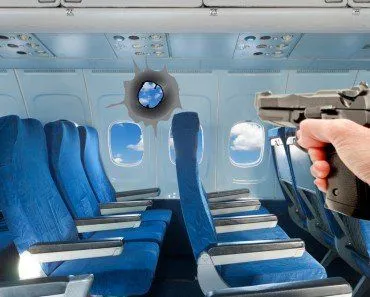
Structural damage to an aircraft can cause sudden drops in pressure, forcing air out of the cabin until equilibrium is established. This is known as depressurization. At times, this damage, primarily cracks and holes, can be large enough for a human to fit through. The rapid loss of cabin pressure can pick up loose objects, and sometimes even passengers, partially or completely pulling them out of an aircraft.
Types Of Depressurization
Depressurization resulting from structural damage can come in two types. Rapid depressurization refers to the loss of cabin pressure over several seconds. Explosive decompression, on the other hand, takes place in less than half a second.
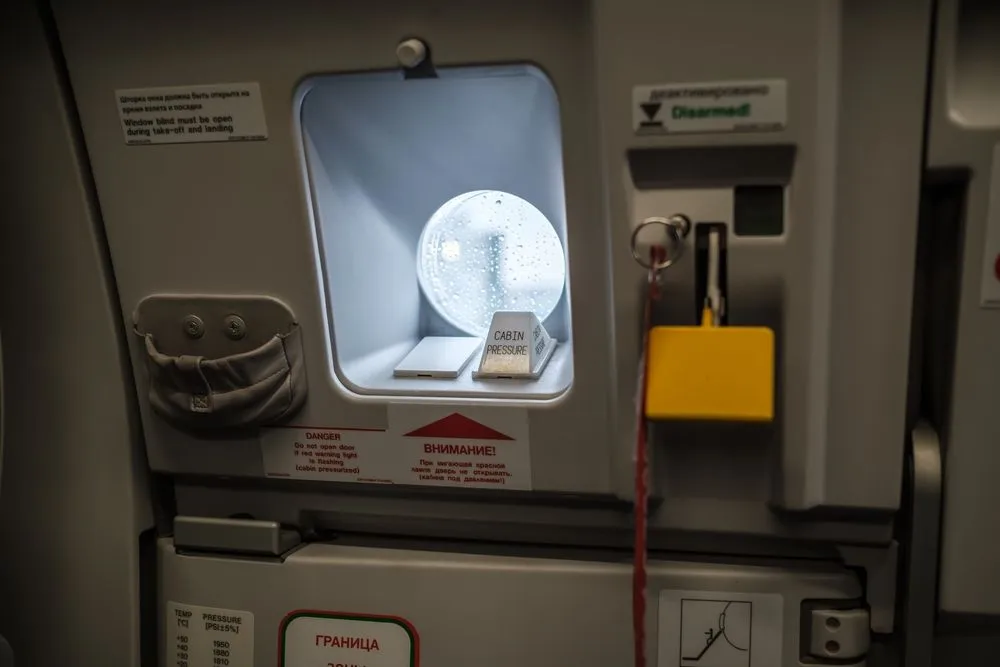
Another form of depressurization, also known as gradual or insidious depressurization, refers to a slow leak. This can arise from faulty gaskets and door seals, window cracks or a malfunction in the pressurization system.
The rate of depressurization is directly proportional to an aircraft’s altitude and the size of the opening caused by the structural damage. At the same time, it is inversely related to the size of the aircraft cabin. Thus, a larger cabin will take longer to decompress than a smaller cabin.
What Happens If You Get Sucked Out Of The Airplane?
Upon accidental depressurization of an aircraft, occupants can experience several things. The sudden reduction in cabin pressure causes altitude-induced decompression sickness and hypoxia, limiting the amount of oxygen available to the blood stream. Other symptoms include ear pain, joint pain (known as ‘the bends’, the most common DCS symptom), stomach cramps, nausea, and even a change in the color of your lips (to blue!).
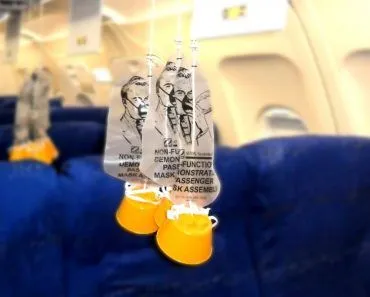
Depending on a passenger’s physical state, hypoxia can either set in immediately or gradually. This results in reduced awareness and ability to respond, and eventually complete incapacitation. In order to prevent this, oxygen masks are deployed.

The rapid exit of air from the aircraft can also pick up loose items, such as food trays, personal items and debris, which further increases the chances of injury. The cabin itself experiences a rapid drop in temperature, causing air to fog up due to the condensation of vapor.
Even in such situations, occupants are largely safe thanks to their seat belts and oxygen masks. Pilots usually declare an emergency and rapidly descend to lower altitudes where air pressure and oxygen density are higher, reducing the need to depend on support systems. Commercial aircraft typically cruise between 33,000 and 42,000 ft. In the event of depressurization, pilots execute an emergency descent and try to reach 10,000 ft or less within minutes, the altitude below which the FAA no longer requires supplemental oxygen for the crew.
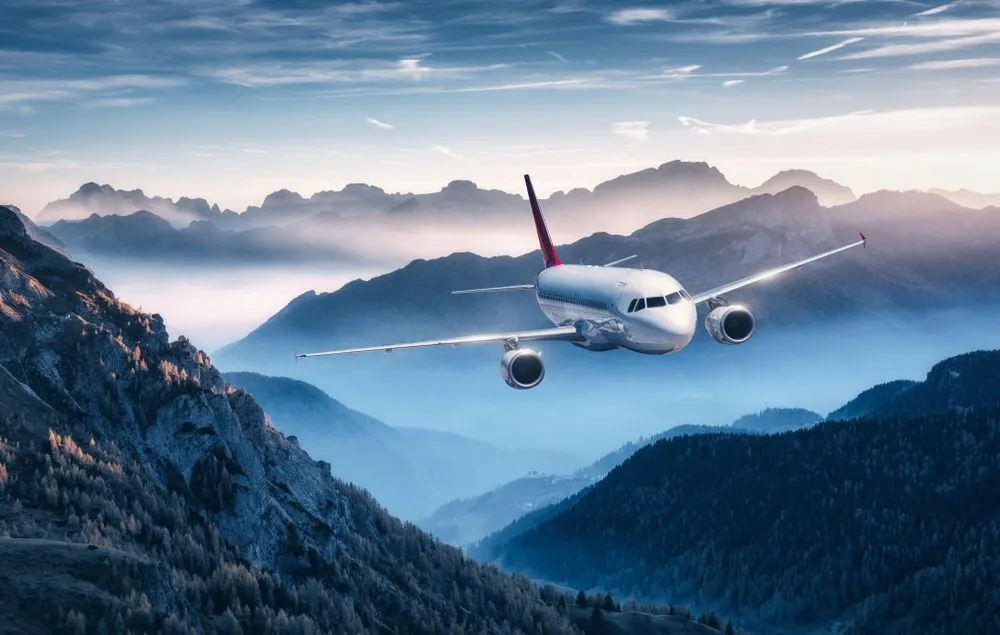
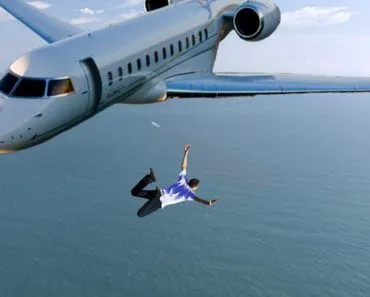
However, someone sucked out of an aircraft is in a highly precarious situation. They are effectively in a high-altitude free fall without any equipment. In such situations, the risks mount quickly and a person’s chances of surviving the fall are extremely bleak.
The danger of hypoxia and extreme lung decompression is huge. High-speed winds at extremely low temperatures make this even more dangerous. Other loose objects or debris being ejected from the plane can collide with the passenger, or the person could even get sucked into the engine itself, which can be detrimental to the flight’s safety.
How Does Cabin Pressurization Keep You Safe So High Up?
Here is the detail that makes the whole "sucked out" scenario possible in the first place: the air you breathe so comfortably in the cabin is nothing like the air just on the other side of the window. At a typical cruising altitude of 10,000 to 12,800 m (33,000 to 42,000 ft), the outside air pressure is below 0.3 atm, and it is far too thin to keep you conscious. An unprotected person up there would black out within seconds. So how has technology made flying at this altitude feel as routine as sitting in a coffee shop?

The trick is to seal the fuselage into a pressure vessel and constantly feed air into it. Jet engines swallow enormous volumes of air, and a fraction of the hot, compressed air from the compressor stages is tapped off as bleed air. It is cooled through air-conditioning packs and pumped into the cabin. Near the tail, an outflow valve meters how quickly that air is allowed to leak back out. By balancing the air coming in against the air bleeding out, the system holds the cabin at a far friendlier pressure than the sky surrounding it.
Regulations keep this honest. Under the FAA's airworthiness standards (14 CFR 25.841), an airliner cabin must not feel like anything higher than 8,000 ft (about 2,400 m), even when the jet is at its maximum cruising altitude. That is the same 6,000 to 8,000 ft cabin altitude mentioned earlier, comfortably close to sea level. Throughout the flight the fuselage holds a pressure difference of roughly 8 to 9 psi (around 0.6 atm) between the cozy inside and the near-vacuum outside, and that stored energy is exactly what rushes out the instant a window or door fails.
Newer jets are gentler still. The Boeing 787's composite fuselage lets it keep the cabin at the equivalent of about 6,000 ft (1,800 m) with more humidity, which is part of why long-haul flights on it leave you less drained. This modest cabin altitude is also why you might feel a little light-headed or sleepy in flight without being in any danger: your blood oxygen dips slightly at 6,000 to 8,000 ft, but it is a world away from the unbreathable air a few centimeters beyond the glass.
How Do Paratroopers Jump Off Aircraft?
While armed forces are definitely real-life heroes, they’re not immune to the whims of physics. How do they manage to jump off the back of airplanes without getting sucked out or chopped up by the engines?

For the most part, paratroopers jump off from the lowest possible altitudes, their goal being to reach the ground as quickly as possible. Similarly, skydivers jumping off aircraft for recreational purposes also go to altitudes within the human body’s safe physiological limits.
However, certain military operations require personnel to be airdropped from altitudes as high as 35,000 ft (so-called HALO and HAHO jumps). The trick here is gradual and controlled depressurization. Cargo aircraft have an outflow valve that releases cabin pressure before the bay doors open. This allows paratroopers and any payloads to exit the craft without being forcefully drawn out by depressurization.
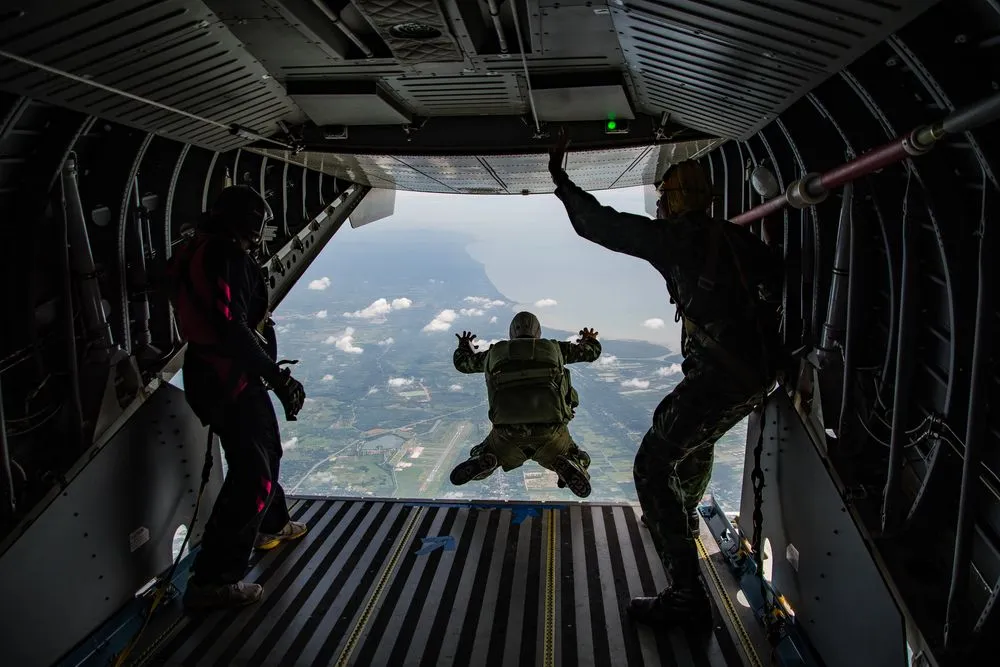
Paratroopers attempting high-altitude jumps use an oxygen supply and compression body suits to prevent hypoxia and decompression-related sickness. Furthermore, locating doors aft of the engines eliminates the risk of any paratrooper getting sucked into them.
Has A Passenger Ever Actually Been Sucked Out Of A Plane Window?
It does happen, but the list of genuine cases is mercifully short, and almost every one traces back to a structure failing rather than a window simply popping open. The most haunting example is Aloha Airlines Flight 243 in 1988. Metal fatigue and corrosion caused roughly 5.5 m (18 ft) of the Boeing 737's upper fuselage to peel away in an explosive decompression at about 7,300 m (24,000 ft). Flight attendant Clarabelle "C.B." Lansing, who was standing in the aisle, was swept out instantly and was the accident's only fatality; her body was never recovered. Everyone strapped into a seat survived.

Thirty years later, Southwest Airlines Flight 1380 showed the same physics through a single window. In April 2018, a fan blade in the left engine snapped because of a fatigue crack, and the flying debris knocked out a cabin window while the Boeing 737 was climbing through about 9,800 m (32,000 ft). Passenger Jennifer Riordan was partially pulled through the opening by the escaping air. Fellow passengers managed to haul her back inside, but she later died of her injuries. Tellingly, she was wearing her seat belt, which is what gave the people beside her something to hold on to.
Pilots are not spared either. Barely a month after that, the cockpit windshield of Sichuan Airlines Flight 8633 blew out at around 9,800 m (32,000 ft), and first officer Xu Ruichen was sucked halfway out of the jet. His seat belt held, the captain dived to a safe altitude, and all 128 people on board survived. It was an almost exact replay of British Airways Flight 5390 in 1990, when Captain Tim Lancaster was pinned half-outside his own cockpit and lived to tell the tale.
The pattern across every one of these incidents is the same: the people who were fully ejected were either unrestrained or standing, while those held by a seat belt stayed with the aircraft even when half of their body was already outside. It is the strongest possible argument for that otherwise boring instruction to keep your belt fastened whenever you are seated.
Conclusion – Is Getting Sucked Out Of An Airplane Really A Threat?
Aviation is amongst the riskiest endeavors undertaken by man. Yet the number of instances of people actually being sucked out of airplanes is proportionately tiny. Captain Tim Lancaster of British Airways Flight 5390 was famously pinned half-outside his cockpit at 17,300 ft in 1990, and survived. More recently, when a door plug blew off Alaska Airlines Flight 1282 at roughly 14,830 ft in January 2024, every passenger and crew member stayed inside the plane. Each of these rare, headline-grabbing events has prompted pan-industry design and engineering changes that mitigate the risks even further.
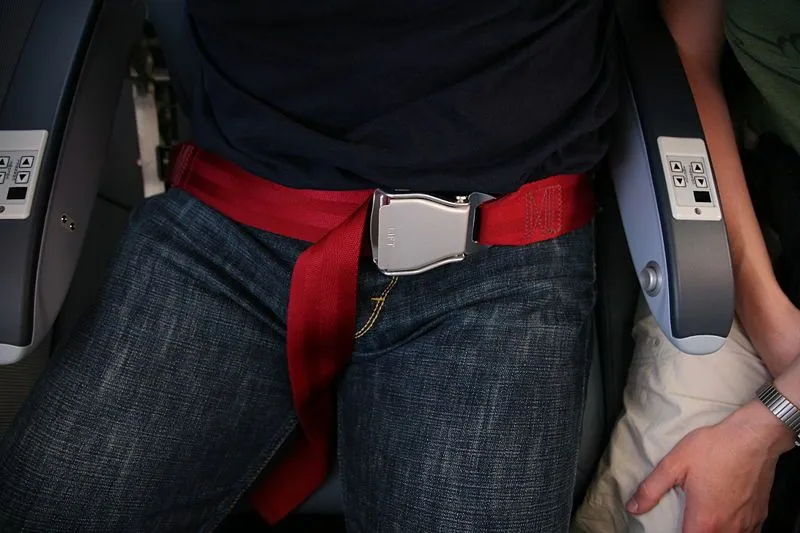
Therefore, while it is not uncommon to face depressurization; it is never as dramatic or violent as they show in movies. At the same time, the risk of being sucked out of an airplane is too insignificant to worry about. If flight paranoia still haunts you, using a seat belt as a safety precaution will ensure that you avoid getting ‘caught in the wind’!
References (click to expand)
- High-altitude military parachuting (HALO/HAHO). Wikipedia
- NTSB Investigation DCA24MA063 – Alaska Airlines Flight 1282 door plug separation. National Transportation Safety Board
- Altitude-Induced Decompression Sickness. faa.gov
- Ottestad, W., Hansen, T. A., Pradhan, G., Stepanek, J., Høiseth, L. Ø., & Kåsin, J. I. (2017, December 1). Acute hypoxia in a simulated high-altitude airdrop scenario due to oxygen system failure. Journal of Applied Physiology. American Physiological Society.
- Rapid Depressurisation | SKYbrary Aviation Safety. SKYbrary
- Time of Useful Consciousness | SKYbrary Aviation Safety. SKYbrary
- Explosive Depressurisation | SKYbrary Aviation Safety. SKYbrary
- Cabin Decompression Awareness - SKYbrary. SKYbrary
- Aircraft Accident Report: Aloha Airlines Flight 243 (NTSB/AAR-89/03). National Transportation Safety Board
- Southwest Airlines Flight 1380 Engine Failure (DCA18MA142). National Transportation Safety Board
- The Airliner Cabin Environment and the Health of Passengers and Crew. NCBI Bookshelf
- Cabin pressurization. Wikipedia
- Sichuan Airlines Flight 8633. Wikipedia