The hyperboloid shape of cooling towers helps to cool the working fluid down to a low temperature by releasing vapors into the atmosphere through the opening at the top of the tower. The shape also helps to facilitate aerodynamic lift and faster and more efficient diffusion into the atmosphere.
While driving through the countryside, you have likely laid your eyes on a number of factories and industrial plants. Without a doubt, the enormity of those structures is overwhelming, but does present viewers with a picturesque vista. Out of these installments, the one feature that always seems to stand out is the cooling tower – a tall chimney that issues a white (or sometimes blackish) smoke. Many cooling towers are made in a specific cylindrical shape; their base is wide, they narrow at the middle, and become broad again at the top. This shape is called “hyperboloid”.
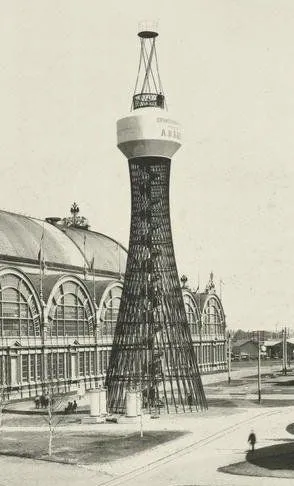
Have you ever wondered why cooling towers are hyperboloid in shape?
Cooling Tower
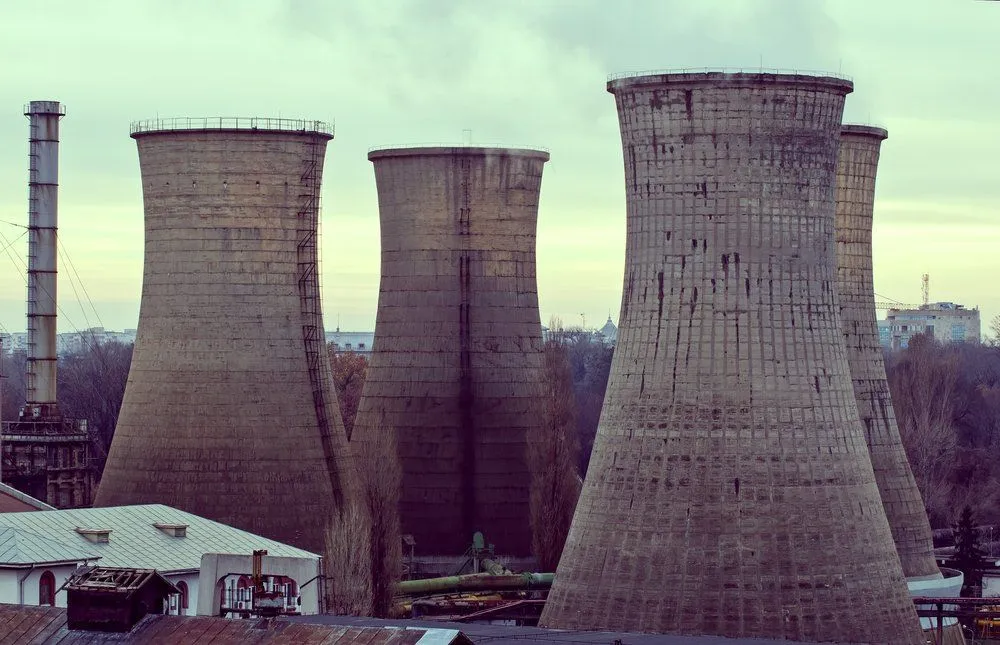
A power plant consists of many components, but cooling towers are some of the most important. For example, many people see cooling towers as an identification feature of power plants. The function of a cooling tower is to release the excess heat (or waste heat) to the atmosphere by cooling down hot fluid (water, in most cases) to a lower temperature.
These towers employ different methods to cool water down, but the most popular method involves evaporation. Excess heat is removed from water through the simple, old-school process of evaporation to cool it down. The other method involves closed circuit dry cooling towers, which are entirely dependent on the use of electrical equipment to cool the working fluid.
Why Do Cooling Towers Have That Hyperboloid Shape?
There’s no universal rule regarding cooling towers that everyone has to follow. There can be (and actually are) many different shapes of cooling towers. However, the most common sight, especially in power plants and nuclear plants, is hyperboloid-shaped cooling towers. Why do architects and engineers find this shape so mesmerizing?
The Strength Factor
First and foremost, the hyperboloid shape impacts the strength of the entire structure. Since cooling towers are supposed to cool the working fluid down to a low temperature, they release vapors into the atmosphere through the opening at the top of the tower. Therefore, these towers have to be sufficiently tall (they can be as tall as 200 meters!), or else the released vapor may cause fogging or recirculation. To support such a high structure, it is extremely important that the base is considerably consolidated and spread over a large area so that it can support the tall, heavy structure above it. This is why cooling towers have a large, circular base.
Facilitating Aerodynamic Lift
As mentioned above, hot fluid is cooled down by evaporation in cooling towers. As hot water evaporates and begins to rise in the concrete structure, the narrowing effect of the tower helps to enhance the speed of parallel layers of vapor without any disruption (referred to as laminar flow). Since hot air is less dense than cool air, it easily rises inside the tower, particularly due to the narrowness of the tower in the middle.
Faster And More Efficient Diffusion Into The Atmosphere
If the narrowness at the center helps to speed up the updraft, then why is the open top so wide?
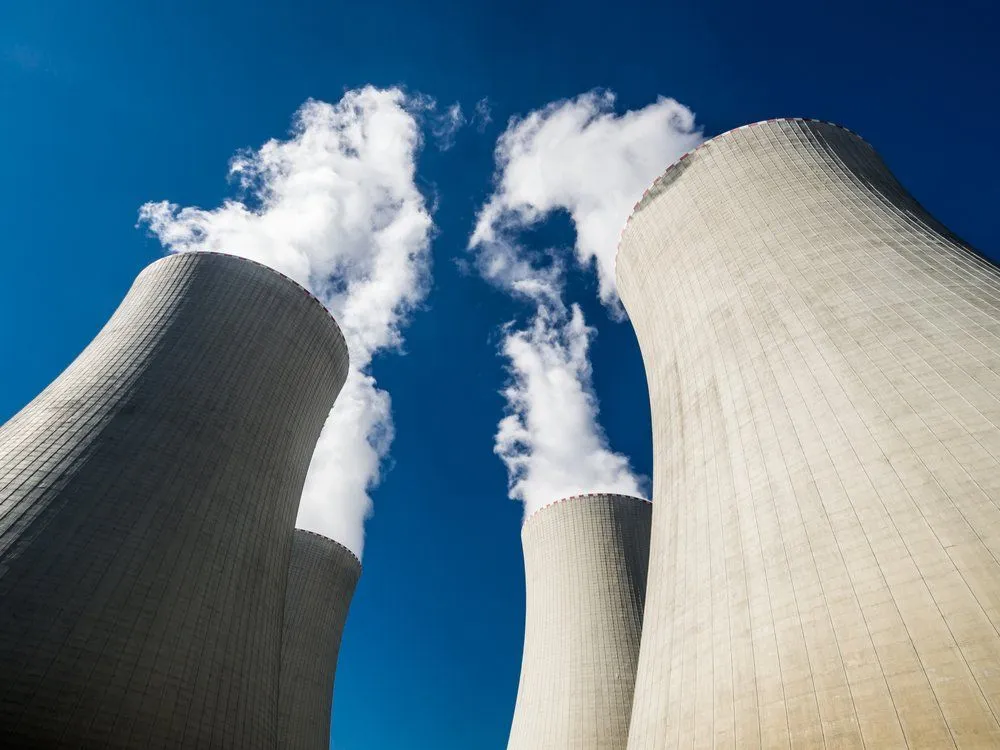
The top of cooling towers widens because this is the point where hot air from inside the tower diffuses and mixes with the atmospheric air. Therefore, we want to maximize the area through which this diffusion takes place, so that more hot vapor is quickly mixed and the entire process of cooling is done more efficiently.
There are a few other reasons behind this shape. For example, a wide base not only provides strength to the whole structure, but also offers ample space for the installation of machinery. From a logistical standpoint, this shape is easier to build, as it employs a lattice of straight beams to erect the tower. Also, this type of structure is more resistant to external natural forces than straight buildings.
Why Are Nuclear Power Plant Cooling Towers Shaped That Way (And Is The Cloud Radioactive)?
The giant hyperboloid towers people most often picture belong to nuclear power plants, but the shape has nothing to do with the nuclear part. A nuclear station, like a coal or gas one, is really just an elaborate way of boiling water to spin a steam turbine. Once that steam has done its job, it has to be condensed back into water, and the leftover heat has to go somewhere. That waste-heat job is exactly what a cooling tower does, so nuclear and fossil-fuel plants reach for the same efficient hyperboloid design.

So is that white cloud streaming off the top radioactive? No. According to Duke Energy's nuclear information center, the plume is simply clean water vapor from a cooling-water loop that is totally separate from the reactor. The water that touches the reactor stays sealed inside a closed system and never mixes with the water in the cooling tower. As the World Nuclear Association puts it, that cooling water "is never in contact with the nuclear part of the plant" and only cools the condenser in the turbine hall. What you see is essentially what your breath does on a cold morning, just on a far grander scale. Warm, moist air leaves the tower, meets cooler outside air, and the water vapor it can no longer hold condenses into a visible cloud of what is basically distilled water.
How Tall Are Cooling Towers, And How Does The Air Move Without Fans?
Part of why these towers look so striking is their sheer size. The largest natural-draft cooling towers stand more than 200 meters (about 660 feet) tall and over 120 meters (around 400 feet) across at the base. For comparison, the Harris Nuclear Plant tower in North Carolina rises 523 feet, nearly matching the 555-foot Washington Monument. At that scale, the concrete shell is astonishingly thin relative to its span, which is only possible because the hyperboloid's double curvature stiffens it against both its own weight and the wind.

Here's the clever part: the biggest towers move enormous volumes of air with no fans at all. Hot water is sprayed onto a grid near the bottom of the hollow tower while air flows in around the open base. As that air picks up heat and moisture from the falling water, it grows warmer and less dense than the cooler air outside, so it naturally rises, exactly like smoke up a chimney. This buoyancy-driven "natural draft" continually pulls a fresh stream of air in at the bottom, and the tower's narrowing waist speeds the updraft on its way to the wide top, where it mixes and disperses. The taller the tower, the stronger the draft, which is a big reason these structures are built so large.
It is amazing how a seemingly simple change in the ‘look’ of a structure can make such a staggering difference in both the quality and quantity of the desired product, which, in this case, is the amount of cooled water!