The upturned curves at the ends of aircraft wings are called winglets. They block the vortex of air that would otherwise spill from the high-pressure underside of the wing to the low-pressure top at the tip. By weakening that tip vortex, winglets cut induced drag by up to about 20% and save Boeing 737-class jets roughly 4-6% in fuel, which trims CO2 and NOx emissions in step.
If you’re a frequent flyer, you may have seen something odd about the aircraft’s wings. You will likely have noticed that the wings have an additional component at the ends. It makes it look rather stylish, doesn’t it? In some ways, it looks like the fins or the tail of a fish. Some ends are bent upwards, while some others are oval in shape! These sections of an aircraft wing are called winglets.
 “A winglet is an additional structural component of a wing structure with the primary function of reducing wingtip vortex, which is produced due to the pressure difference between the upper and lower surface of a wing while an aircraft is moving.”
That’s the kind of definition that would make your professor’s knees weak in admiration, but let’s work through this definition in small steps. To understand the winglet, let’s first understand why an aircraft needs it.
Is A Wing Curved On Both The Top And The Bottom?
Before we get to the bent tips, it helps to clear up a different curve that the wing carries along its whole length: the shape of its cross-section, called the airfoil. Slice through a wing and you will see the top surface bowing upward in a pronounced curve while the bottom is much flatter. So if you have ever met the quiz question "an airplane wing is curved on both the bottom and the top, true or false?", the honest answer is that both surfaces are usually curved, just not equally. The upper surface is rounded outward more strongly than the lower one.

Engineers measure that built-in curve with the camber, which NASA defines as the maximum distance between the straight chord line (drawn from the leading edge to the trailing edge) and the mean camber line that runs halfway between the upper and lower surfaces. The more the upper surface bows out while the lower surface stays flat, the higher the camber. Some simple wings, such as the Clark Y airfoil used on many trainers and propellers, really are flat on the underside behind roughly the first third of the chord, which is where the popular "flat on the bottom, curved on top" picture comes from.
A famous myth is attached to this shape: that the longer path over the curved top forces the air to speed up so it can "catch up" with the air from below at the trailing edge. NASA is blunt that this is wrong. Two air molecules that start together at the leading edge do not have to arrive together at the back, and in reality the air over the top reaches the trailing edge before the air underneath. The air does flow faster over the top, lowering its pressure (that part of Bernoulli holds), but it speeds up because the cambered shape and the wing's tilt, its angle of attack, turn the oncoming air downward. By Newton's third law, pushing air down pushes the wing up. Tellingly, even a symmetric airfoil with identical top and bottom surfaces makes plenty of lift once it is tilted, which is exactly how a jet can keep flying while inverted, and why the curve alone is only half the story.
What Are Vortices?
A wing works as a result of Bernoulli’s principle, which essentially states, ‘the pressure of a fluid is inversely proportional to the velocity of the same in space’. When an aircraft is in motion, the airflow is split at the leading edge (front) of the wing. Due to the angle at which the wing is fixed to the aircraft fuselage, higher air pressure is experienced on the lower surface of the wing than on the upper surface. This creates a pressure difference between the top and bottom sections of the wing, which generates lift (upward movement of the aircraft).
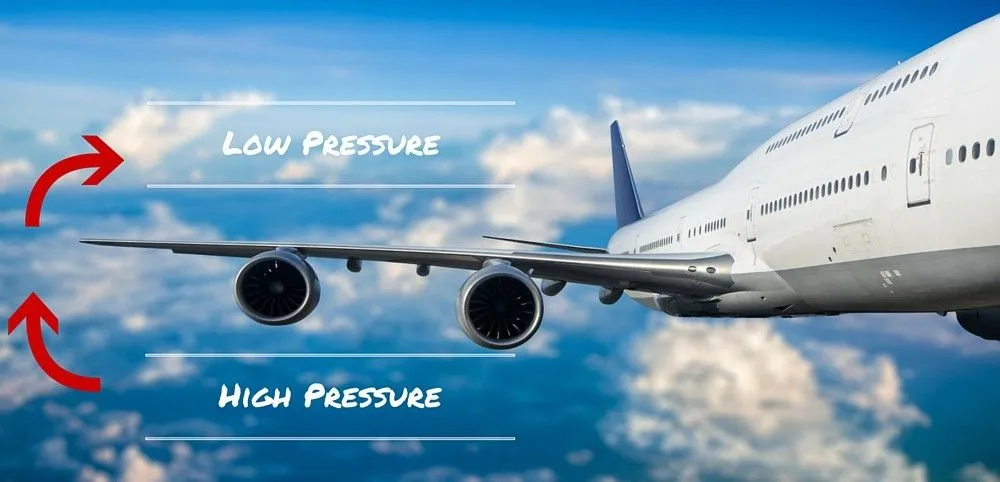
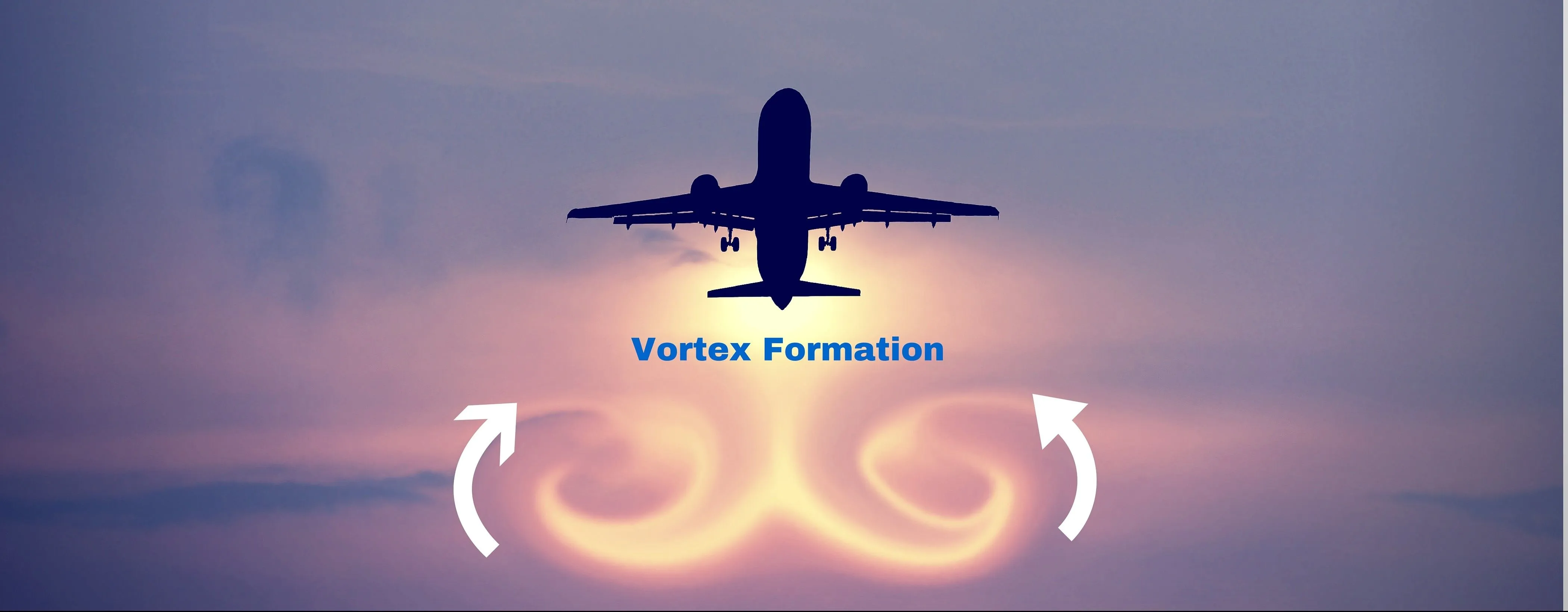
The property of fluids is that they flow from a region of higher pressure to a region of lower pressure. Following this principle, the air tends to move from the high pressure below the wing to the low pressure above the wing around the wingtips, thus forming and leaving behind vortices (mini-tornadoes) as the aircraft moves.
Why Is This A Concern For Aircrafts?
A significant source of drag (air resistance) is actually caused by the high pressure under the wing, which causes air to flow up and over the wingtip before spinning off in a vortex. Wingtip vortices hamper performance, cut into fuel mileage, range, and the speed of the aircraft. It may look beautiful in the sky, but it actually may cause an aircraft that flies through the same region to lose stability and even result in an emergency situation.
Environmental factors also factor into the need for a solution. Due to the drag caused by the vortices, a larger consumption of fuel is required, which results in higher emissions of CO2, other artificial particulates and noise.
The Solution – Winglets:
To avoid the formation of the vortices, two solutions were explored as being possible. One was to manufacture an infinitely long wing. There would be total separation of the airflow from the lower and upper surface, therefore preventing any vortices from being formed. Sound rather outrageous? Obviously, there were some major issues with this.
The other solution was to create a separation between the two differential pressure regions by introducing a structural component. This was to be called a ‘winglet’, a term that was first coined by Richard Whitcomb.
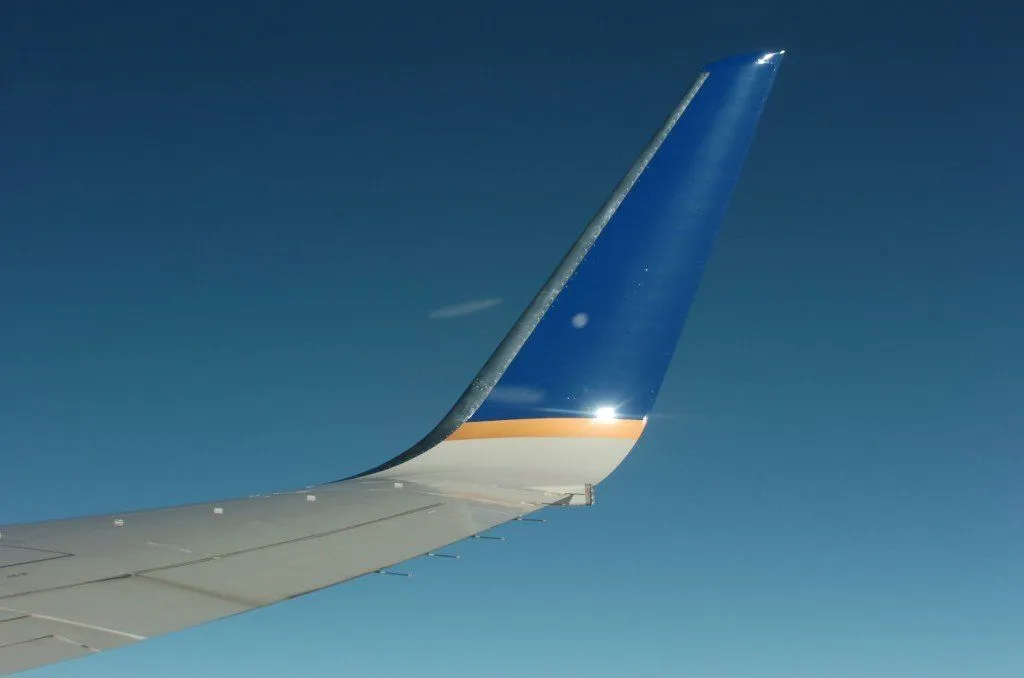
Since the 1980s, winglets have been a major part of future aircraft designs. For some old aircrafts, winglets were fitted after the plane’s introduction into the market. Winglets are a proven way to reduce drag, save fuel, cut carbon dioxide and nitrogen oxide emissions, and reduce community noise. This helps the operating airlines save money by decreasing the amount of fuel consumed, as well as landing charges at airports.
 In other words, if you ever make a paper plane, be sure to bend the ends of the wing upwards just a little, and it will fly a bit further. It’s not cheating, it’s just science!
Why Do Winglets Come In So Many Shapes?
If you watch aircraft for a while you will notice the bent tips are not all the same. Some sweep up in a smooth curve, some look like a sharp fin, and some split into a V with one fin pointing up and another pointing down. NASA notes that "many different winglet designs appear on various airliners" because each tip device has to be tuned to that wing, and engineers keep refining the trade-off between drag saved and the extra weight and bending load the device adds. Here are the shapes you are most likely to spot.

- Blended winglet: the familiar upturned fin that joins the wing through a smooth, large-radius curve rather than a sharp corner, which keeps the airflow from concentrating into drag at the join. NASA puts the fuel savings from this technology at roughly 4 to 6%, and credits it with saving billions of gallons of jet fuel worldwide, with a single Boeing 737-700 saving on the order of 100,000 gallons a year.
- Split-scimitar winglet: a blended winglet with an added downward-pointing tip below the wing, giving a double-swept shape that squeezes out a further 2% or so in drag on long flights.
- Sharklet: Airbus's name for the tall, upswept fin on later A320-family jets; it resembles a shark's dorsal fin and can save up to about 4% in fuel.
- Wingtip fence: seen on earlier Airbus aircraft, this is a small twin surface jutting both up and down from the very tip, a compact way to break up the vortex without adding much weight.
- Raked wingtip: not a vertical fin at all, but an extra slice of wing swept sharply backward, used on the Boeing 777 and 787 to get a similar drag benefit by effectively lengthening the wing.
Whatever the shape, the job is identical to the one we have already met: blunt the wingtip vortex so less of the engine's effort is wasted dragging a spiral of churned air across the sky.
Fun Fact:
In 1897, British engineer Frederick W. Lanchester conceptualized wing end-plates to reduce the impact of wingtip vortices six years before the first powered flight was operated by the Wright Brothers (1903). Talk about being ahead of your times!
References (click to expand)
- Wing tip - Wikipedia. Wikipedia
- Wingtip device - Wikipedia. Wikipedia
- Winglets Save Billions of Dollars in Fuel Costs | NASA Spinoff. The National Aeronautics and Space Administration
- Why do aircraft wings now go up at the ends? - The Guardian. The Guardian
- Wing Geometry. Beginner's Guide to Aeronautics, Glenn Research Center, NASA
- Lift (and the Incorrect Lift Theory). Beginner's Guide to Aeronautics, Glenn Research Center, NASA
- Bernoulli and Newton. Beginner's Guide to Aeronautics, Glenn Research Center, NASA
- Winglets. Beginner's Guide to Aeronautics, Glenn Research Center, NASA
- Clark Y airfoil - Wikipedia. Wikipedia
- Winglet Types: Blended and Split Scimitar. Aviation Partners Boeing
- Fuel Efficiency Solutions (Sharklets). Airbus