No. Classical conditioning (the Pavlovian reflex) only works on learned responses, so it cannot desensitize an innate reflex like blinking, knee-jerk, or the gag reflex. You can briefly suppress some reflexes through distraction, deep breathing, or habituation, but you cannot truly unlearn an involuntary response.
Imagine a world where you could control your reflexes, such as flinching, blinking or pain responses.
What if there was a way to repeatedly hit your knee and train your body to not react… would that be possible? If there was a way to train your eyes to not automatically blink when a fast-paced object comes at it? Would it be possible?
These are the questions we will be answering in this article. There have been many claims that a person could use Pavlovian Association to reduce their reflexes, so let’s see if it is actually possible!

What Is Pavlovian Association?
Pavlovian Association is also known as classical conditioning.
It was founded and studied by Ivan Pavlov, who was originally studying the digestive system of his dogs. He built a device that could accurately measure how much saliva was being produced by the dogs at the sight of food, or when they were fed food. The salivary glands naturally release saliva to aid in chewing and digestion when food is placed in the mouth of any animal.
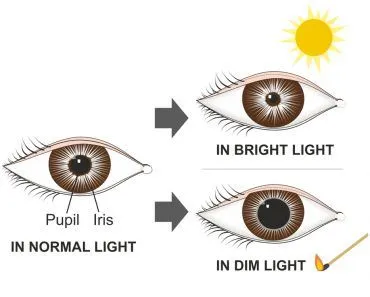
This is known as a reflex. A reflex is an unlearned and involuntary response that is not in our control. We don’t have a choice when it comes to reflex actions, and salivation in response to food is one of the many reflexes that occur in both animals and humans.
A stimulus is defined as any object, event, or experience that can trigger or cause a response. In the case of Pavlov’s dogs, the stimulus of ‘food’ led to the response of ‘salivation’.
Mid-experiment, Pavlov discovered that his dogs were also salivating when they were not supposed to. Some salivated at the sight of the lab attendant bringing them their food, while others started salivating when they heard the clatter of bowls in the kitchen.
This made Pavlov switch his focus to studying classical conditioning.
Classical conditioning has been described as a process of learning where an animal or individual learns a reflex-like response to a stimulus. In simple words, it is the association caused by linking two stimuli (in this case food and other objects related to the food) to produce a new response in an animal or human (in this case, salivating at objects related to food).
Classical conditioning is often used to desensitize against certain behaviors.
Desensitization refers to a process that helps someone experience an emotion or feeling less intensely than they originally did. A person who is afraid of dogs is desensitized if they came across a dog and didn’t feel like their heart was about to explode.
To understand whether it can work to counter reflexes, we have to understand the different elements of classical conditioning.
Elements Of Classical Conditioning
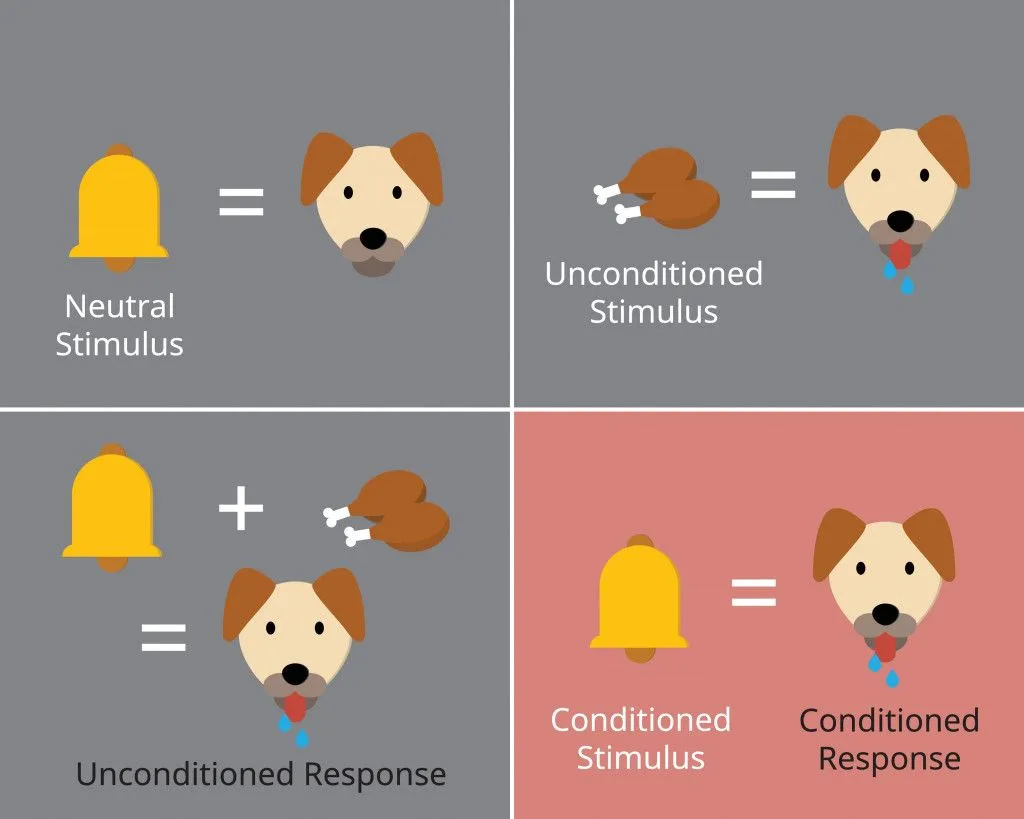
Pavlov, along with his colleagues, conducted several experiments with the dogs. Contrary to the popular “Pavlov’s bell” image, his standard tools were actually metronomes, buzzers, tuning forks, whistles, and lights; historians have noted that bells were rarely used. He highlighted the key elements that must be present in a particular way for classical conditioning to be successful. They are:
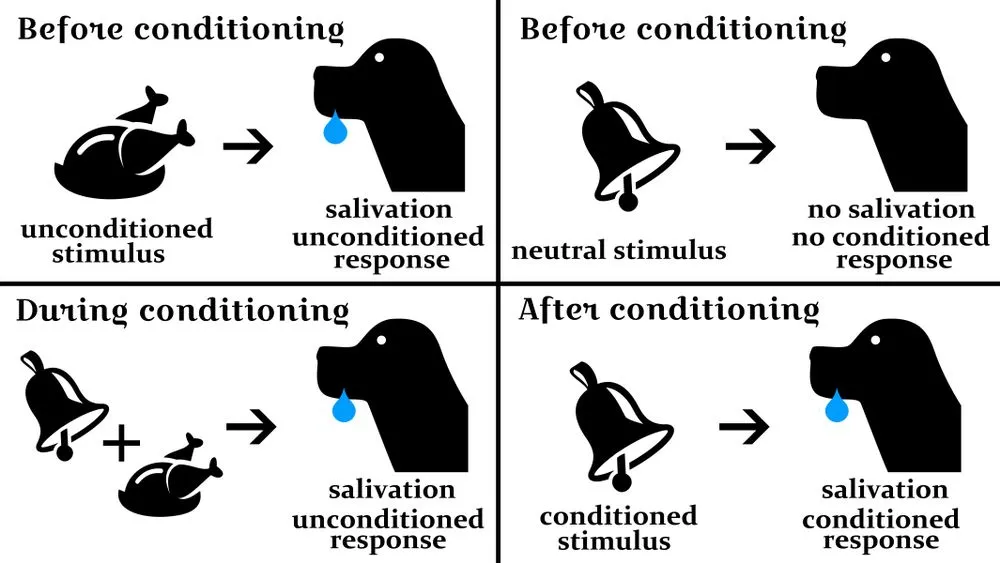
Unconditioned stimulus: The unconditioned stimulus is the original and naturally occurring stimulus, and doesn’t have to be learned. This is the stimulus that will lead to an involuntary response. In Pavlov’s experiment, food is the unconditioned stimulus.
Unconditioned response: The involuntary and reflex response to the unconditioned stimulus is known as the unconditioned response. This is an unlearned response and usually occurs because of the way animals and humans are “wired” genetically. In Pavlov’s experiment, salivation to the food is the unconditioned response.
Conditioned Stimulus: According to Pavlov, any stimulus or object that becomes associated with the unconditioned stimulus by being paired becomes a conditioned stimulus.
In his experiment, the sight of the food plate became a conditioned stimulus for the dogs, that led to salivation before the food was even served to them. The first few times when they saw the dish, it was a neutral stimulus, as it had no effect on their salivation. However, the dish was enough to produce the salivation response when it was paired with the food several times. Thus, in this, a previously neutral stimulus becomes a conditioned stimulus after being repeatedly paired with the unconditioned stimulus.
Conditioned response: The response to the conditioned stimulus is known as a conditioned response. Here, the dogs’ salivation to the dish is the conditioned response. It is important to note that the conditioned response is not as strong as the natural and involuntary unconditioned response. However, it is the same response, in this case, salivation.
Can You Use The Pavlovian Association To Desensitize A Reflex?
In simple words, no. You cannot desensitize behaviors that were not learned. Only learned responses can be desensitized, or in a way unlearned. Involuntary, automatic, and innate responses cannot be unlearned by association or classical conditioning.
That said, innate reflexes can be partly weakened through a separate, non-associative form of learning called habituation — the gradual reduction of a response after repeated, non-threatening exposure to the same stimulus. This is why a startle response to a loud noise fades the tenth time you hear it, even though the underlying reflex circuitry is unchanged.
While you cannot completely stop a reflex action from occurring, there are some ways to suppress certain reflexes.
For instance, you can suppress gag reflexes and coughing. One way this works is by distracting oneself. This is especially effective for gag reflexes. A 2015 review in the Journal of Pharmacy and Bioallied Sciences noted that distraction, behavioral techniques, and acupressure at points such as PC6 and CV24 can all help reduce an overactive gag reflex.
Another strategy would be to use soft toothbrushes, keeping acidity in check, and performing deep breathing in order to calm down the contraction of the muscles. For coughing, distraction strategies such as tickling, telling yourself you’re not going to cough (self-talk), and deep breathing can usually settle the problem.
Please note that these strategies don’t mean that the reflexes won’t occur or will be completely desensitized, but with conscious effort, they can be suppressed momentarily. It’s like you and your friend can have a staring competition of who doesn’t blink first, but it doesn’t mean blinking as an automatic action will be completely eliminated.
Why Can’t Classical Conditioning Desensitize A Reflex Action?
The conditioned stimulus must always comes before the unconditioned stimulus. The unconditioned stimulus that brings about a reflex cannot always be predicted. You cannot replace an automatic response if there is no way of ensuring when it occurs and when it doesn’t!
The conditioned and unconditioned stimulus should come close together; longer intervals can interfere with the conditioning. The optimal gap actually depends on the response — for a human eyeblink, it’s roughly half a second; for slower physiological responses such as salivation, it can stretch to several seconds.
There should be a direct association of the conditioned and unconditioned stimulus. Here, again, a reflex action can be triggered by, for instance, something appearing too fast and close to your eye, which causes you to shut it, as well as other unpredictable circumstances.
It’s almost impossible to pair a conditioned stimulus every time in close succession to the unconditioned stimulus. This is because you don’t know when a fast-paced object is going to cause you to blink, as there is no way to anticipate it. In Pavlov’s experiment, the dogs could anticipate the food based on the sound of the bell. However, since reflexes happen too quickly and can occur at unpredictable times, it cannot be paired with a conditioned stimulus every time.
The neutral stimulus must be paired repeatedly with the unconditioned stimulus several times for conditioning to take place. The conditioned stimulus should also be distinct or stand out against other competing stimuli. For instance, in Pavlov’s experiment, the sound of the metronome was not usually present in the laboratory and was distinct. Again, this is not possible with reflex actions, as they happen too quickly and involuntarily.
In fact, it is usually the conditioned responses that are learned on the basis of involuntary reactions or responses. For instance, whether it is fear or dislike, or physical responses, such as salivation or sweating, all of these are reflexes and can be acquired (in weaker intensity) as a response to situations or objects, other than the unconditionally or organically occurring situations.
Thus, unlearning a reflex action is so difficult that it is almost impossible!
References (click to expand)
- Bitterman, M. E. (2006, December). Classical Conditioning since Pavlov. Review of General Psychology. SAGE Publications.
- (1984) Recent Developments in Classical Conditioning*. Oxford University Press
- Rescorla, R. A. (1988). Pavlovian conditioning: It's not what you think it is. American psychologist, 43(3), 151.
- Anand, M., Rai, R., Bettie, N., Ramachandiran, H., Solomon, & Praveena, S. (2015). Acupuncture - An effective tool in the management of gag reflex. Journal of Pharmacy And Bioallied Sciences. Medknow.
- Rankin, C. H., et al. (2009). Habituation revisited: An updated and revised description of the behavioral characteristics of habituation. Neurobiology of Learning and Memory. NIH PMC.
- Daniel Todes on the myths around Pavlov’s bell. Johns Hopkins Magazine, 2014.