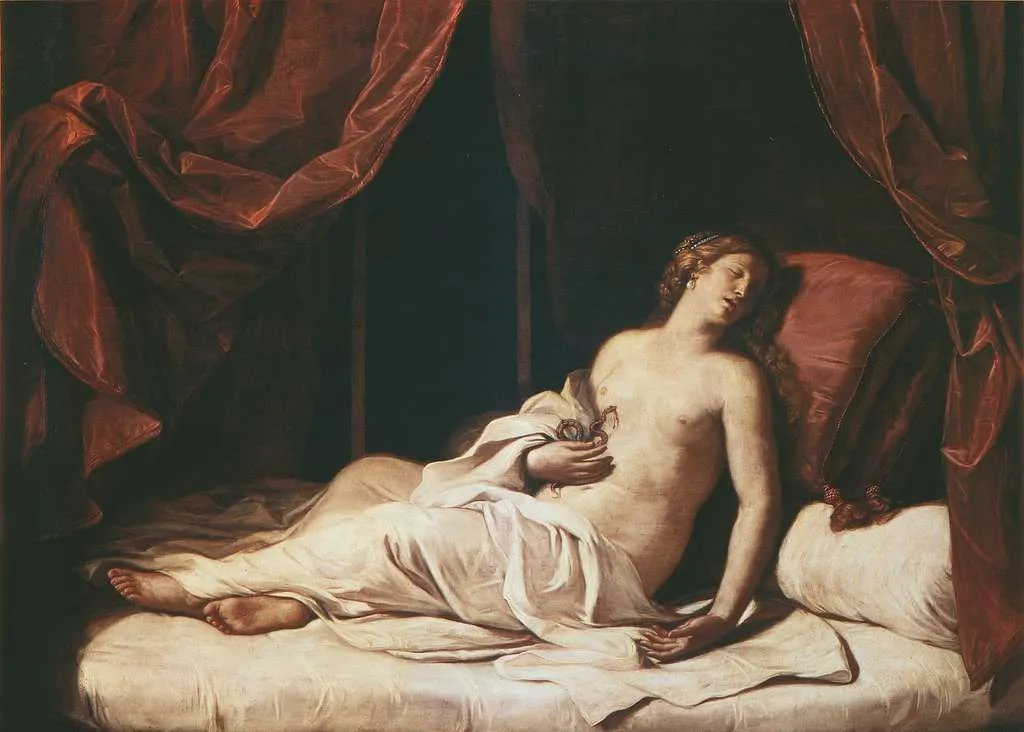
Probably not. The famous image of an asp (an Egyptian cobra) biting Cleopatra comes mainly from Plutarch, who wrote about 150 years after she died in 30 BCE. A snakebite is an unreliable way to ensure death, and most historians now think Cleopatra and her two handmaidens died by poison instead. The truth, though, remains uncertain.
Age cannot wither her, nor custom stale
Her infinite variety. Other women cloy
The appetites they feed, but she makes hungry
Where most she satisfies. For vilest things
Become themselves in her, that the holy priests
Bless her when she is riggish.
This how Shakespeare described Cleopatra. Needless to say, she was a big deal.
If you like romantic dramas with strong female leads and aren’t afraid of some gore sprinkled in for good measure, I’d recommend the story of Cleopatra’s life and love to you.
It has dramatic costumes, brilliant scenery, the thrill of wartime alliances and betrayals, and a tragic double suicide where the protagonist kills herself via snakebite, provided you believe Shakespeare, the writers of the film Cleopatra (in all three versions, 1917, 1934 and 1963), and literally any other popular depiction.

Who Was Cleopatra?
Cleopatra VII Philopator was the Queen of the Ptolemaic kingdom of Egypt from 51 to 30 BCE. She was famous for her firm rule, wits and beauty, which captivated the hearts of Julius Caesar and later Mark Antony. She belonged to the dynasty founded by Alexander the Great’s general Ptolemy (hence Ptolemaic) upon the former’s death, and was thus technically a Macedonian.
She supposedly embodied the femme fatale trope, what with her seductive beauty that had conquered two of the bravest Romans (see how the narrative revolves around her beauty as a woman, rather than her prowess as a ruler) that Hollywood has gone on to adopt.
How Did She Come To Be Allies And Then Lovers With Mark Antony?
In the aftermath of Caesar’s assassination, a power struggle emerged in Rome between his assassins (Brutus and Cassius) and his supporters (Mark Antony, Octavian and Lepidus), who were dubbed the Second Triumvirate. Both parties sought Egyptian aid in defeating the others. Cleopatra, who had been provided Roman legions by Caesar as protection, decided to send support to the latter.
The Second Triumvirate emerged victorious, and Mark Antony invited Cleopatra to Tarsus. When she sailed into the city, in the robes of the goddess Isis, he was left enamored. This is how the (disastrous) couple came to be. Mark Antony pledged himself to the service of Cleopatra, vowing to protect her crown and eliminate her rivals.
Did She Die Of A Snakebite?
When Cleopatra and her paramour Mark Antony lost the naval Battle of Actium in 31 BCE, their fate was effectively sealed. Roughly a year later, in August of 30 BCE, a Roman army led by Octavian reached Alexandria. Rather than face a cruel future in Roman hands, Cleopatra took her own life. The pharaoh’s pride would not let her surrender to Octavian.
When she met with Octavian, one record states that she had asserted her unwillingness to be treated as a spoil of war, saying, “I will not be led in a triumph”. This is perhaps a reference to the rumors she had heard about being paraded in Octavian’s Triumph (her children, captured by him, certainly were), a Roman civil and religious tradition wherein the success of the general or leader who had led Rome to victory in war was publicly celebrated.
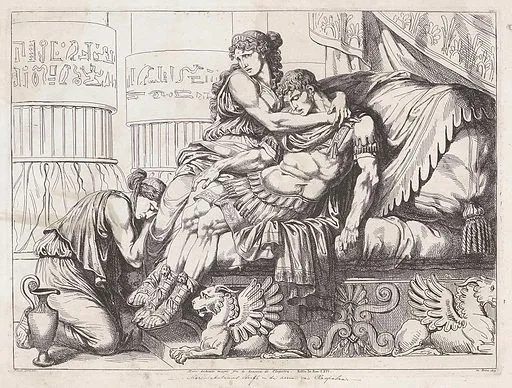
Thinking that Cleopatra had committed suicide, choosing death over defeat, Mark Antony stabbed himself with his sword. She was, however, still alive, and only after burying him did she actually try to kill herself. The familiar version of what came next, that Cleopatra’s end was brought about by a venomous snake, comes mainly from the Greek biographer Plutarch, who wrote his account of these events roughly 150 years after they happened. In that telling she died from the bite of an asp, a name the ancients used for the Egyptian cobra, a serpent tied to Egyptian royalty and divinity and worn on the pharaoh’s crown. Plutarch himself, though, was careful to note that no one really knew how she died.
Is It Possible That A Snakebite Could Have Killed Her?
The story goes that the snake, very often referred to as a cobra, was smuggled to Cleopatra in a basket of figs. She, along with her two handmaidens, Iras and Charmion, then died from its bite. This version runs into trouble fast. An adult Egyptian cobra can be well over a meter (3 ft) long, which makes it next to impossible to hide in a fruit basket, and no snake was ever found near her body. Plutarch reports that the investigators sent by Octavian noticed only two faint puncture marks on her arm, and even he could not say for sure that a snake had made them. Some historians suggest those marks fit poison introduced with a sharp implement, such as a hollow comb or hairpin, just as easily.
Even if a snake had been involved, the odds of three people dying from a single snake’s bite are very low. Snakes tend to deliver venomous bites only in those rare moments when they feel cornered, and a large share of cobra bites are “dry,” injecting little or no venom at all. It is far more probable that Cleopatra and her attendants died from a fast-acting poison, something more reliable and easier to obtain (a dose of hemlock or a custom-mixed cocktail, perhaps). A few modern scholars go further still and argue she may not have chosen her own death at all, but was quietly murdered on Octavian’s orders.
The only thing we know for sure is that she committed suicide.

Conclusion
Cleopatra was a controversial figure throughout her lifetime, and has captured the imagination of the world for centuries. However, she also established herself as one of the few influential females in ancient history whose lives have not been subsumed by their relations with and to the men around them. Maneuvering her way through complex social, political and personal spheres, she was able to create an infamous niche for herself. To this day, she still holds an undeniable allure, both for her power and her legendary beauty!
References (click to expand)
- Griffiths, J. G. (1961, December). The Death of Cleopatra VII. The Journal of Egyptian Archaeology. SAGE Publications.
- Bowen, S. A., & Geraghty, L. (2016). Finding strategic communication & diverse leadership in the ancient world: The case of Queen Cleopatra VII, the last pharaoh of Egypt. Cogent Arts & Humanities.
- AE Delaney. (2014) Reading Cleopatra VII: The Crafting of a Political Persona. Kennesaw State University