Table of Contents (click to expand)
Often not exactly. Memory is reconstructive, not a recording: the more you recall an event, the more you can rewrite it. Later experience adds layers that reshape your inner narrative, and your imagination can even slip in details, or whole memories, that never happened.
Most of the events we experience on a day-to-day basis are only remembered for a short period and then tend to disappear from our memory quite quickly. For instance, if you’re asked about what you had for lunch today, you will be able to recall the information with little difficulty. If you are asked that same question a week later, the details are likely to have been forgotten.
This makes sense. It’s not useful for our brains to remember everyday mundane events, but what about traumatic or important events? And, if we do remember these events, do we remember them scene-by-scene as it really happened? Or do we modify those moments and remember them inconsistently?
Flashbulb Memories

Psychologists theorize that our brains tend to imprint details of sudden traumatic experiences as if we’re taking a photograph of those moments. During the event, emotions run so high that whenever we recollect these memories, the emotional recollections flash across our eyes on an event-to-event basis. This is why these memories are called “flashbulb memories“; they have photographic accuracy. However, this notion of flashbulb memories being accurate did not translate into evidence for the same.
When the 9/11 attacks happened, within a week researchers asked more than 3,000 Americans across seven cities to narrate their own 9/11 experiences: where they were, who they were with, and what their response had been to the news. They then went back to the same people at roughly 1 year and 3 years. By the 11-month follow-up, people’s flashbulb memories matched their original account only about 63% of the time, meaning roughly 4 in 10 details had quietly changed, and those altered versions barely recovered over the following two years.
This misremembering is called the “time-splice error”. Because of this error, we remember the facts of our experiences, but fail to accurately recall the sequence of events.
In this case, participants remembered facts about their 9/11 experience, but they did not remember how these facts all fit together.
For example, in this study, a man mentioned that he was on the street when he heard the news about the attacks, but in reality, he was in his office! This misremembering can be attributed to the fact that the man probably did spend a considerable amount of time in both places on that day, which is why his memory blurred as time passed!
Once we have come up with a narrative that is coherent, even if it may be inaccurate, we tend to stick with it. This is why, while many people’s reporting of what happened on 9/11 changed in the year following the attacks, they then stuck to telling themselves the same revised story for years afterward.
Inconsistent flashbulb memories are more likely to be repeated than corrected, as the participants did not have a clear recorded event to go back to in order to check for their memories. On the other hand, inaccuracies regarding the event itself (for instance, what airlines had been hijacked) were more likely to be corrected, as there was backed-up data to refer to. Thus, these inaccurate memories were not repeated often.
Another factor for misremembering details of a tragic event can be explained by errors of commission. For instance, changing a pair of blue pants to black ones, or misremembering who you were with when you first experienced the event.
Memories Are (Re)Constructive

Why does so much of our memory fall through the cracks? And why are new memories that we haven’t experienced added to the story?
We’ve all experienced vivid and well-defined memories, but as the section above highlights, our memories are not an exact copy. It’s not like we’re watching a replay telecast of an event or situation, even though it might sometimes feel like that.
Memories are constructed and reconstructed; we use information before, after, and during the time of the event in order to compose our memories of the event.
According to Sir Frederic Bartlett (1932), a memory theorist, the process of forming a memory is similar to creating a story, rather than reading an already written one. This means that memories are built from the information that we store. Every time we remember the memory, we alter and revise it, include new information, or omit certain bits of information.
This does not mean that what we recall is always inaccurate, but it suggests that our recollection is not a replica and can be open to both modification and error.
According to Bartlett, the reason why this occurs is because of the role that schemas play when it comes to remembering past events. He described schema as a system that organizes past reactions or past experiences. Schemas are organized mental memory structures that enable us to apply our past experiences to new situations and help in guiding our behavior. For example, if you go to a restaurant in Italy, you likely have a schema of what to expect in a restaurant that guides your novel experience of actually being in a restaurant in Italy.
However, these schemas, though helpful, can also produce certain expectations that reduce ambiguities in new situations, and these expectations can lead to errors in recalling these events.
For instance, when you recall your time at a restaurant in Italy after your vacation, there may be a chance that you misremember some events that may not have taken place in that particular restaurant at all, but in a different restaurant with similar infrastructure.
Brewer and Treyens in 1981 found that their participants, when given a memory task, ended up reporting items that they had expected to see based on the context, even though these items or words had not been presented to them. Schemas also influence boundary extension errors. Here, people remember more of a visual scene than what was originally presented. For example, when you recall a good amount of greenery from a scene in your favorite movie, but it was not present at all!
False Memories
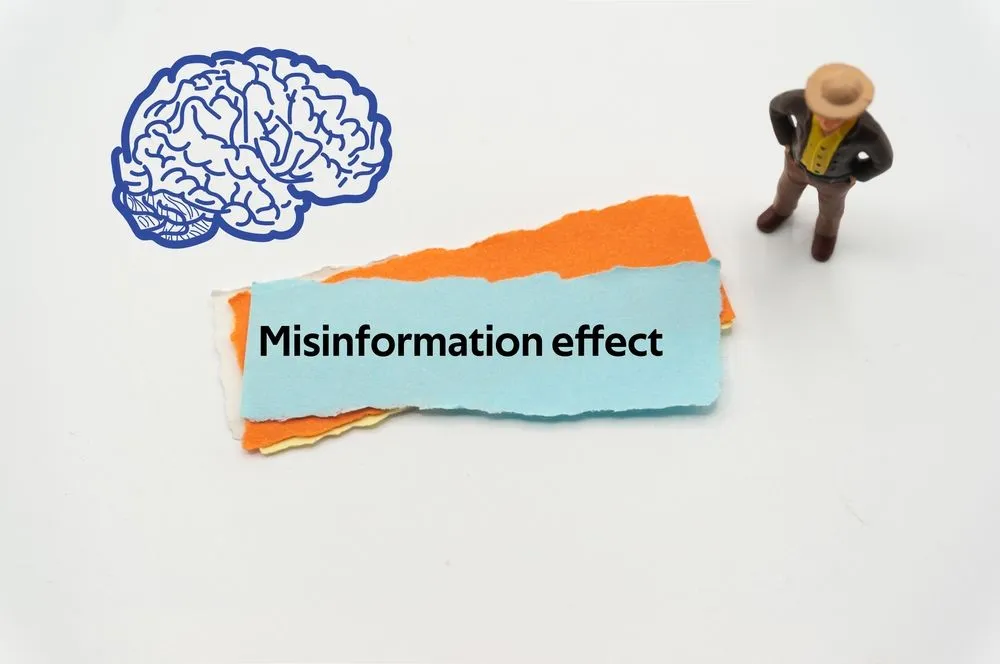
False memories occur when people classify a certain mental experience as a real experience.
In 1974, researchers Elizabeth Loftus and John Palmer noticed that language can affect how we remember an event. They asked participants who had seen a movie of a car crash to describe the crash. Using the word “smashed” instead of “hit” led participants to perceive a more severe accident. Likewise, using “collided” also resulted in reported differences in accident severity.
The famous “Lost in the Mall” work provides more compelling evidence of false memories.
It began as a pilot demonstration by Jim Coan, then a student of Elizabeth Loftus. Coan gave his 14-year-old younger brother, Chris, four short write-ups of childhood events. Three were true, and one was false: a story Coan invented about Chris getting lost in a shopping mall around the age of 5, then being rescued by an elderly stranger and reunited with the family. Chris was asked to read all four and write down whatever he could remember about each one over several days.
By the end, Chris had built a vivid, detailed account of being lost in the mall, even adding his own touches the story never contained. When he was finally told the memory was false, he had trouble believing it.
Loftus and her graduate student Jacqueline Pickrell turned this into a formal study in 1995, planting the same lost-in-the-mall memory in 24 volunteers. About a quarter of them came to “remember” the event that had never happened.
The ethics of the experiment were later questioned, though it did have a significant impact on our understanding of false memories.
Anecdotal evidence has shown that this phenomenon of false memories is witnessed among eyewitnesses’ stories, as well as stories about alien abductions or satanic abuse. One such example is Patricia Burgus, in a case against her psychiatrist Dr. Braun for malpractice. According to her, Dr. Braun used repressed memory therapy, including hypnosis, which led her to believe that she was the high priestess of a satanic cult.
References (click to expand)
- Brown, R., & Kulik, J. (1977, January). Flashbulb memories. Cognition. Elsevier BV.
- Hirst, W., Phelps, E. A., Buckner, R. L., Budson, A. E., Cuc, A., Gabrieli, J. D. E., … Vaidya, C. J. (2009, May). Long-term memory for the terrorist attack of September 11: Flashbulb memories, event memories, and the factors that influence their retention. Journal of Experimental Psychology: General. American Psychological Association (APA).
- https://psycnet.apa.org/record/1984-13790-001
- Edwards, D., & Middleton, D. (1987, April). Conversation and remembering: Bartlett revisited. Applied Cognitive Psychology. Wiley.
- Brewer, W. F., & Treyens, J. C. (1981, April). Role of schemata in memory for places. Cognitive Psychology. Elsevier BV.
- Loftus, E. F., & Palmer, J. C. (1974, October). Reconstruction of automobile destruction: An example of the interaction between language and memory. Journal of Verbal Learning and Verbal Behavior. Elsevier BV.
- Loftus, E. F. (1999, March). Lost in the Mall: Misrepresentations and Misunderstandings. Ethics & Behavior. Informa UK Limited.
- Nourkova, V., Bernstein, D., & Loftus, E. (2004, June). Altering traumatic memory. Cognition & Emotion. Informa UK Limited.
- Hyman, Jr., I. E., & Pentland, J. (1996, April). The Role of Mental Imagery in the Creation of False Childhood Memories. Journal of Memory and Language. Elsevier BV.
- Loftus, E. F., & Pickrell, J. E. (1995). The Formation of False Memories. Psychiatric Annals.
- How Accurate Are Memories of 9/11?.