Table of Contents (click to expand)
Carbon dioxide is the most important human-made greenhouse gas. Its atmospheric concentration has climbed from about 280 ppm before the Industrial Revolution to roughly 430 ppm in 2025 (NOAA). On the environment, this rising CO2 drives three main effects: global warming, ocean acidification, and carbon fertilization of plants.
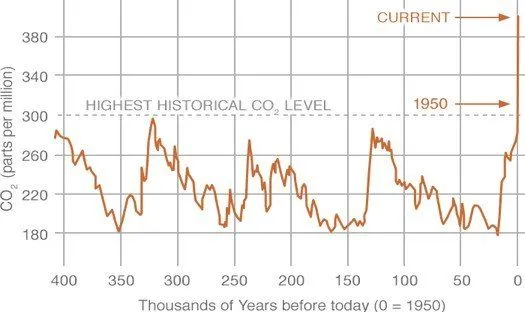
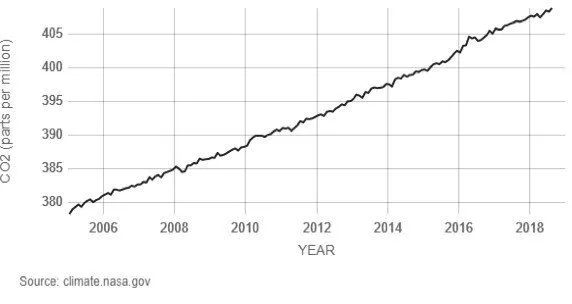
Earth has several greenhouse gases. Water vapor is the most abundant, but carbon dioxide (CO2), methane, and nitrous oxide are the ones humans are adding most, and CO2 is by far the most important of these. Although it is only a trace gas, CO2 drives the long-term warming of the planet. Like other gases, the concentration of CO2 is measured in parts per million, i.e., the number of moles of CO2 per million moles of air. For at least the past 800,000 years, the concentration of CO2 stayed within a band of roughly 180 ppm to 300 ppm, sitting near 280 ppm in the centuries just before the Industrial Revolution. Since the mid-19th century, the concentration has been rising sharply, passing 410 ppm in 2018 and reaching about 430 ppm in 2025. In the late 1950s, the annual rate of increase was about 0.73 ppm per year; over the past decade it has averaged more than 2 ppm per year, and in some recent years it has exceeded 3 ppm (Source).
CO2 concentration and emission:
The concentration of CO2 is rising because the rate of CO2 emission in the atmosphere is greater than the rate of its absorption creating an imbalance in the carbon cycle. The carbon dioxide emission in the atmosphere comes from both natural and human activities.
The primary source of increased CO2 emissions is the increase in the burning of fossil fuels to meet the energy demand. The emission of carbon dioxide is measured by weight in tons of CO2. The amount of CO2 by weight can be calculated using the molecular weight of carbon dioxide and molecular weight and the total weight of air in the atmosphere.
The molecular weight of CO2 is 44 g/mole, and that of air is 28.97 g/mole. The total mean mass of the atmosphere is approximately 5×10¹⁵ tonnes. At the concentration of 400 ppm, the amount of CO2 in the atmosphere by weight is about 3,000 Gt of CO2 (400 x 10-6 x 44/28.97 x 5 x 1015). At today's level of roughly 430 ppm, that burden has grown to well over 3,300 Gt. As a worked example of how fast the load is building, the CO2 concentration increased from 369.55 ppm in 2000 to 389.90 ppm in 2010 (Source: NOAA Global Monitoring Laboratory).
The change in concentration implies addition of 154.5 Gt CO2 to the atmosphere from 2000-2010. As per the data on historical emissions, the total emission in this period was 344 Gt CO2 (Source: https://www.climatewatchdata.org) indicating that the carbon sinks absorbed around 45% of the total emissions and the rest remained in the atmosphere. Unlike most pollutants, CO2 has no single atmospheric lifetime. Carbon sinks pull a large share out within a few decades, but a meaningful fraction of each pulse of emissions lingers for centuries, and some persists for thousands of years (IPCC). Hence, the CO2 emitted at a given time keeps accumulating in the atmosphere over a very long period.

Direct impacts of CO2 emissions:
Carbon sinks such as forests and oceans absorb the almost equal amount of the total CO2 emitted, and the rest remains in the atmosphere. There are two major effects of carbon dioxide emissions: first, an increase in the concentration of CO2 in the atmosphere, and second, an increase in the absorption of CO2 by oceans and plants. The increased concentration of CO2 in the atmosphere results in a temperature rise. The increased absorption of CO2 by oceans causes ocean acidification. The increased absorption of CO2 by plants results in carbon fertilization. I have discussed the direct impacts of these three effects of CO2 emissions below.
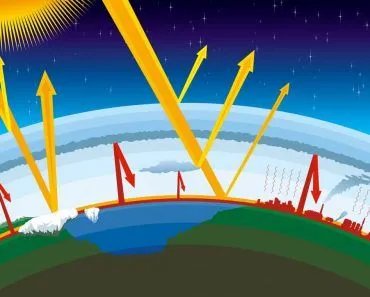
- Global Warming: This is where CO2 earns its reputation. Sunlight warms the planet, and Earth radiates that heat back out as infrared (longwave) radiation. CO2 molecules absorb some of this outgoing infrared and re-emit it in all directions, including back toward the surface, trapping heat that would otherwise escape to space. Adding more CO2 strengthens this effect, so the increase in temperature is the major cause of all other changes in Earth's climate. The rise in temperatures is causing warming of the oceans, melting of ice mass, and an increase in evaporation. These effects have several physical impacts, such as sea level rise and greater variability in weather patterns and extreme weather events. 2024 was the warmest year on record and the first calendar year to average more than 1.5 °C (2.7 °F) above the pre-industrial level (WMO). The adverse impact of these physical changes due to global warming is now becoming visible across biological and human systems, and the magnitude of the impacts varies in both space and time.
- Ocean Acidification: The oceans absorb almost a quarter of CO2 emitted in the atmosphere. The excess CO2 reacts with the seawater to form carbonic acid. The acidification causes suppression of carbonate ion concentration that is essential for animals in the sea such as corals and shellfish to build bones and shells.
- Carbon Fertilization: The carbon dioxide emissions absorbed by plants increases photosynthesis thereby increasing plant growth depending on plant type and other inputs for plant growth. There is also a positive impact on water use efficiency. However, the effect of CO2 on plant growth is such that the photosynthetic rates increase with increasing levels of CO2 but then saturates. On the other hand, temperature affects photosynthesis and other growth and development phases of plants.
Conclusion

CO2 is a trace gas in the atmosphere but plays a critical role in maintaining the energy balance of our planet. The increase in sources of atmospheric CO2 due to the burning of fossil fuels and reduction in sinks due to changes in land use patterns such as deforestation for cultivation is causing a net increase in CO2 in the atmosphere. The increase in CO2 emissions causes global warming, ocean acidification, and carbon fertilization. Global warming and ocean acidification have a significant adverse impact on natural and human systems. Although carbon fertilization of plants increases plant growth and improves water use efficiency, these positive effects are expected to diminish gradually as the CO2 concentration increases in the future.
References (click to expand)
- Carbon Dioxide | Earth Indicators - NASA.
- Trends in Atmospheric Carbon Dioxide - NOAA Global Monitoring Laboratory.
- Overview of Greenhouse Gases - US EPA.
- Climate Data for Action | Climate Watch | Emissions and Policies.
- WMO confirms 2024 as warmest year on record - World Meteorological Organization.
- What is Ocean Acidification? - NOAA Ocean Acidification Program.
- The CO2 fertilization effect - Food and Agriculture Organization.