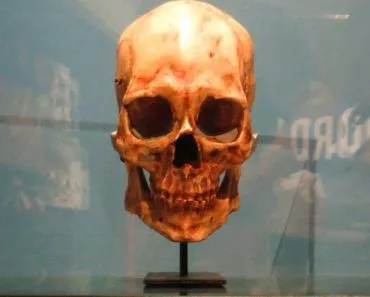
No, elongated skulls are not linked to aliens. They are the result of artificial cranial deformation, a real practice in which an infant's soft skull was bound to reshape it. Found in cultures worldwide, including Peru's famous Paracas skulls, every example tested has proven to be fully human.
If you’re familiar with the popular Steven Spielberg movie Indiana Jones and the Kingdom of the Crystal Skull, you might recognize this:
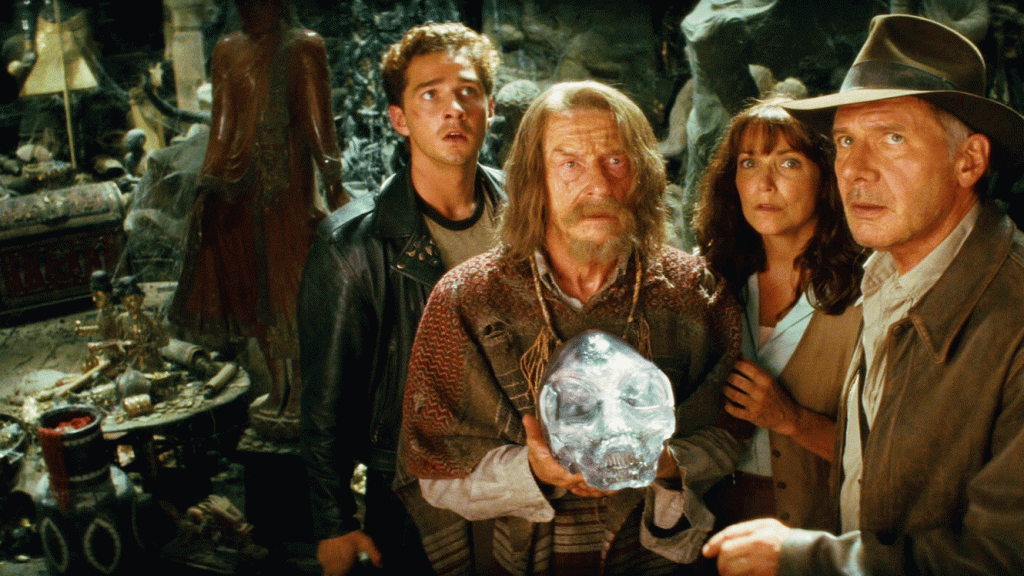
The movie’s plot was largely based around a crystal skull, more specifically, an elongated humanoid skull made of a crystalline material. The movie also popularized the idea that such elongated skulls are the skulls of aliens that visited Earth in ancient times.
So, how much of this is true? Is there such a thing as elongated skulls? Do elongated skulls provide us with evidence of an ancient alien species?
Are Elongated Skulls Real?
Yes. Deliberately elongating the human skull was a real custom, and it turns up in a striking number of ancient cultures that had no contact with one another. Archaeologists have documented it across South America, Mesoamerica, parts of Europe and Africa, the Near East, and Australia. Strikingly similar methods show up again and again in all of these regions.
How Was It Done?
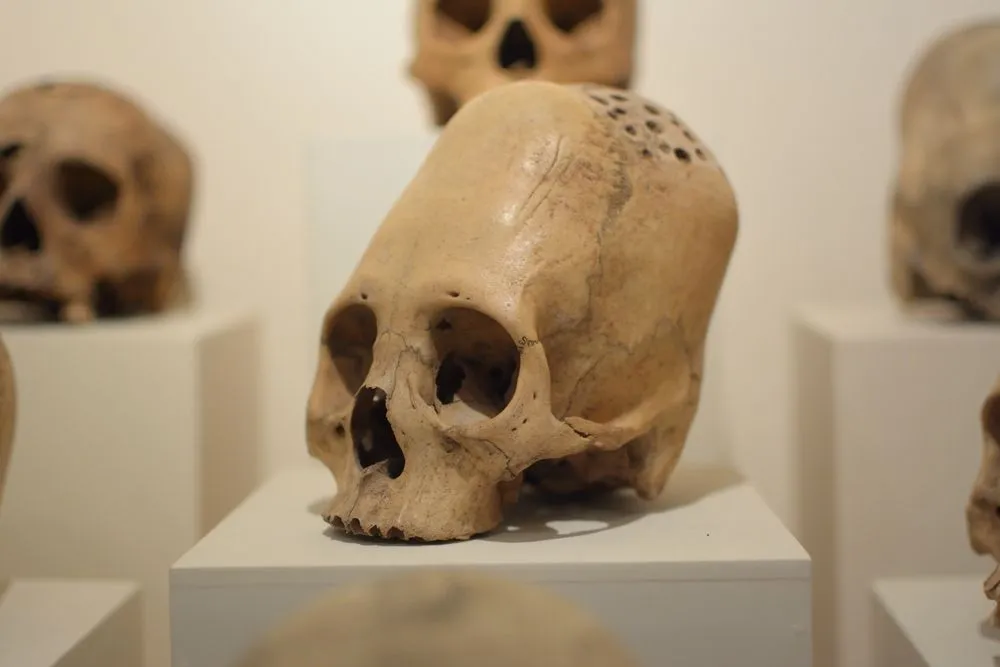
An elongated skull is caused by what is known as artificial cranial deformation. The human skull in toddlers is very soft because it hasn’t developed completely and some bones take time to fuse. During this premature stage, it is possible to modify the shape of the skull by putting pressure on the head. Under pressure, the bones fuse in different shapes and the structure of the skull will end up being different from a regular one. A natural question is whether this harmed the brain. The short answer is no: the binding is done in infancy while the brain is still growing, so it simply develops to fill the reshaped vault. The brain’s total volume stays the same, and there is no good evidence that the practice lowered intelligence or caused serious neurological problems.
The skulls can be classified in three categories, depending on how they look and how they are formed. These three categories are as follows:
Tabular Erect
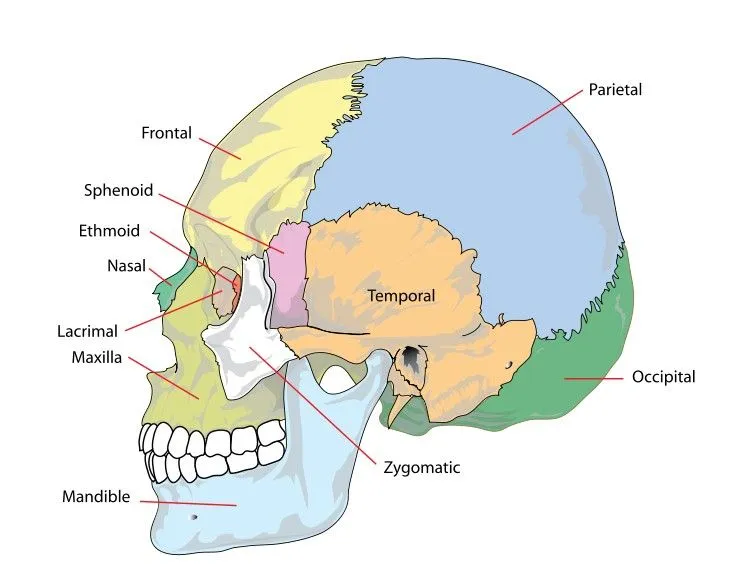
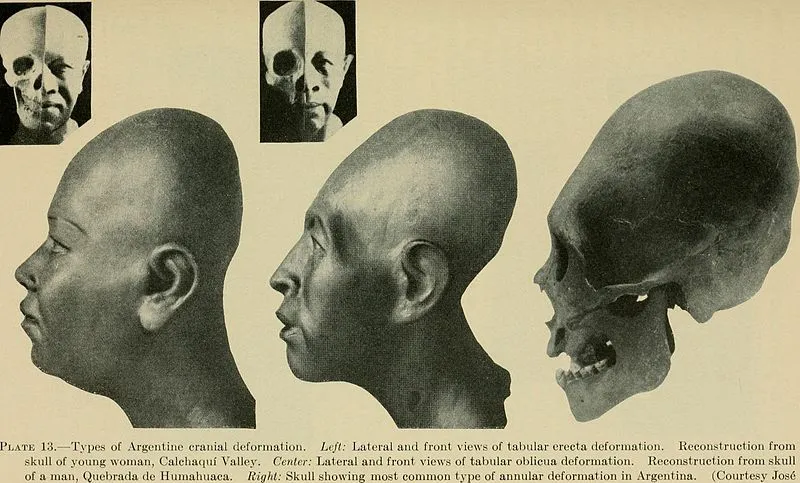
This type of deformation occurs when pressure is applied to the back of head. In this process, the occipital and the frontal bones are the most heavily affected. The pressure applied to the skull affects the normal fusion of these bones and produces a different pattern of fusion by which the shape of the skull is affected. The skull, under pressure, fuses to form a slightly broader and more vertical shape, which is classified as tabular erect. This type of deformation was prominent in South American regions.
The picture below represents the three kinds of deformations that this article will talk about. The picture will be repeated in all three descriptions to aid your understanding of the three types, and the differences between them.
Tabular Oblique
In contrast to the method mentioned above, the formation of tabular oblique skulls required putting pressure on multiple sides of the head. The wooden planks used to carry out this process were known as “headpads”. It is in these skulls that we see the usage of dual pads as the primary tool. The dual pads put a significant amount of pressure on the head and affected multiple bones, resulting in a slightly oblique and longer skull than the tabular erect skulls. It is difficult to pinpoint exactly what areas of the skull were affected by this, but it is understood that the amount of time and pressure applied led to longer and much more elongated skulls.
Annular Method
The annular method is what produced the most elongated skull variation. In this process, ropes, strings, compressed hats, bandages, and tight caps were used.
The process of using these tight compression materials or ropes to induce such deformations is known as “circumferential binding”. The resulting deformation is circular, in comparison to the results produced by the other two methods. This method affects the fusion of multiple bones of the skull; therefore, if kept under pressure for a long time, the resulting deformation is the longest and “most deformed” (most far off from the regular shape and size of the human skull).
Why Was This Done?
Unfortunately, there is no definitive answer to this question. We have no conclusive evidence to establish a universal answer… all we have are the skulls. But, of course, there are plenty of speculations and theories that hope to answer these questions by taking the facts into account. Let’s take a look at the three major theories:
- The Kingship Theory: Judging by the limited amount of members in society who went through the deformations, as well as the decorations, clothes, jewelry and accessories that these specific people wore (or were found buried with them), it is suggested that the deformations applied to a higher section of society that was set apart from the regular civilization. This theory suggests that the skulls were deformed either to represent a higher nobility or ruling class who could rule over or guide other “regular” people.
- The Geographic Theory: This theory suggests that the process of deforming skulls was not limited to one specific section of society. The theory mentions that, due to the vast expanse of land in South America, a variety of cultures resided in this area. There must have been a specific group of people (The Andean people), who artificially deformed the skulls of almost all members of society in order to establish themselves as completely different in the region. The deformations, along with accessories like headbands, jewelry and clothes, cemented the differences between the people. The goal of those who practiced such deformations was to establish these differences even in a physical form.
- The Lower Strata Theory: It is speculated that, in places like Australia, skulls were artificially deformed to represent a section of society that was looked down upon and discriminated against.
Is There A Link To Extraterrestrial Life?
Due to the shape and size of these skulls, it is often speculated that the skulls are “proof that extraterrestrial life visited earth” or that “aliens do exist and have lived among us”.
How much of this is the truth? Let’s review the facts:
- A majority of elongated skulls that have been found exhibit ancestral human qualities, such as the same cranium, bones, structure etc.
- It has been proven that due to the soft nature of the skull in children, under pressure, skulls can be reshaped.
- The difference of shapes that exists between the elongated skulls can be readily explained by the different methods that can be used to reshape a skull.
- The skulls of the Paracas people (who lived in southern Peru) are the ones most often dragged into the alien debate, thanks largely to claims popularized on television.
- Those claims (that the Paracas skulls are far heavier, hold much more brain volume, or have oversized eye sockets) do not hold up. Binding reshapes a growing skull, but it does not add bone, weight, or cranial capacity. Measured Paracas skulls fall within the normal human range.
You may have heard that, in 2014, DNA taken from the Paracas skulls turned up “mystery” sequences that supposedly were not human. That claim, pushed on the History Channel’s Ancient Aliens, never held up: the geneticist was anonymous, the samples were badly contaminated, and the work was never published or peer-reviewed. Later efforts have struggled too. A 2026 analysis of these “conehead” mummies recovered too little DNA for a reliable ancestry result, and the researchers stressed that inconclusive data is not evidence of aliens. Where ancient DNA has been recovered from such deformed skulls, it has come back fully human and Indigenous American, which puts the alien theory to rest.
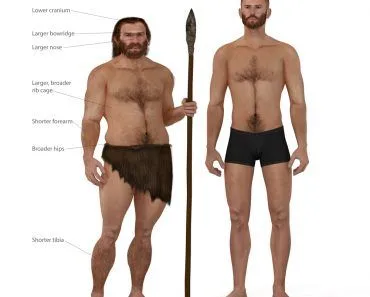
It is also worth remembering that human beings, as we are today, are the product of a long evolution. The Neanderthals who lived before Homo sapiens actually had a braincase as large as ours, or slightly larger (Neanderthals averaged roughly 1,500 cc, modern humans around 1,350 cc). In other words, a skull does not have to look like yours to be entirely human.
So it is not at all strange to find skulls that look different from a typical modern one. The more interesting questions are human ones: which group practiced the binding, and what did the reshaped head signal about a person’s status or identity within their society.
The search for extraterrestrial life has been an interesting and long one. It’s a search that will continue to be contested, but the conclusion that we arrive at for this particular topic is that, while they are certainly bizarre in nature, these skull modifications are practices that human beings performed, and cannot be linked to some greater purpose or extraterrestrial ancestry.
References (click to expand)
- Morphological consequences of artificial cranial deformation: Modularity and integration. PubMed Central (NIH)
- Why early humans reshaped their children’s skulls. BBC Earth
- Can DNA solve the mystery of Europe’s pointy skulls? National Geographic
- Are These Elongated Skulls Found in Peru Aliens? Snopes
- DNA Analysis of Conehead Mummies Deepens Mystery of Peru’s Paracas Skulls. Greek Reporter