Table of Contents (click to expand)
The Sherbert test is a legal standard that asks whether a government action substantially burdens a person’s religious freedom. It came from the Supreme Court case Sherbert v. Verner (1963). If a burden exists, the government must show a compelling interest pursued through the least restrictive means, an application of strict scrutiny.
It’s never easy to stare unemployment in the face. However, these difficult times are made slightly less stressful if one qualifies for unemployment compensation benefits.
People are eligible for these benefits if they are unemployed through no fault of their own, such as being laid off or experiencing a wrongful termination. Basically, if a person is fired due to their own misconduct, they would not be eligible to receive benefits. Moreover, employees who quit their jobs are not qualified to receive these benefits unless they establish good cause for leaving work, although what constitutes ‘good cause’ in the eyes of the law differs from state to state.

Deciding the eligibility of a person by the courts demands an intricate study of established law. Many factors are taken into account by the courts in each case when determining whether or not to grant unemployment compensation.
The Sherbert Test is a tool that helps courts do this in cases involving religion. This test, created during the ruling of the Sherbert v. Verner case (1963), ensures that government actions do not substantially burden or impinge upon religious freedom.
Sherbert V. Verner
Adele Sherbert, a Seventh-day Adventist, worked as a textile-mill operator. Two years later, her employer switched from a five-day to a six-day workweek, and Sherbert faced a problem. She could not work on Saturdays, because her faith treats Saturday as the Sabbath and forbids labor on it. When she refused to work that day, her employer fired her, and she filed for unemployment compensation.
Sherbert looked for work at three other mills in the Spartanburg area, but they all ran six-day weeks too, so she found no suitable five-day job. South Carolina then denied her unemployment benefits, reasoning that by refusing to work Saturdays she had turned down suitable work without good cause. The state trial court and the South Carolina Supreme Court both upheld that denial. She eventually appealed to the U.S. Supreme Court, contending that her free exercise rights had been violated.
So, what are free exercise rights?
Free Exercise Clause
The Free Exercise Clause is a clause in the First Amendment of the United States Constitution that protects a person’s right to freedom of religion from government interference. It reserves the right of American citizens to hold any religious belief and engage in religious rituals. It reads as follows:
Congress shall make no law respecting an establishment of religion, or prohibiting the free exercise thereof…
In view of this clause, the Court held that denying unemployment benefits to Sherbert imposed a burden on her free exercise rights, forcing her to choose between her religion and her job. The Court also noted the lopsidedness of South Carolina law, which protected Sunday worshippers (no one could be made to work on Sunday against their conscience) while offering no such shelter to a Saturday Sabbatarian like Sherbert.

During the ruling of this case, the Court created a tool, the Sherbert Test, to determine whether an act by the government infringes on a person’s religious freedom.
Sherbert Test
The Sherbert test has three prongs. First, the Court must decide whether the government’s action in question puts a burden on an individual’s religious freedom, which can be anything from withholding benefits to imposing penalties for religious practices.
However, under certain circumstances, the government may be allowed to burden an individual’s right to the free exercise of religion. The second and third prongs of the test state that the government may do this if it can show:
1. Its compelling interest;
2. That the law was narrowly tailored to achieve that interest.
The Court applies strict scrutiny by using these two prongs of the test. Let’s look at what all of this means.
Strict Scrutiny
There are different levels of scrutiny. Some laws might require a low level of scrutiny, wherein the court only asks whether a government regulation might serve some ‘legitimate’ governmental interest. On a slightly higher level, called intermediate scrutiny, the court requires that the regulation serve an ‘important’ interest.
Strict scrutiny, however, requires a much higher level of governmental interest than ‘legitimate’ or ‘important’.
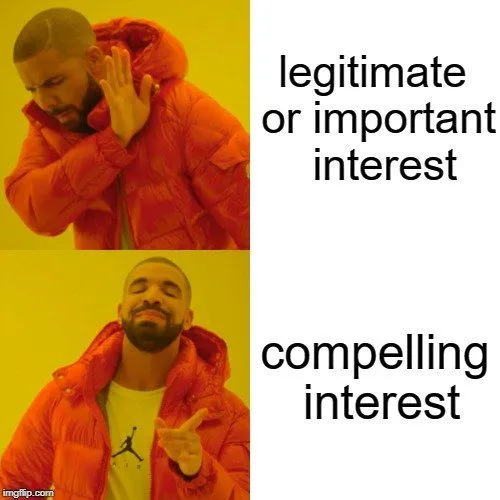
Some have described this higher level of ‘compelling’ interest as necessary, crucial and more than a simple exercise of discretion or preference. Any attempt to regulate First Amendment Rights must be justified at a higher level. The government must also show that it cannot achieve this compelling interest without burdening the individual’s freedoms.
The regulation must be narrowly tailored and be the least restrictive means to achieve the governmental interest. This means that the law must place as few restrictions on First Amendment liberties as possible, while also establishing that no alternative form of regulation can avoid the infringement and still achieve the government’s interest.
However, it is important to note that, although the Sherbert test protects an individual’s religious beliefs, it does not provide protection to all overt acts linked with religious beliefs, such as acts that pose a threat to peace, public safety or order.
In Employment Division v. Smith (1990), the Supreme Court sharply limited the Sherbert test. It ruled that the compelling-interest test does not apply to laws that are neutral and generally applicable, even when those laws happen to burden a religious practice. Under Smith, strict scrutiny kicks in only when a law singles out religion or is applied in a way that discriminates against it. The case grew out of two members of the Native American Church who were denied unemployment benefits after being fired for using peyote, a banned drug, in a religious ceremony.
Congress pushed back. In 1993 it passed the Religious Freedom Restoration Act (RFRA), which wrote the Sherbert compelling-interest standard back into federal law. The Court trimmed RFRA in City of Boerne v. Flores (1997), holding that it could not be forced on the states, so today RFRA binds the federal government while many states have passed their own versions.
The Sherbert test, born from a landmark judgment decades ago, carved out room for religious practitioners to claim their rights without having to choose between their faith and their work. The constitutional version no longer governs neutral, generally applicable laws, but its compelling-interest logic lives on through RFRA and state statutes. Recent decisions such as Fulton v. City of Philadelphia (2021) and Kennedy v. Bremerton School District (2022) have, without overruling Smith, made it easier for religious claimants to trigger strict scrutiny once again, keeping Sherbert’s core idea very much alive.
References (click to expand)
- Unemployment Compensation (UC): Eligibility for Students ....
- EngagedScholarship@CSU - Cleveland State University.
- Sherbert v. Verner.
- Sherbert v. Verner (1963) | The Free Speech Center - MTSU.
- Free Exercise Clause | Wex - Law.Cornell.edu.
- Freedom of Religion.
- Compelling State Interest | The Free Speech Center - MTSU.
- Narrowly Tailored Laws | The Free Speech Center - MTSU.
- Employment Division v. Smith, 494 U.S. 872 (1990) | Legal Information Institute - Cornell Law School.
- Religious Freedom Restoration Act (42 U.S.C. 2000bb-1) | Legal Information Institute - Cornell Law School.
- Fulton v. City of Philadelphia (2021) | The First Amendment Encyclopedia - MTSU.
- Kennedy v. Bremerton School District (2022) | The First Amendment Encyclopedia - MTSU.